
Take your last losing trade
Take your last losing trade. Maybe you entered early, moved your stop, or added to a position after the thesis was already invalidated.
You tend to focus on your own behaviour because it's the most information you have about the trade.
But what if it's not relevant?
Put that trade through the following twelve questions instead.
Who was on the other side of it, and what were they doing there?
Was liquidity taken hostage to move price to where a large participant wanted to do business, with you and many others trapped and carried along with it?
How many points of evidence did you have before you entered? Count them.
Did those points combine into positive expectancy, or did it just look like a trade that had worked before?
Was the trade uncrowded, or did you join many other traders in the same direction?
Which trade in your playbook was it, and how many times have you taken that same trade before?
Does your playbook include trades for every market environment, or only some of them?
On the day, did you overlay a repeatable framework that showed you where you could no longer be long, and where you could no longer be short?
Before you started trading, did you know the scenario and price that gave positive expectancy long, and the same for short?
When price got there, did you have a playbook trade that matched how it was behaving?
When a trade turns against you, do eight out of ten come out at a scratch or a papercut, or do most run all the way to your stop?
Was this a known scenario that already told you whether to size up and press, or trade it for singles?
The other side
You've probably never thought about who it was. Nothing you were ever shown described the other side as more than an abstraction. Price moves up, price moves down, and somewhere behind it sits a vague notion of smart money.
Market makers, relative value desks, hedgers, directional speculators. Each is in that market for a different reason, with different constraints on what they can and can't do. One of them needed to transact at your stop price.
Two or three reasons
That's what most traders rely on to enter a trade, and it feels like enough at the time because each one does a lot of persuading on its own.
But when you move to seven to ten, you can tell what's impacting price and what isn't. Some of what's argued for the trade gets disqualified by evidence you'd never have seen at two or three.
"It looked like a trade that had worked before"
That's the most common answer to question four. A trade that resembles one that worked isn't automatically the same trade.
Environment, catalyst, participants, fair value, sentiment, positioning, the themes in play, the time of day and where you are in the month. All of it differs hour to hour, never mind week to week.
What's demonstrated to work isn't proven to work.
Eight out of ten
If your losers mostly run the full distance to your stop, you're missing the observable behaviours that get you out for less than the full cost. Eight times out of ten that cost comes down to a scratch or a papercut.
Traders who defend that cheaply aren't more disciplined. They're trading with a repeatable framework and specific playbook trades, so the exit isn't a subjective call. The trade stops doing what a working trade should be doing in the moment, and they're out.
Take this one. Playbook 101, didn't work, out. Playbook 101 again, didn't work, out. Predictable Efficiency on the third, and that one paid. Same thesis each time, a different playbook trade as the behaviour changed.
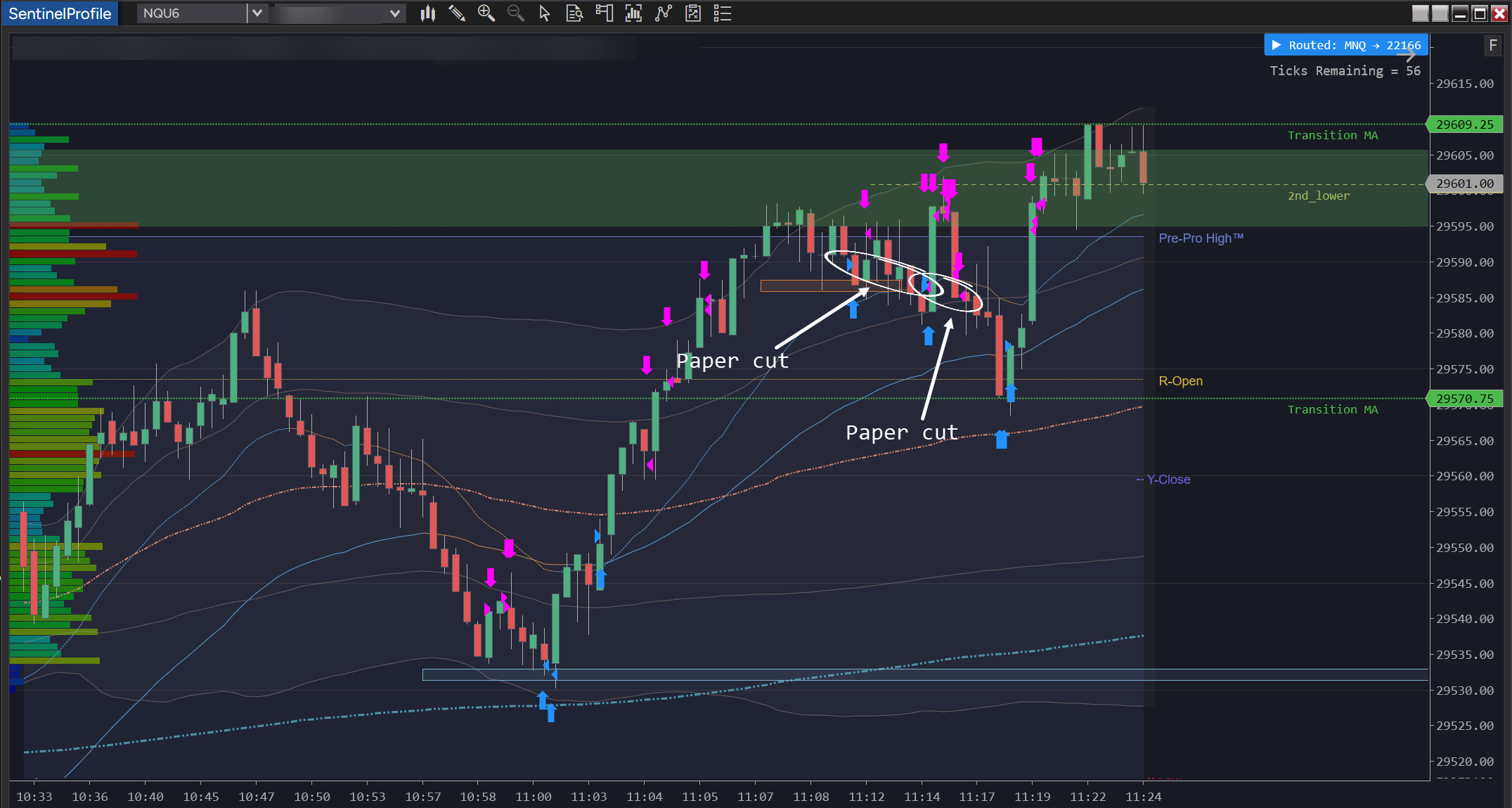
Two papercuts, minutes apart. What got me out isn't on the chart, but each cost is.
That's how markets behave. Not always, though there are days you'd swear it was every trade.
If you can't get out cheaply eight times out of ten, you can't come out ahead on a thesis that takes several attempts before it finally pays.
None of the best traders used them
Dr Brett Steenbarger has spent his career as a performance coach inside professional trading firms and large hedge funds. Writing on TraderFeed on 20 August: "When I first began working at professional trading firms, particularly large hedge funds, I was struck by the fact that none of the best traders used methods similar to those taught online. None."
He also took popular patterns those gurus teach and programmed them, so they'd run with perfect discipline, so he could measure what they actually returned. The patterns worked in some market environments and not others, "ultimately resulting in unacceptable drawdowns".
The picture
Answer all twelve without pausing, and there's nothing here for you.
Stall on several and it's not a discipline issue you're facing. Neither is it psychology, impatience, greed, fear or a poor risk management problem. None are root causes. They show up when the trading is full of holes.
Every one of the twelve questions asks what you comprehend about the market while you're entering and managing a trade.
You can't apply discipline to a picture you were never shown.
But somebody who can answer all twelve about your losing trades is on the other side of them.