Trade like you came up through a
professional trading firm
The industry keeps pushing the same solutions - you need better psychology, discipline, risk management. Each change you make feels like you've finally turned the corner. Then the usual step back.
On the other side of your losing trades is someone who trades like they came up through a professional firm. You feel it every time you pay for it.
Your biggest trading cost is that no one has ever been at your side, leading you through each precisely defined trade, correcting you and giving feedback as you take it.
You see price moving up and down. They see which participants are moving it. Market makers, relative value desks, hedgers, directional speculators. They see who's trapped and about to be forced to exit their trade for a loss.
You have setups and patterns. They have a playbook of signature trades, each one targeting a specific market behaviour, participant type, and set of conditions. Trades with a defined basis for why they work and who they take the other side of. You were never given that either.
A small selection of signature trades you'll make: The House. Tram Track Open Road. Premium Long. Nose Dive. Playbook 101. Once Bitten Twice Shy.
Trading as you imagined it
The likely scenario you've prepared for unfolds in front of you. Trapped traders are exactly where your framework said they'd be. You know which of them are about to be forced to exit for a loss, and why.
How you trade the opportunity isn't simply a case of either entering a long or short trade. The correct approach is matching the best-suited playbook trade to the current market behaviour.
The trade is in your playbook. You've taken it before. You know the conditions, the specific behaviour, exactly how and when to enter and exit, and what dynamic sizing to use.
Playbook trades are ultra-specific, so there's only one course of action. No hesitation. You act.
The wrong diagnosis
Trading is a constant frustration of random outcomes without a framework and specific trades. Yet the industry promotes resolving it by improving your patience, discipline and psychology, none of which give you a framework or specific trades.
If it's happening to you, you get caught in a continuous loop of identifying the wrong problem and applying the wrong fix, and sooner or later you start to believe the problem is you.
Twelve questions
Take your last losing trade.
Who was on the other side of it, and what were they doing there?
Was liquidity taken hostage to move price to where a large participant wanted to do business, with you and everyone else trapped, carried along with it?
How many points of evidence did you have before you entered? Count them.
Did those points combine into positive expectancy, or did it just look like a trade that had worked before?
Was the trade uncrowded, or did you join many other traders in the same direction?
Which trade in your playbook was it, and how many times have you taken that same trade before?
Does your playbook include trades for every market environment, or only some of them?
On the day, did you overlay a repeatable framework that showed you where you could no longer be long, and where you could no longer be short?
Before you started trading, did you know the scenario and price that gave positive expectancy long, and the same for short?
When price got there, did you have a playbook trade that matched how it was behaving?
When a trade turns against you, do eight out of ten come out at a scratch or a papercut? Or do most run all the way to your stop?
Was this a known scenario that already told you whether to size up and press, or trade it for 'singles'?
Answer all of them without pausing, and you're already trading like you came up through a professional firm.
Stall on any of them, and it isn't discipline or psychology you need to change. Neither one replaces the fundamentals you were never given.
Thinking differently comes from trading differently
It's often said that successful traders think differently to losing traders. But that thinking isn't a latent talent you either have or don't have. It's merely a by-product of how your trading method aligns with how markets actually function.
Over short timeframes, unlike long-term investing, the market is a mechanism for money to change hands, from the uninformed and unskilled to the knowledgeable and skilled. Your framework and playbook of ultra-specific trades have to be aligned with that.
You can't help but think correctly about trading and markets when your framework and playbook trades identify and profit from the uninformed and unskilled traders who keep getting caught on the wrong side of the market.
"My strategy stopped working"
Markets are always changing their behaviour. Traders can lock into trading a specific behaviour, profit from it, and then the behaviour changes and the 'strategy' no longer works. It's one of the most common complaints you hear from traders.
The failing comes back to the method not being aligned with how markets function. A framework based on how the market functions, as already described, goes on working. Some market behaviours may change or become less frequent, but all that means is one of the 20 playbook trades shows up less often, or not at all.
You can't force playbook trades. The market is either behaving like a playbook trade, or it isn't. Playbook trades are simply trades that match how the market is behaving when the framework identifies an opportunity to take the other side of losing traders.
Nobody ever traded beside you
Expertise is most successfully developed when immediate feedback is given to you while you're doing that activity.
You're at your screens and the market is live. I take the seat next to you, and we trade together.
*Ericsson, Krampe and Tesch-Römer (1993), "The role of deliberate practice in the acquisition of expert performance". Kahneman and Klein (2009), "Conditions for intuitive expertise: A failure to disagree". Kulik and Kulik (1988), "Timing of feedback and verbal learning".
Trading in probabilities without having to force it
You're told to think in probabilities. Trading is a game of probabilities, after all. But probabilistic thinking doesn't come naturally to anyone.
The framework integrates into your trading platform, appearing as coloured lines and shapes, which your brain processes 10 times faster than text. When 7-10 of those points of evidence appear together, the probability of the next playbook trade paying you is very high. Your actions become probabilistic without having to think in probabilities.
Signature trades: Income-producing assets
A playbook trade exists to monetise how other traders get caught on the wrong side of the market. That happens in a range of different market behaviours, so you need a suite of playbook trades, one for each of the most common of these behaviours.
You only need to trade a few of them to regularly take money out of the market, with 20 in total if you want to develop more. To support you repeatedly taking playbook trades and not random trades, you stamp each trade on one of your charts with the playbook trade it was.
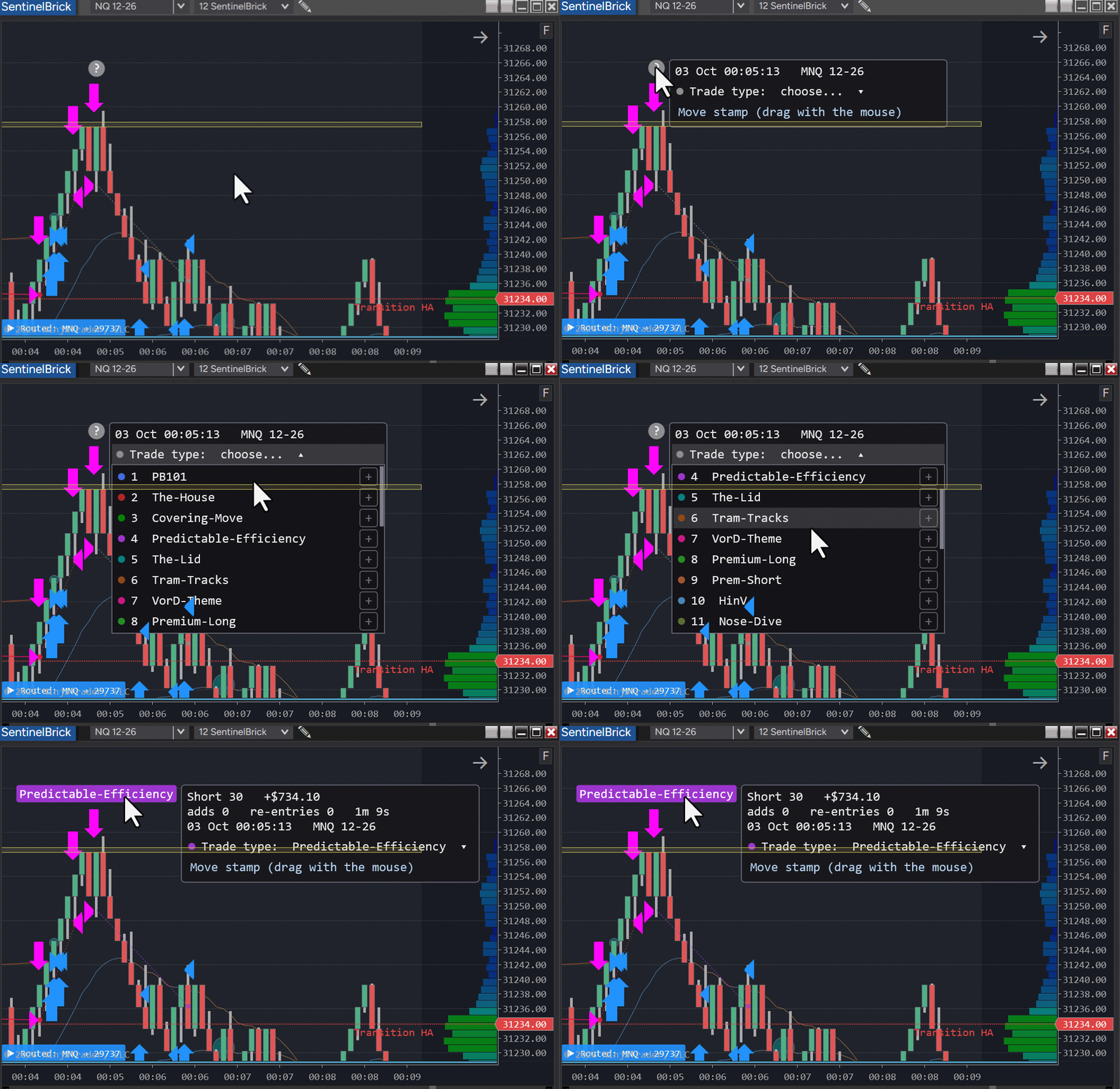
That's how you quickly build up a record of which playbook trades you do best in and which are your weakest - intel on which to trade with more size, and which to reduce size on, in addition to what the framework implies.
Having a playbook of trades from the get-go saves you hundreds to thousands of hours of research and live market testing you'd otherwise have to invest in.
Your team of eyes and ears on the live market
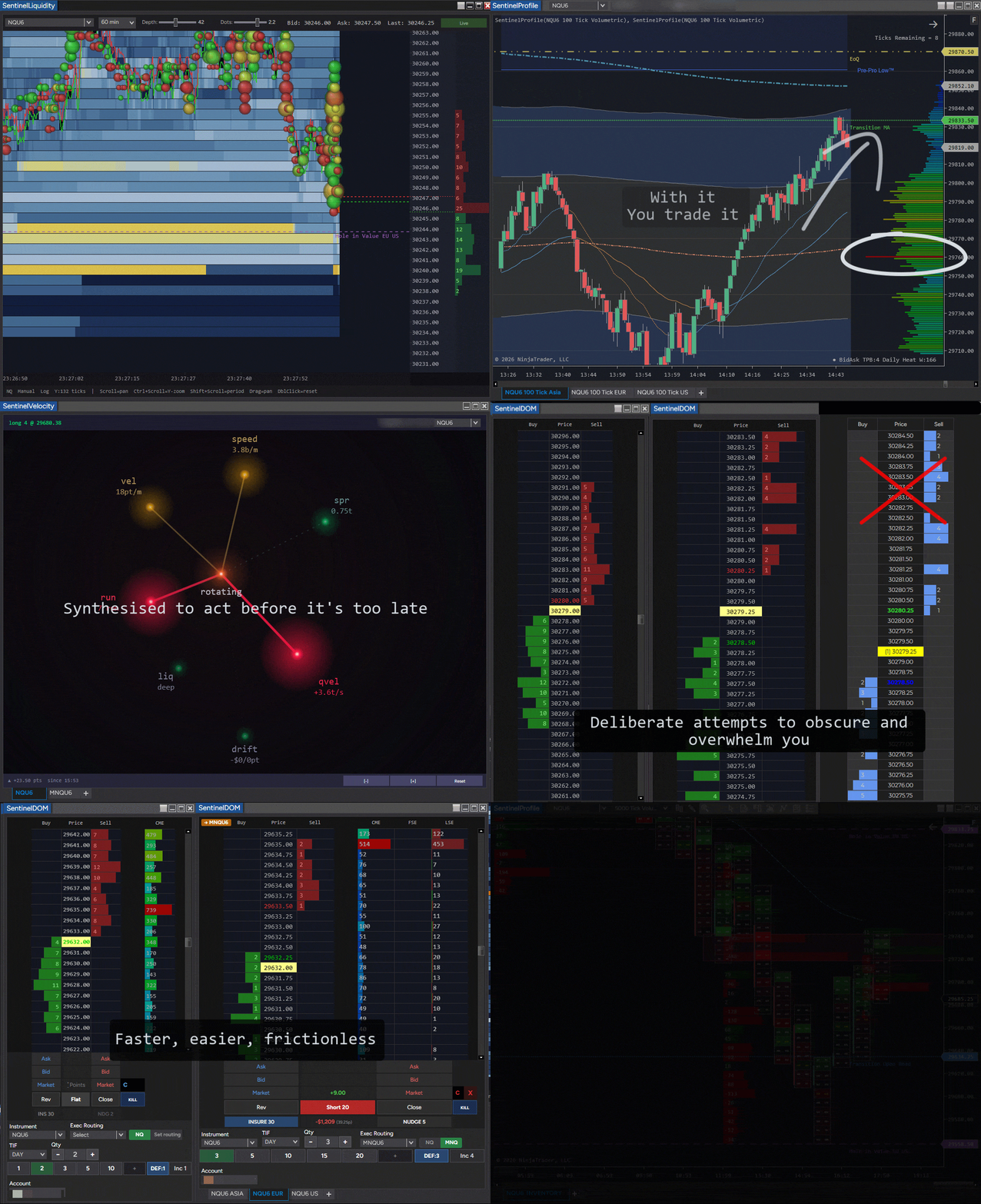
I've made trading the correct way easy to do, without putting the burden back on you to remember all the stuff to do. All the game plan levels appear on all the different windows, colour and style coded, and they become your trading map to follow.
That's done through more than 40 proprietary tools that integrate with NinjaTrader's Order Flow+ data engine. Collectively, it's like having a team of eyes and ears on the market, so most traders can't compete with you, which is how you take their money.
The tools are exclusive to Private Development clients and aren't sold separately, because they have my trading IP in them. The framework and playbook are protected under NDA.
NinjaTrader with Order Flow+ is required. NinjaTrader was chosen for its 25-year history and full integration with these tools. We confirm your hardware is compatible before you start. Your workspace is installed automatically and reviewed by me, so your platform works exactly as mine does from day one.
What's required
You need to have experienced what it feels like being caught off guard and targeted by other traders. That's why prior live trading experience is required.
Before anything goes ahead, we have a conversation about suitability.
Next steps
The next step is a conversation to determine if this is the right fit for both of us.
We'll discuss where your trading is now and whether this is the right time.
Adam Fiske
Director & Founder
Boss Trading
What are traders saying?
Feedback appearing on this website may not be representative of other clients or customers and is not a guarantee of future performance or success.