Chances are you don't know recurring trades that last minutes can have positive expectancy
If you'd rather see the trades first - one US session of Nasdaq mini and micro futures, losers included - they're further down.
Assume for a moment you've had the operating system for consistently profitable trading installed into you.
It works as intended. But it still requires you to become competent at applying it.
You know 99% of all computer problems - whether it's a trading platform or even getting the printer running wirelessly - are user error, not the operating system.
In trading, even when you know the correct operating system, implementing it is an entirely different skill - and one I've tackled.
This works
We meet at your screens. I'm there as you trade - guiding, directing, reiterating, and giving you immediate feedback.
That interaction during the live market is how you feel, with your own hands, what it's like to take money out of the market over and over using a repeatable approach.
You apply, first-hand, a framework and playbook of trades with positive expectancy. Me guiding you doesn't change the fact you experience making profitable trades.
Every session we do, you make numerous trades. And you come out on top in all but the occasional session.
Now you've lived it - repeatedly doing what works - which in and of itself has a huge say in how you behave moving forward.
Taking playbook trades repeatedly - and watching them work in real time - that tends to stick.
But when I'm not there and you go solo, what's there, just in case, to stop you reverting to previous habits?
Old habits
I've been involved in installing the operating system of profitable trading for over a decade.
From all my years of live trading, and of observing what helps traders get better faster, I've developed a huge suite of proprietary trading tools - tools no-one else has - to reduce friction, nurture and support trading successfully. I'm obsessive about it.
But I've noticed old habits can resurface - off-script, random, unjustified trades.
You know the trades I mean - the ones you look back on and think, "what was I doing there?"
Behavioural science tells us you don't change a habit, you replace it with a new one.
Random, unjustified trades are a habit of the past. Trades which have zero positive expectancy, no proven record, lack supporting evidence... Trades that fall outside professional trading standards.
Trades where you're caught up in "I want to make money", or "I think the market is going to XYZ", or "I didn't make enough on that last trade".
To avoid returning to these random non-playbook trades (until you come to your senses), picture this.
Just like people in Alcoholics Anonymous have a sponsor to keep them on track, here's a sponsor for your trades.
SentinelPlaybookStamp
The playbook trades I've developed, the same ones I share with clients, exist to monetise how other traders get caught on the wrong side of the market. Each one is so specific it has its own identity - its own name.
You only need a few to take money out of the market often, with 20 in total if you want to develop more to capture further opportunity.
SentinelPlaybookStamp stamps each trade with its correct name and adds it to your chart.
Every time you enter a new trade, an obnoxious '?' appears where you entered, waiting for you to nominate which playbook trade you took.
Only after you've selected the correct playbook stamp can you hover over the trade to see what you're curious to know: trade duration and outcome.
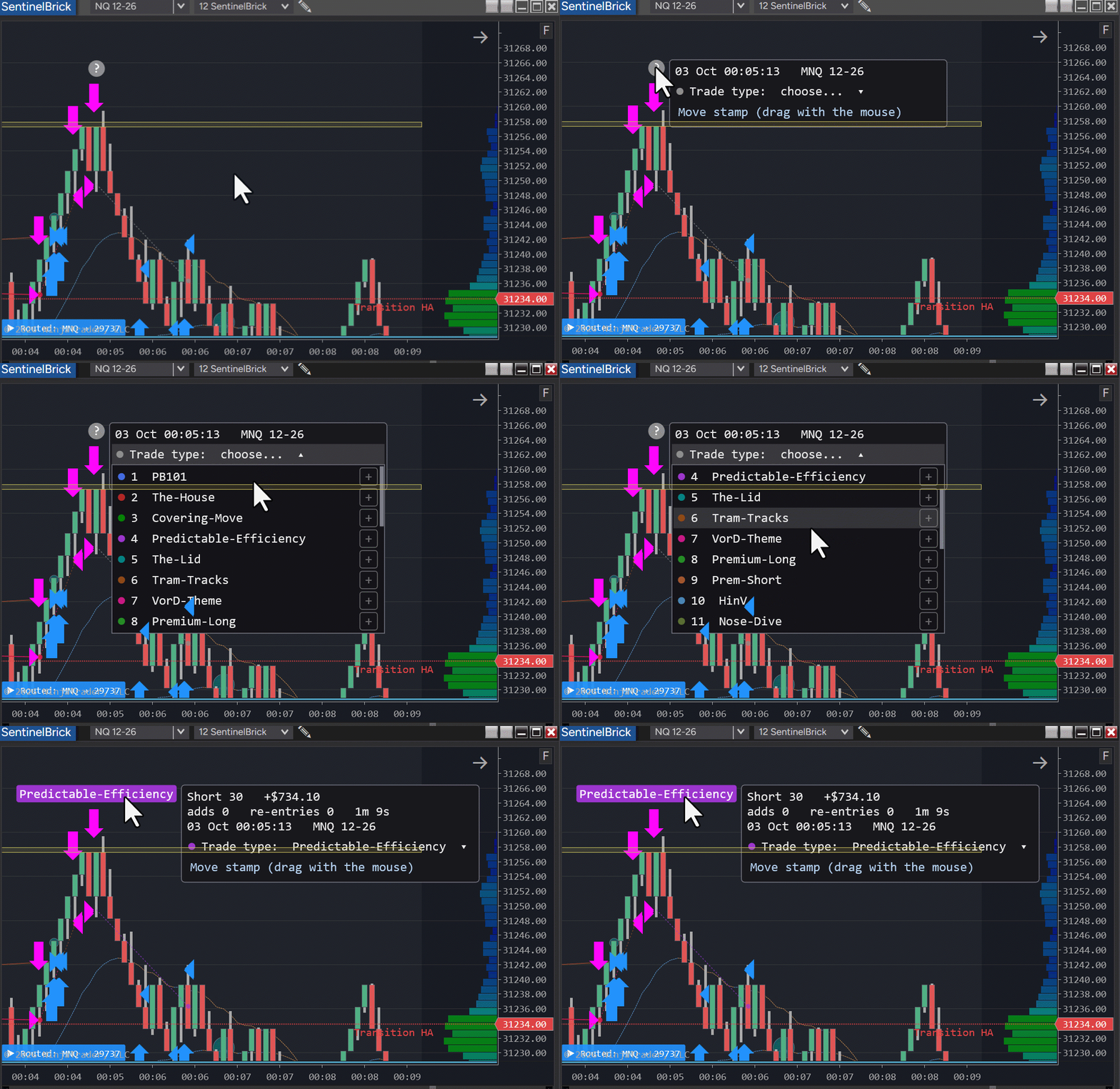
The funny thing is how we're wired when it comes to staying on script. Because the feature exists to stamp all your playbook trades, and it's ultra simple to do, you actually do it. Research backs this up.
Stanford behaviour scientist BJ Fogg found a behaviour happens when three things occur at the same moment: motivation, the ability to do it, and a trigger. The '?' is the trigger.
There's a second reason, which psychologists call reactivity: recording what you do changes what you do. Having to nominate which playbook trade you've taken keeps you taking playbook trades, so you can keep stamping them.
Sometimes you'll make an error (it happens) and take a trade that isn't the playbook trade you first thought it was. That's still a type of trade - an Unforced Error - and it has its own stamp too.
It's human nature to want to avoid errors, so when you do make one, the stamp is simply a data point telling you, "hey, here's something you want to resolve".
The stamps make it easier to see what needs your attention, and avoiding errors is something you're naturally driven to do anyway.
Finally, there's what Robert Cialdini calls the human desire for consistency. Seeing the names of your playbook trades stamped on your chart, over and over, is so satisfying you can't help but keep stamping.
And because you know a stamp is coming on every trade, you're asking which playbook trade it is before you've even entered. Once you've seen yourself act a certain way, you want to keep acting that way.
By stamping every trade, you're also building an organised source of data. Overall performance doesn't tell you which trades you perform best in and which you underperform in.
Yet it's exactly knowing this specific data that can give a meaningful boost to your performance. You can increase the size of the trades you perform best in and reduce how often you take the ones you underperform in.
What you're looking at: Trading October 3rd in the US session
Trade duration is minutes, and playbook trades show up repeatedly.
The charts use a custom brick style, not time bars, because a playbook trade incorporates them. A new bar forms when price moves a set amount, so the spacing isn't even in time. The hover details show how long each trade was held.
The charts are NQ, but the trades are executed in MNQ, the micro contract, for greater flexibility managing each trade.
Underpinning every trade is a framework - knowing where other traders will get caught on the wrong side of the market. And to make that framework easier to follow, it's mapped out onto the charts in the form of horizontal lines, their individual meaning based on the colour and line style.
I make mistakes. You'll see them marked Unforced Error. An example of an error is overlooking a rule of thumb that would disqualify making the trade to begin with.
I would prefer not to lose money by making mistakes. But mistakes are reality. How I trade doesn't require being perfect to be profitable.
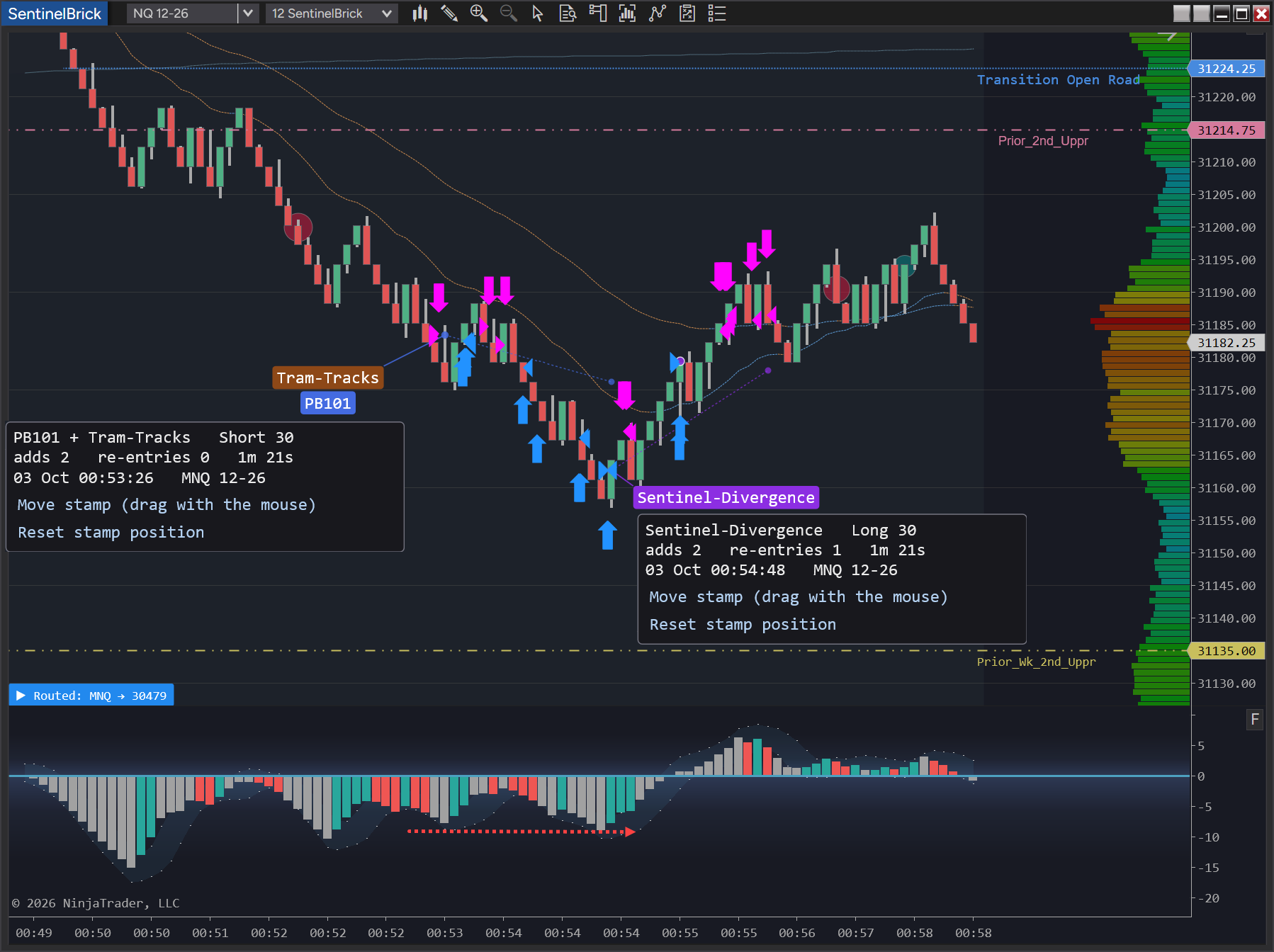
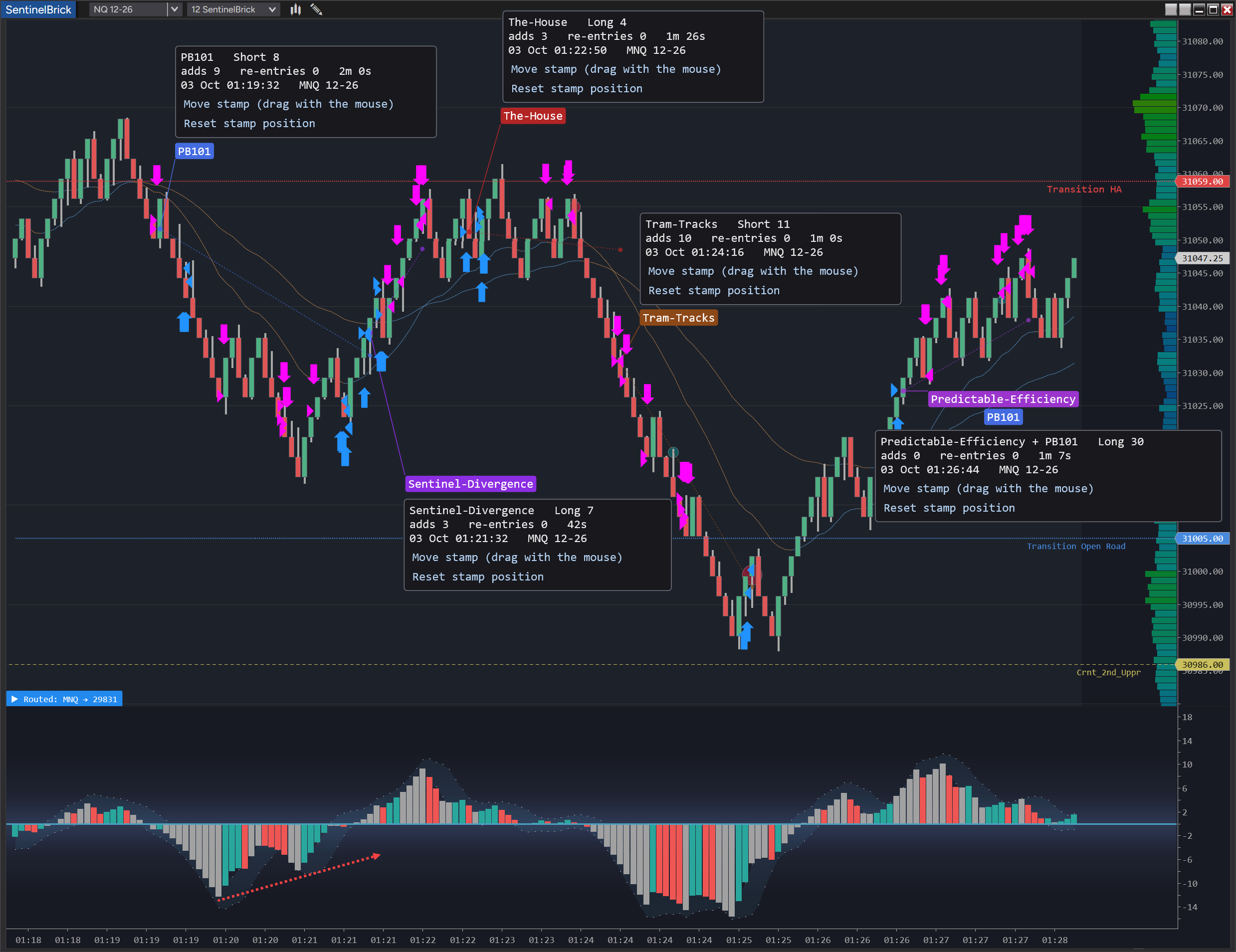
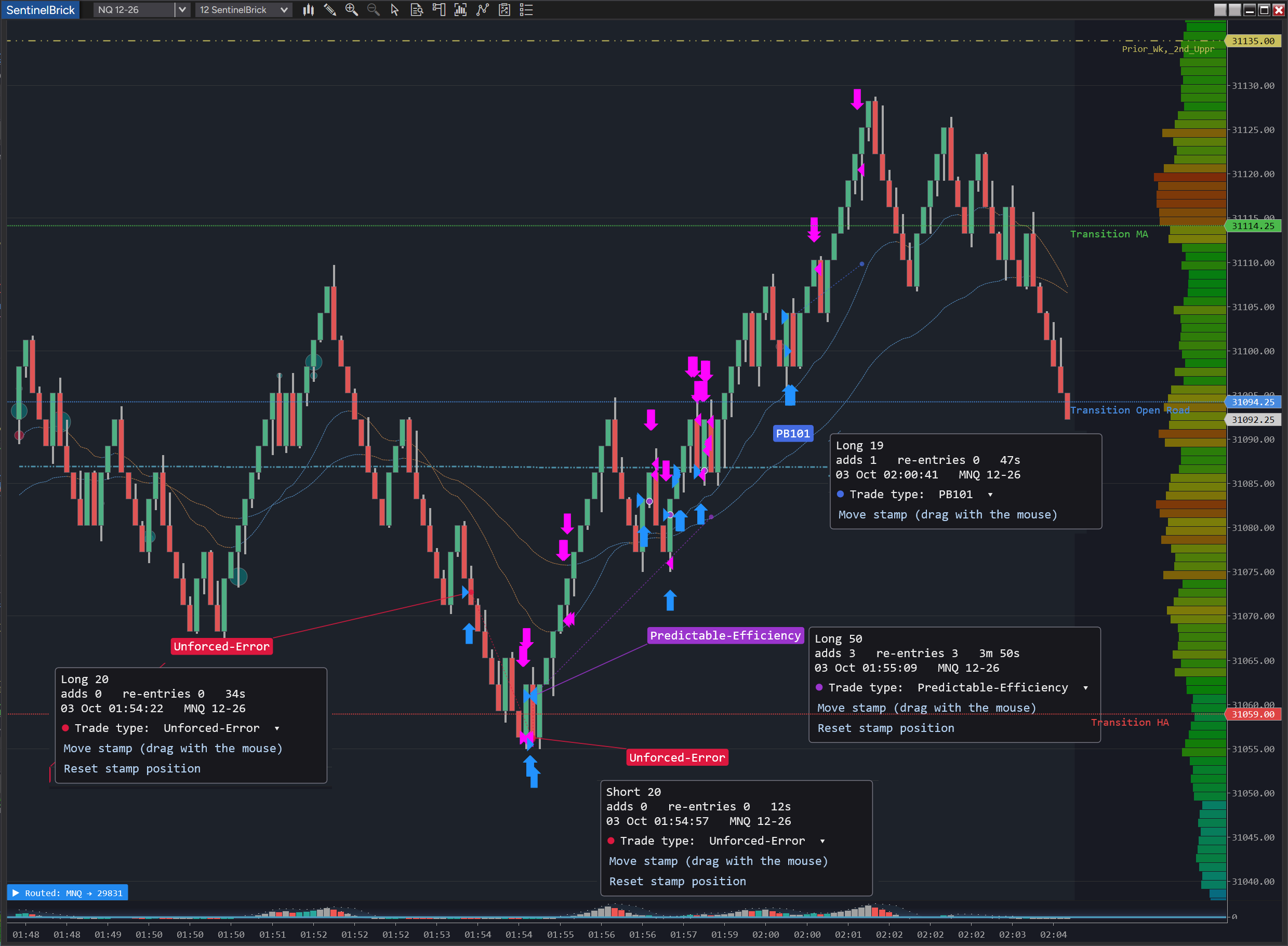
The reason I'm sharing every trade is so you can see how frequent playbook trades in NQ/MNQ are, and how quickly each trade is finished, without taking over-sized risk (see the losers).
It's that frequency of opportunity that silences that little voice on your shoulder that might otherwise say:
"Oh, I didn't make enough on that last trade, I'll just jump back in."
You don't feel any sense of scarcity when the opportunity is so frequent. It also helps to take losses for the same reason.
And why do they consistently pay you? I've covered this in more detail here. But in a nutshell, inefficiency is frequent in small windows of time, and inefficiency itself is asymmetric.
But it's not just how often they show up. You can see trade size isn't static. Variable trade size is the Holy Grail of trading. But it's not a 'gut thing' - it's only the Holy Grail when the sizing is aligned with the framework and appropriate playbook trade. So, if you want the Holy Grail of trading working for you, you have to stick to playbook trades.
The trades in the images - that's what trading looks like when you can comprehend the market to the degree you see how the different groups of traders behave.
Money passes from one group to another, and the framework tells you where, and at what prices, each group will act. The playbook trades are how you act on it, each one matched to the behaviour happening at the time. Then it comes down to having the skill to execute them. Because they're specific and repeatable, you're simply doing the same thing over and over.
You can comprehend language. You don't get an entirely different comprehension reading the same brief email. That's comprehension. It's only without comprehension that the market appears to you as having multiple interpretations.
Final note: I've been doing this a long time, and my trading reflects the hours behind it. Your trading can grow with the hours you put in when you have a sound approach.
Adam
Sources for the three behavioural science lines: Fogg, B.J. (2009), "A behavior model for persuasive design", Proceedings of Persuasive 2009. Korotitsch, W.J. & Nelson-Gray, R.O. (1999), "An overview of self-monitoring research in assessment and treatment", Psychological Assessment, 11(4). Cialdini, R.B. (1984), Influence: The Psychology of Persuasion.