
You can be a bit right or even partly wrong, and the market still pays you
My bias was long, and then the market sold off. Does that mean I was wrong?
I'm looking at the market after a 550-point drop in the Nasdaq. It's the overnight session in NQ, which is the Asian day session for me.
I work through a few heuristics to quickly create the framework for the day. The first is whether I want to be a buyer or a seller.
I look at the daily view and conclude expected value is greatest to the upside.
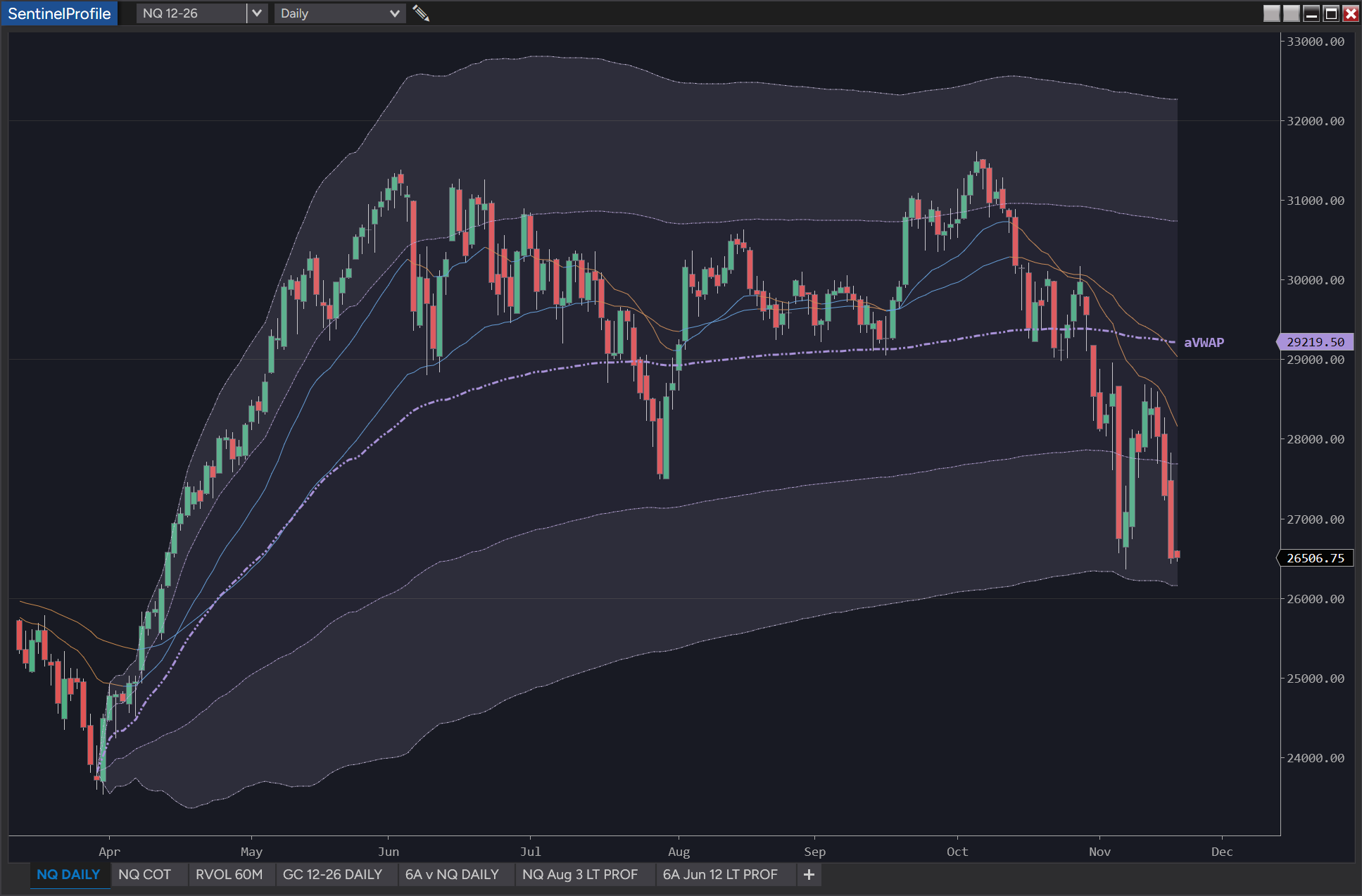
For context, earlier in the month when price dropped to the same level, participants rejected trading at these prices.
What I don't know yet, but will be monitoring is whether or not the market tries to reject them again, or if this time the market decides this is where the current value of NQ should be.
Clues this is happening will be fast moves to the upside, but also plenty of fast moves to the downside.
Why fast?
I look at the market as playing fields, of which there are different varieties. The current playing field is like driving on the open road as compared to another type where it's like driving in city traffic.
The open road is where you see near vertical price moves. Trading it requires you to be nimble because what goes up quickly can also move back down quickly.
I'll be simultaneously monitoring the speed and size of price moves and the size of the spread using SentinelVelocity.
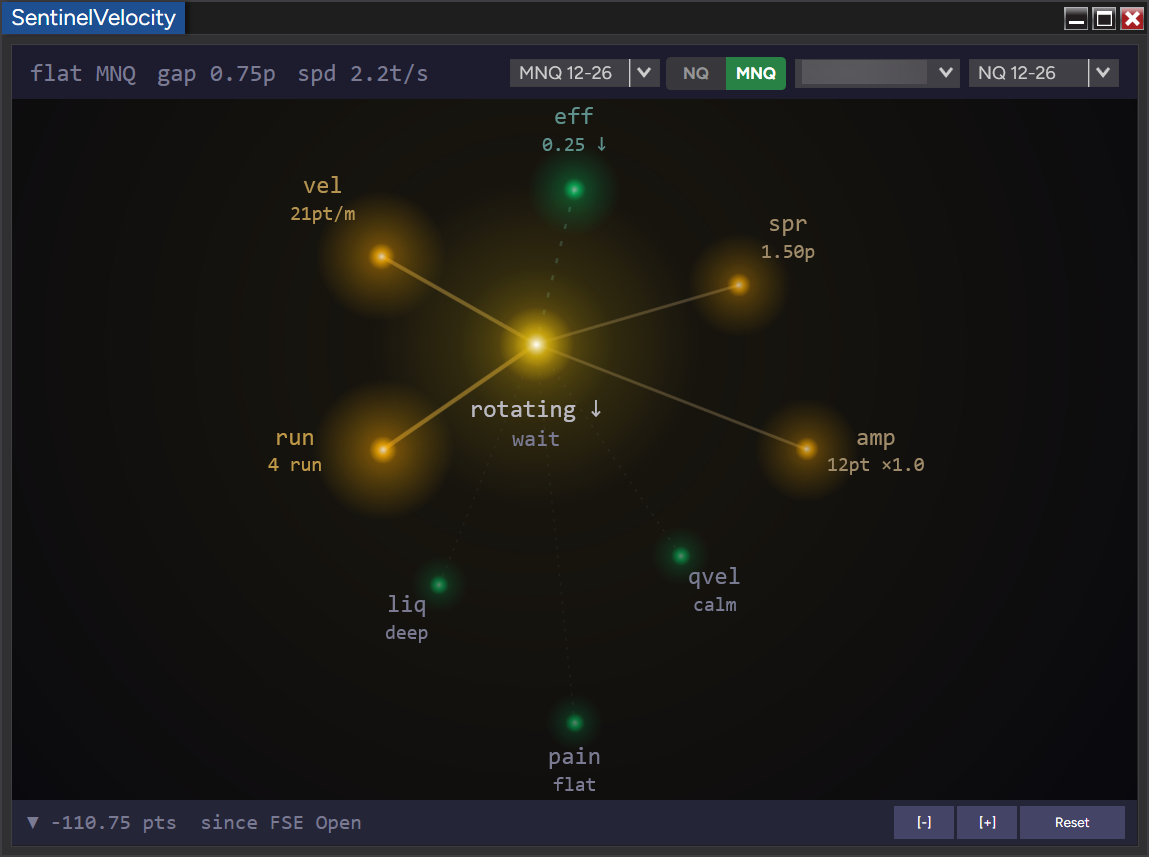
If the market keeps moving back down after every strong move up then that's not the same as most participants rejecting current prices back in early November.
But that's looking ahead. Right now I'm going to trade the current market, and everything points to the long side.
NQ is also trading in what I call the 'forbidden bands', because statistically it reverses direction there over 80% of the time.
I'm not the only trader who knows this. So while I'm focusing on the long side of the market 'now', plenty of traders will do the same.
But there's a trait in human behaviour that's well researched. A 2018 study published in Psychological Science found people are binary in their thinking, even when the answer sits somewhere in between.
Right now price is reversing from the 'forbidden bands' the way it typically does. Binary thinking says that's the play, as opposed to 'I'm only right so far'.
Whenever I talk about comprehending the market story, this is what I mean. A rule of thumb I like to use is 'trades are degrees of wrong and right', and being aware of that directly correlates with your performance.
So when I'm not in a trade, I keep checking in with my initial game plan and look for evidence it's no longer valid. That's how I'm constantly able to adjust to 'right now'.
What I see is that many traders aren't doing this. That leads to opportunities for those who do to take from those who don't.
When I'm in a trade and it's working, my heuristic is 'I'm only right so far', not 'I'm right'. I don't know how long I'll stay right. And yet having trades work to varying degrees isn't a barrier to profitability.
This goes against typical thinking, and it's why taking the other side of traders who are wrong works. They don't need to be wrong immediately, just at some point.
What underpins my confidence in what I do started with the realisation that everything I was doing wrong in my trading wasn't unique to me. They're the same errors in thinking people typically make when they get into trading. I don't believe anyone is born a natural trader, because so much of trading is counterintuitive to how we all naturally behave.
Back to the session. When you see a rowing squad practising on a river - you'll tend to also see someone riding along on a bike beside the river yelling instructions.
I have a tool on one of my charts that does pretty much the same thing. As of 'now' it's not telling me I need to be short.
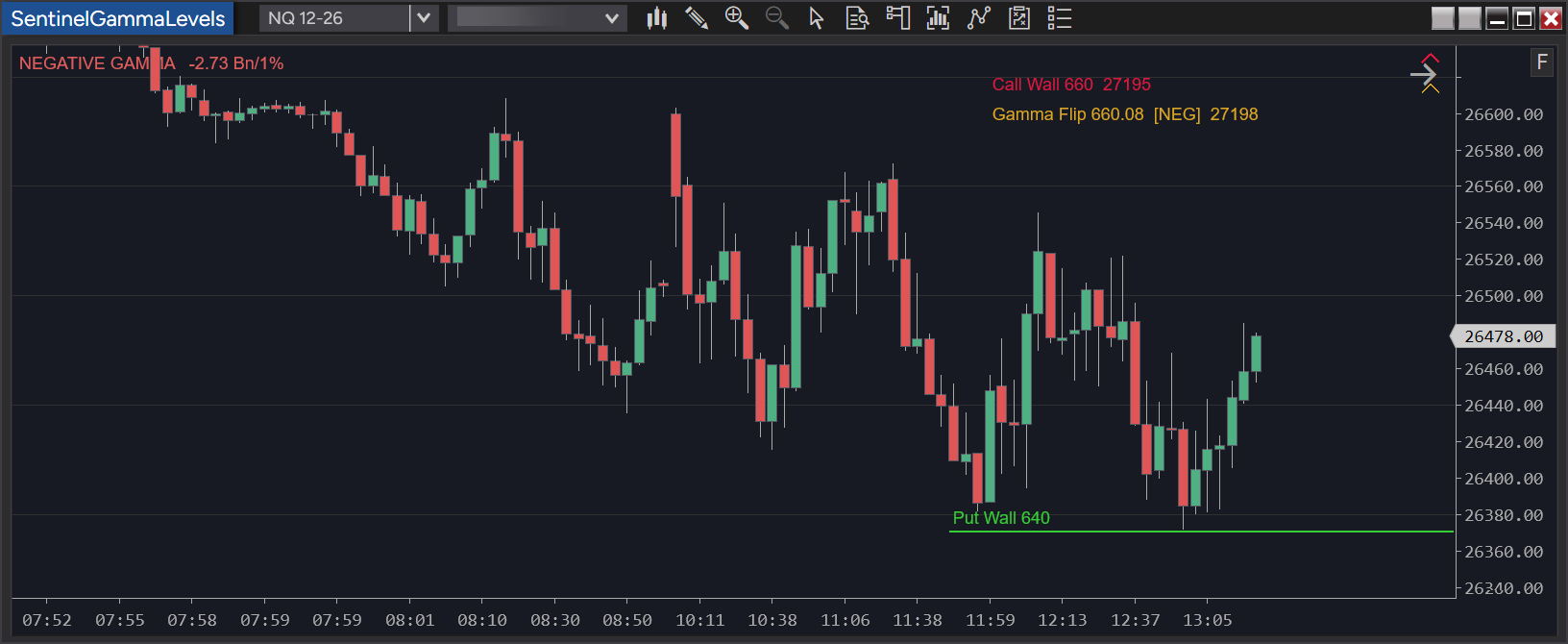
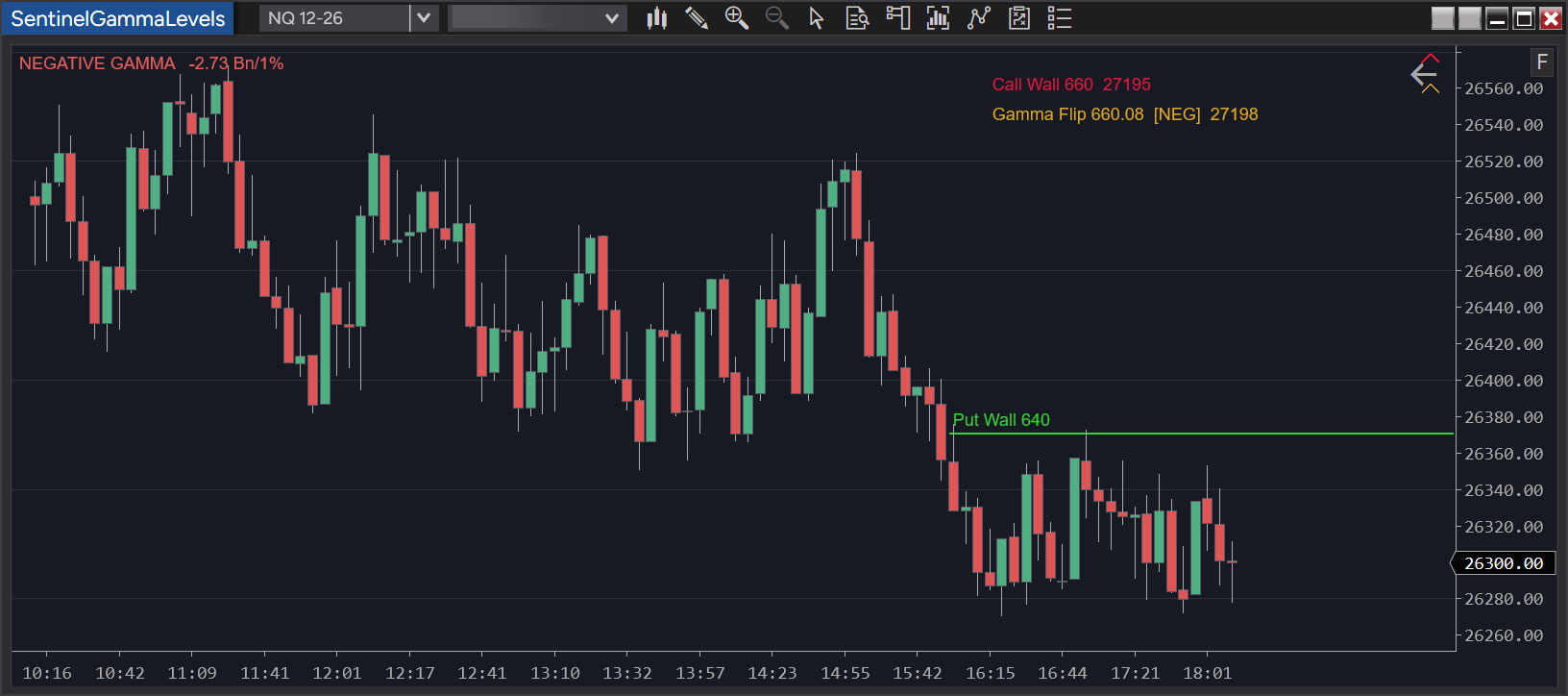
I've also developed a tool, SentinelGammaLevels, that gives a 'best guess' of where the put wall in QQQ options would be, converted to the equivalent price in NQ (below).
I say best guess because right now QQQ isn't trading, so it calculates where those levels would be if it were regular trading hours.
And what it's showing me is price hasn't been able to get through the put wall so far, which is one additional piece of evidence to trade the long side.
Now that we have a framework in place, the next step is how to monetise it.
A common complaint you hear is 'my strategy stopped working.' Well there's never going to be a market where traders stop losing, so taking the other side of them keeps working.
Yet what I struggled with for a long time will probably be familiar. You have an idea about the market direction, but after your attempts to trade it you actually lose money.
You feel you have a solid foundation in the technicals, yet you're still not profitable and at your wits' end as to why.
A big part of the reason is not having specific trades (with positive expectancy) that match the current market behaviour.
The solution was to develop a playbook of those trades.
As an example, below are my first three trades of the day (I've since completed 23 trades so far today and am using a break from trading to write this).
A note on the chart below: I use a combination of charts and tools for every trade, but for illustration purposes this one uses bricks rather than time, volume or trade quantity because it's easier to see what's happening. The executions are MNQ shown on an NQ chart.
All three trades are on the long side. But each trade is different based on matching the current behaviour. How to size each trade also varies based on odds.
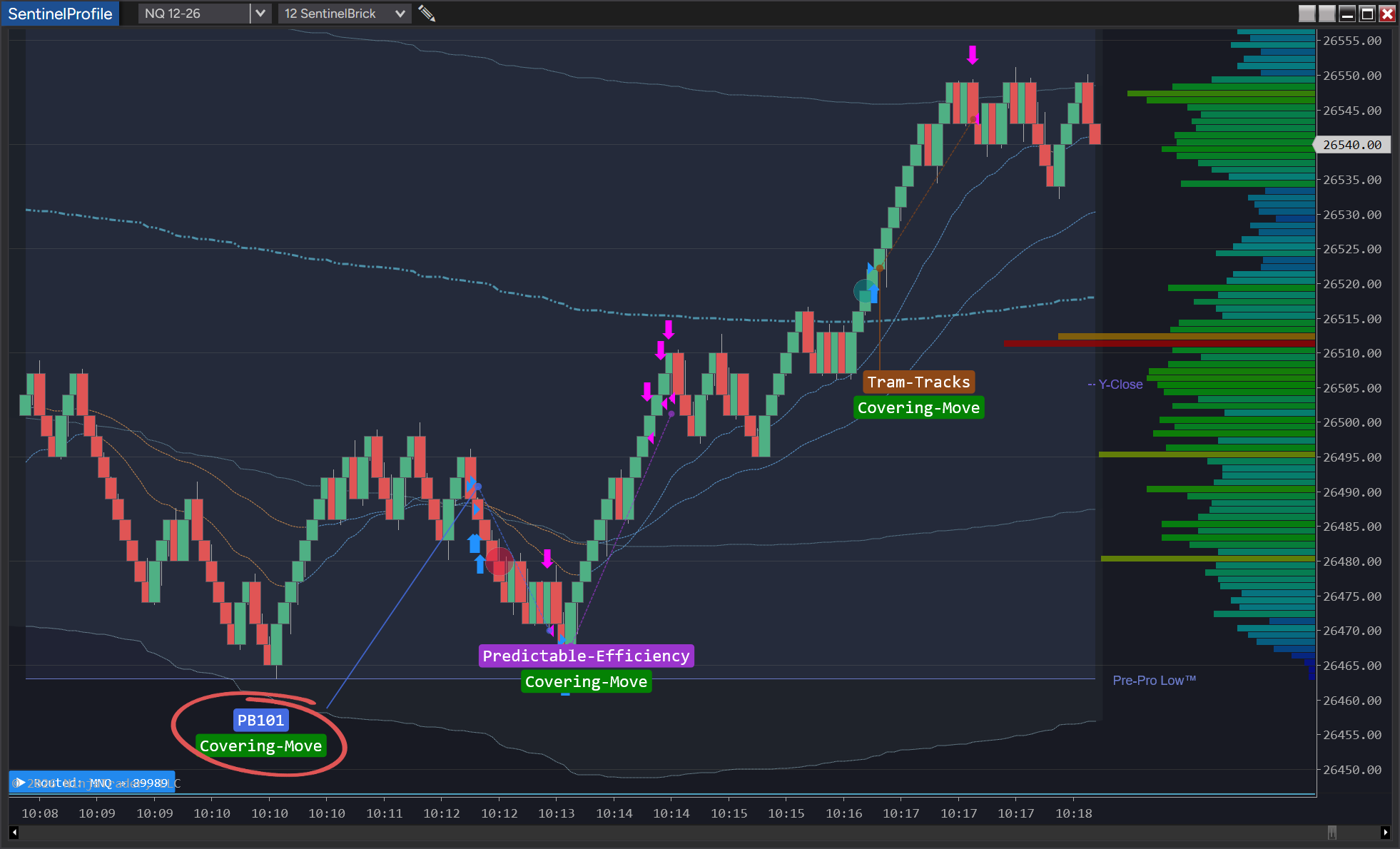
The behaviour may all seem like just one big 'go long' trade to you. But there is so much variance when you drill down through a range of different charts and data tools. And it's that range of charts and tools plus an underlying foundation that turns inconsistency into a reliable trading business.
If I only had one or two of these trades, I would be passing on many opportunities.
Every day I spend in front of the screens, I'm still looking for new recurring behaviours I can develop into playbook trades.
That list currently sits at 21, not counting trades that no longer occur. I imagine that's pretty typical for anyone who's traded intraday full-time for years.
A note on positive expectancy.
Your trading must have some 'fat' in the profit margin to allow for errors and slippage.
For example, my first trade of the day was a loser.
Price moved so quickly on a wide spread that my 'insurance' order kicked in before I could manually exit.
If the trade's not working I get out. As a safeguard, I have a button called insurance. It tells me the total amount I will lose if my insurance level is hit - so it's also a reminder to me if I've got too much size on.
Update
I've now completed 33 trades for the day, and some of them were shorts.
Value has definitely shifted lower as participants accept prices they rejected in early November.
If we have a look at an updated view of SentinelGammaLevels you can see the put wall is now anchoring price to the downside.
I traded NQ on Thursday during both the Asian and European sessions, before the US open. The behaviour is what I refer to as 'marked up' as opposed to bought up aggressively by large size.
The first lower high of that mark up was the point I anchored VWAP from.
You can see a clear theme (circled) playing out a couple of deviations below the anchored VWAP once price was offered down below the transition (how I divide the market into playing fields).
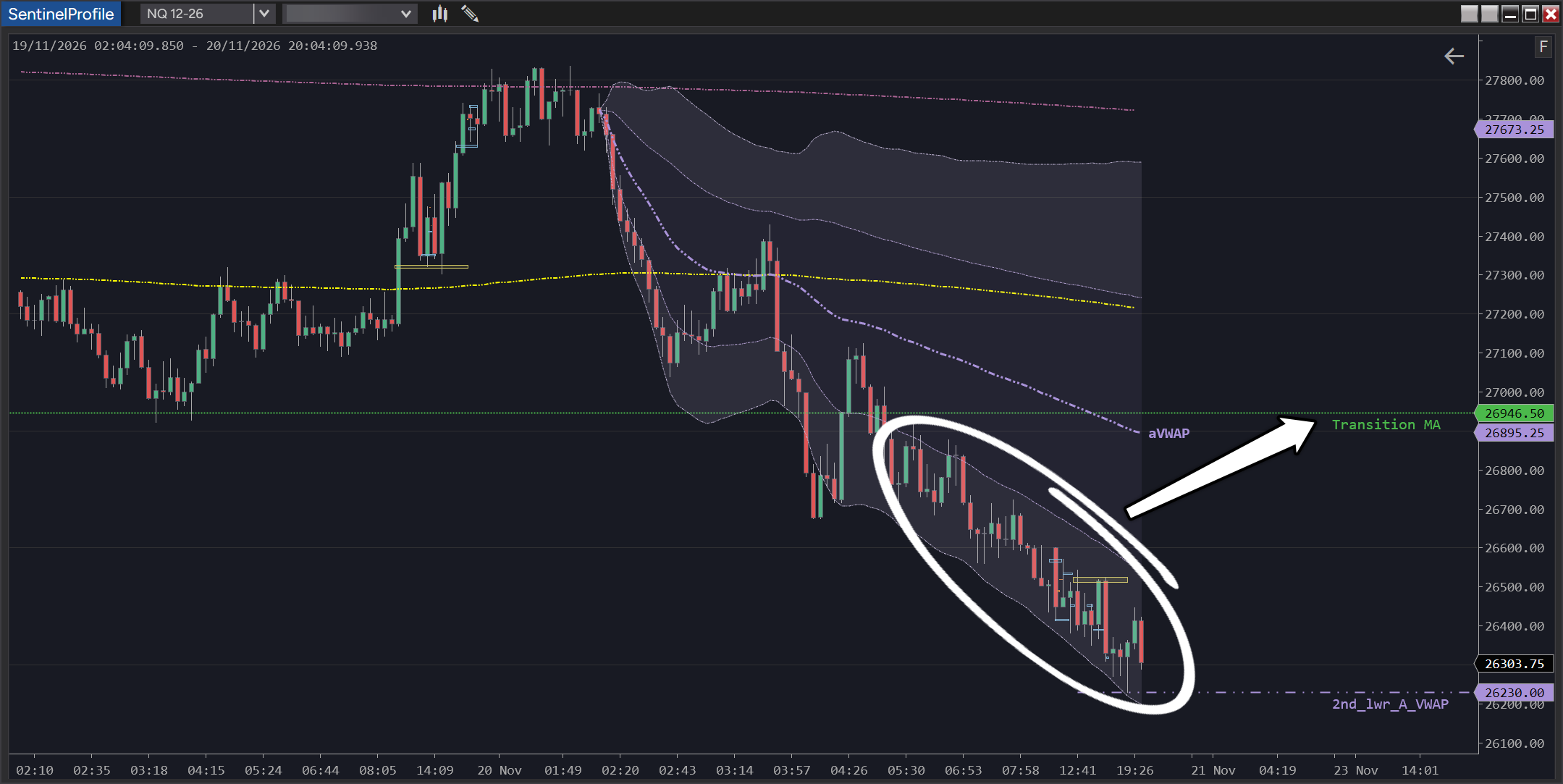
Again I've traded whichever playbook trade showed up both to the long and short side within the boundaries of the current theme.
If I'd stuck to my guns on the long side I would have been stopped out over and over and most likely had a disastrous day.
The best opportunities are when most of the traders you compete against aren't expecting what the market ultimately does.
Adopting 'I'm only right so far' is how you're able to take these opportunities as soon as they arise, because you adjust to changes faster than your competition.
You'll also find you take more out of the market, instead of letting trades in profit turn into breakeven or losing trades.