
Why your losses are bigger than your winners
You're solid on the technicals, but losses are more than the winners.
It usually starts with one or more of the following.
One: the market fails to reach what you'd targeted as a meaningful reward for the risk you're willing to take.
You're taken out of the trade at a loss before price reaches the target.
Two: you notice price eventually reaches that target, but you're not in the trade.
Three: when you first put on the trade, you're not expecting it to lose, and why would you?
You didn't just randomly enter long or short. There was some analysis or method behind the trade.
What happens next?
You either keep experiencing 'one' and watch your account die by a thousand cuts, your winners whittled down by the losses.
Or, because you keep experiencing 'one', you widen your stops or add to the losing trade to average it. And wow, your account goes up.
But every trader who does this eventually experiences the time it doesn't, and those can be some mortifying losses.
Or you add to the loser simply because the trade losing really wasn't expected.
Sure, you might have an idea of what you'll do if price goes against you by X, but once it does, crystallising the loss isn't something you can carry out.
The popular explanation is that traders do this to avoid the pain of taking the loss. And it's right about now you start thinking it's your discipline or your psychology that's the issue.
But in my experience that's not entirely the case.
We know price seldom moves in a straight line. Instead, it moves from one level to another in any number of different ways.
But when traders enter the market, whatever the 'pattern' or 'setup' is, it's mostly focused on the entry. And as long as price is moving their way, that's often the extent of what's taken into consideration.
What's ignored is how price is currently behaving, and it starts with how the market moves from one price to another.
If the only trade you have is the 'setup' that got you in, then when it fails, there's nothing else to get you back into the move.
That's a limitation that puts pressure on you to average into the trade, or hold it when it's underwater.
Adding to a loser unquestionably hurts the expectancy. But thinking in probabilities isn't natural, which is why it happens so easily.
To compound issues, traders set targets and use trailing stops, both of which seem like the best thing to do but are, in actual fact, costing you money.
We know there's no 'edge' in predicting where price will go. But setting a target is a prediction, which is why, for the most part, targets fail. I'll show the alternative shortly.
As for trailing stops, they're used by so many traders that other participants have a good sense of where they often are, given the time frames most people trade, and they'll find ways to exploit those likely orders. (I'm excluding long-term trend following.)
How to take profits if not using targets?
My intraday approach, which hasn't changed in over 14 years, is to use what I refer to as 'playing fields'.
I use that term because, like a playing field in sport, there's a boundary for where it's fine to trade. Outside this boundary is 'out of bounds', and you don't trade.
But once I know the boundaries, entering and exiting the trade (including profit taking) all depends on which playbook trade I'm trading.
If I have a reason to trade the long side, price first needs to be 'in bounds'.
Next, depending on how the market is currently behaving, I select the playbook trade that matches the current market behaviour. I'll provide examples to illustrate.
Trades from Friday 6 November
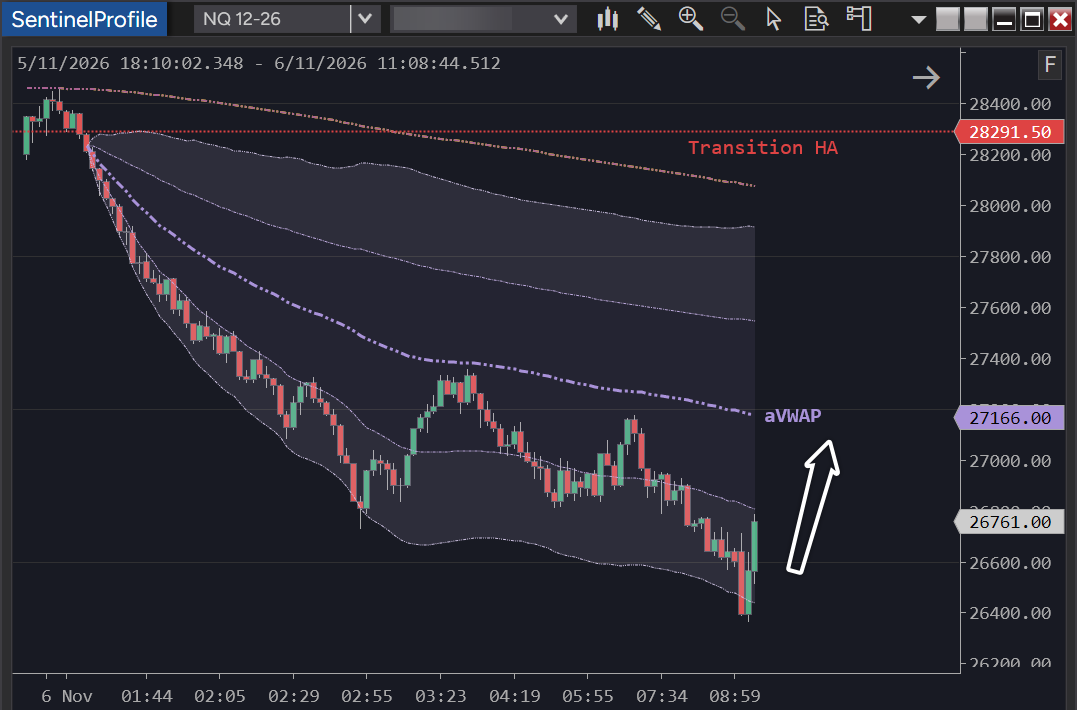
Friday's playing field (the Thursday US night session) is a straightforward one, given the heuristics I wrote about here.
My game plan is to trade the long side, and I'm okay to do so up until price reaches out of bounds: the anchored VWAP that starts at what I consider an important area of business.
It's an 'uncrowded' approach, which underpins everything I do.
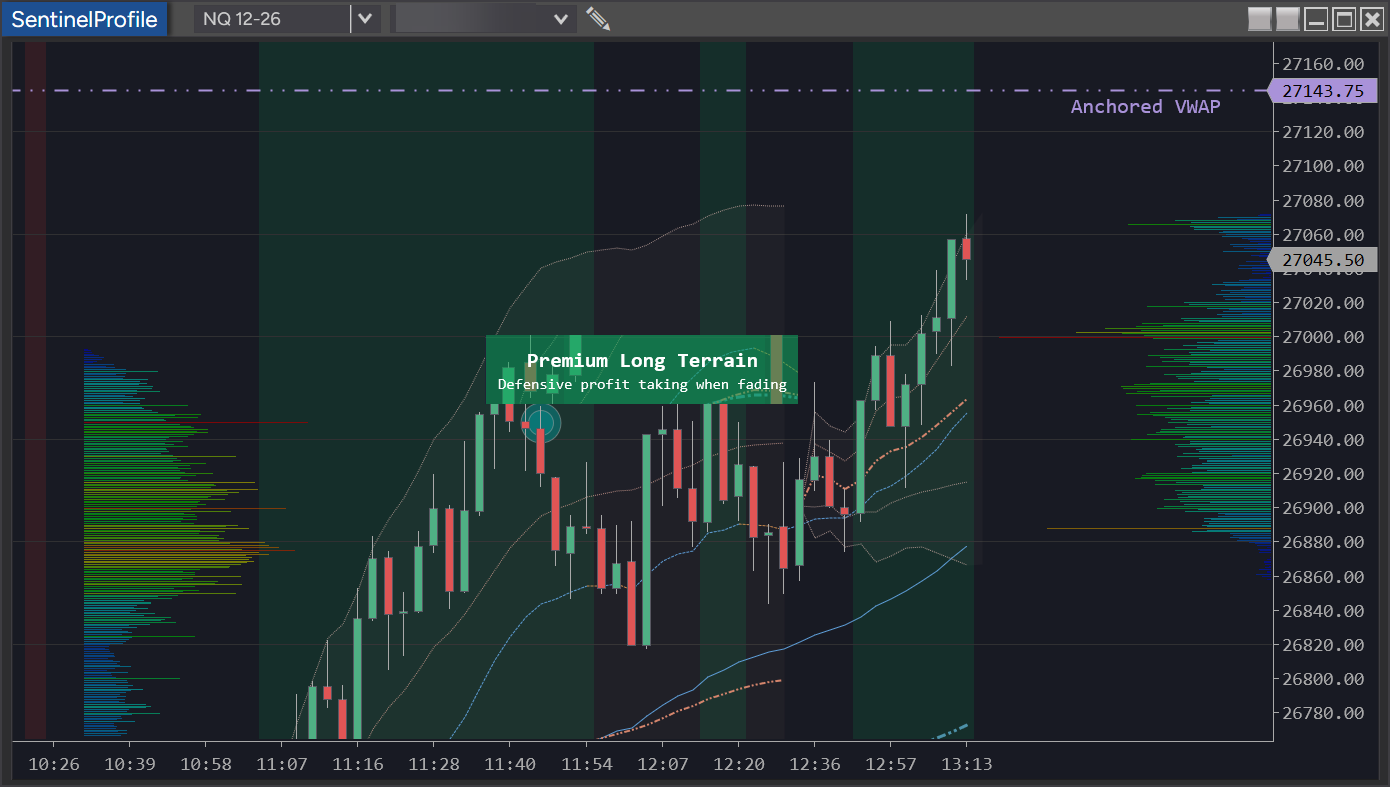
The market is currently trading intraday in what I call 'Premium Long Terrain', as per the visual reminder on one of my charts.
Part one
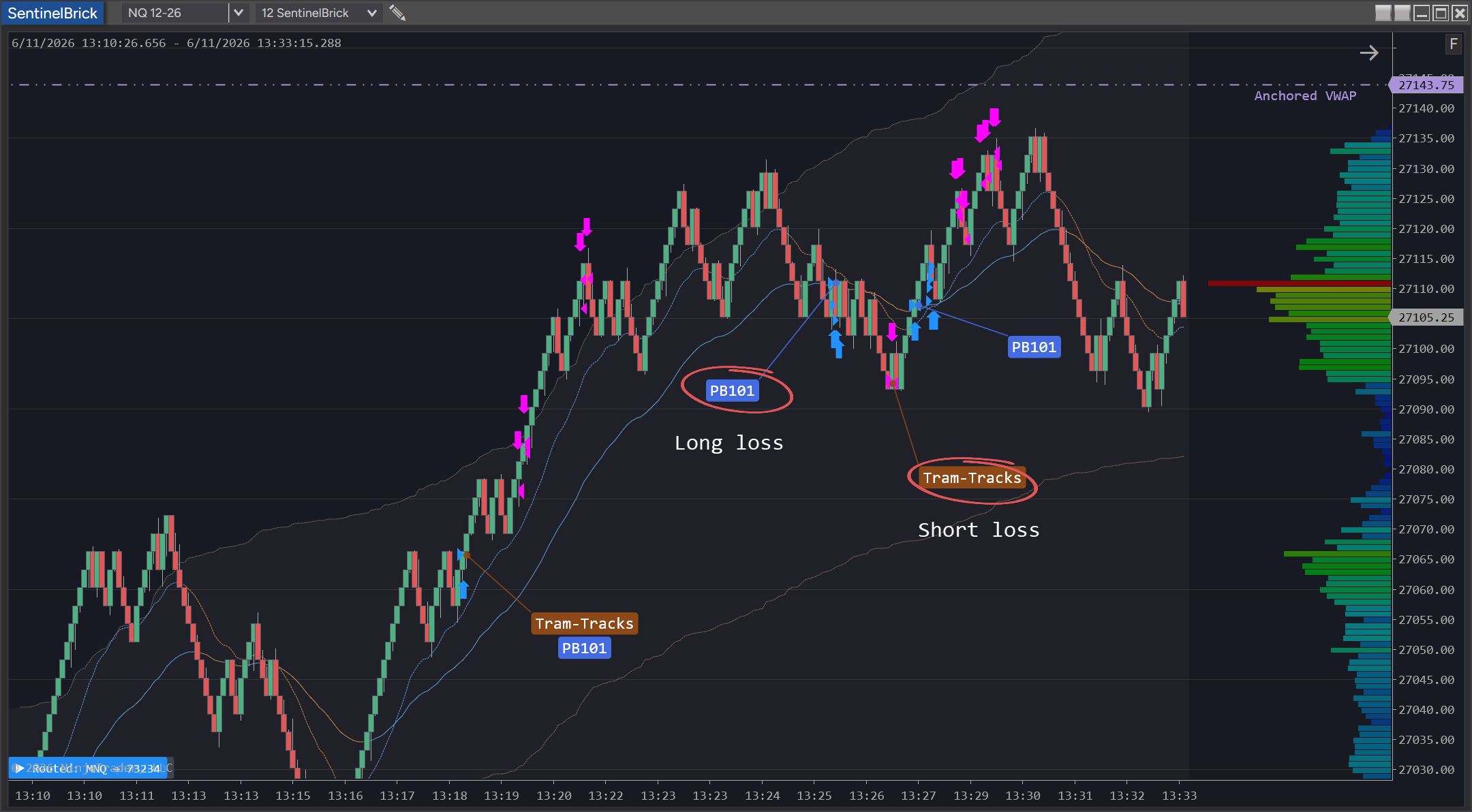
The chart below shows the buying (blue triangles) and selling (fuchsia triangles).
Note:
The chart isn't time, volume or trade based. It's a brick-style chart.
My DOM reroutes orders to MNQ, while another tool overlays those MNQ trades onto a chart of NQ.
I use multiple charts (and other tools) simultaneously when matching the playbook trade to the current behaviour.
The profit taking on the three long trades is based on a theme in play that isn't on the chart below.
I was aware price was roughly at the edge of the playing field and likely to reverse. My first attempt to trade that reversal was a loss.
Part two
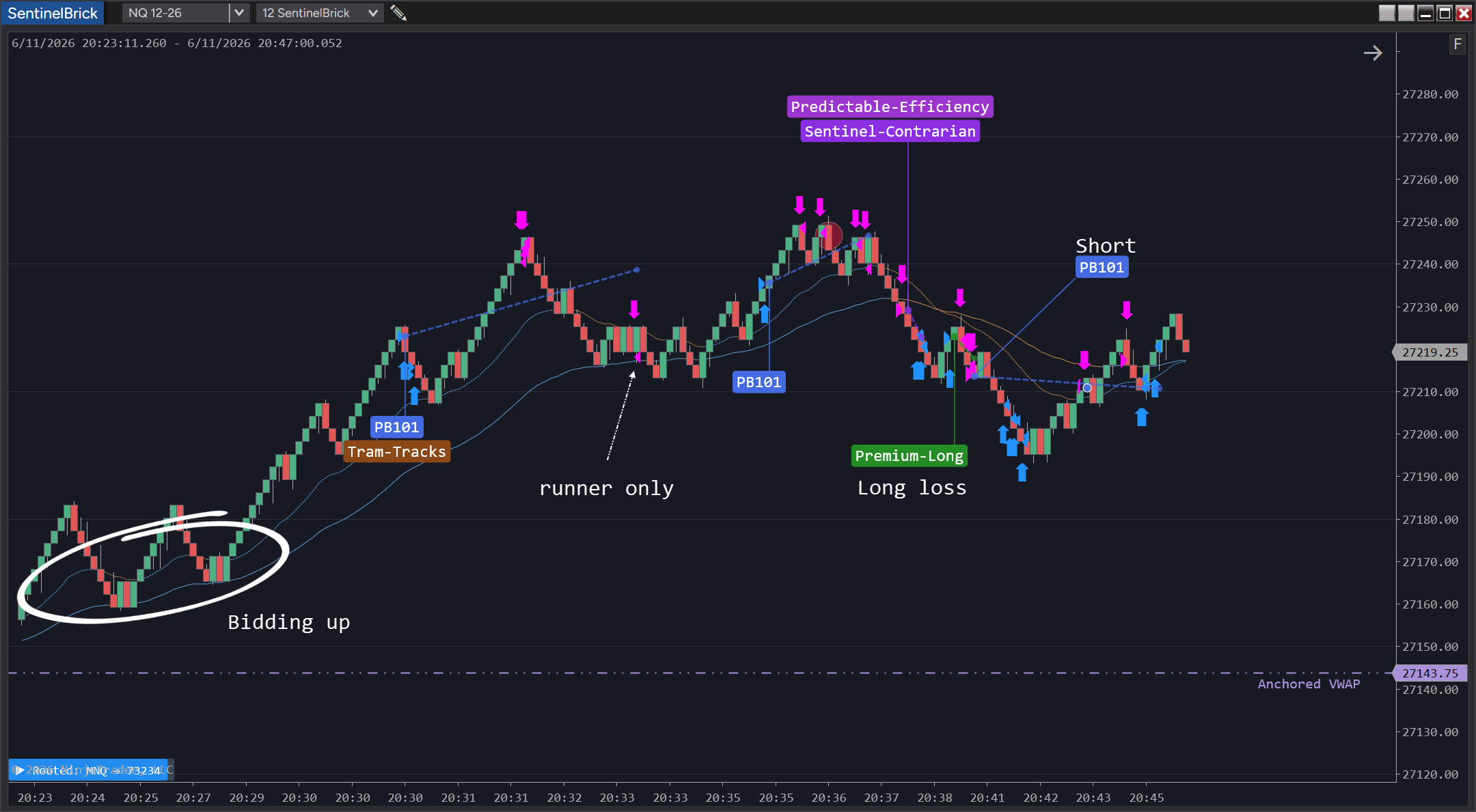
If price moves above the anchored VWAP, I can re-enter long, provided I'm seeing genuine 'bidding up'.
Bidding up is what validates the next playing field, but I'm mindful of how markets can extend temporarily before reversing violently.
Same brick-style chart. I left a runner on the first long trade, which was out at roughly the entry. But it's the 'Premium-Long' playbook trade (a loss) I'm going to cover in more detail.
The last thing I want to be doing when trading is making a judgement call. I want all the actions to be 100% based on a process.
From another viewpoint, soon after I entered the 'Premium-Long' trade, the circled behaviour is how price was behaving in relation to the EMAs.
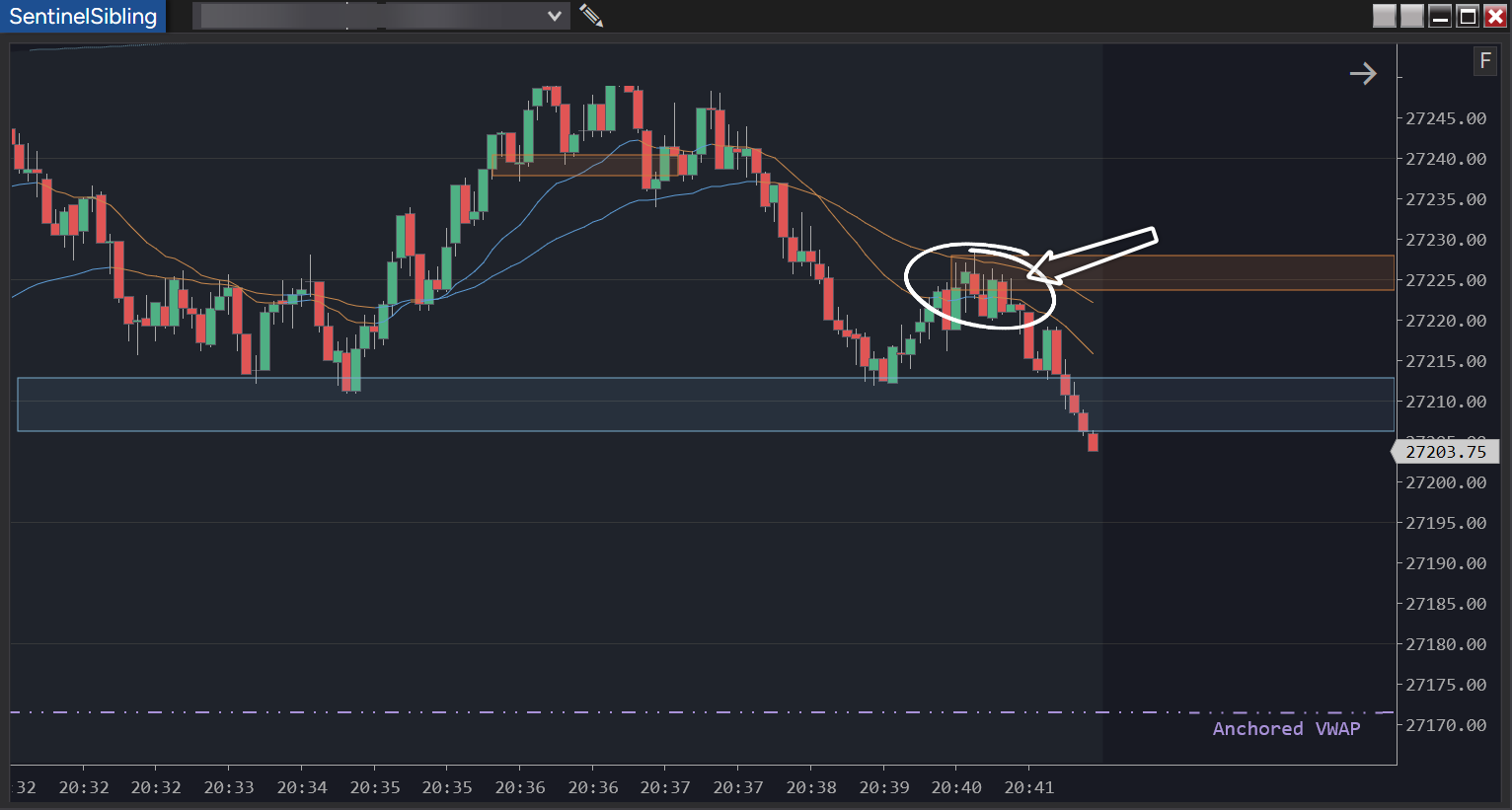
This is an example of 'nuance' or 'ultra-specific' behaviour, which tells me to cover the long trade. More than 75% of the time, price will drop below the entry and reach the stop loss.
You don't need to sit and ponder, "Is this trade going to fail?", and then start second-guessing yourself: "Should I hold or should I exit?"
There's none of that. You're out based on odds. But not only does it reduce the size of a pending loss, it also frees you up to take a trade on the short side, as was the case.
This is another mental shortcut in managing the trade, which is how you act faster than other traders. By acting faster than they do, you're frequently taking money from them.
Not long after that losing long trade, NQ dropped 200 points. Not a scenario to have sat through, added to or, worse, seen your in-the-money trade turn into a loser.
I have 21 playbook trades in total. That breadth helps you capture most of any price move without then wiping out your gains, or even more.
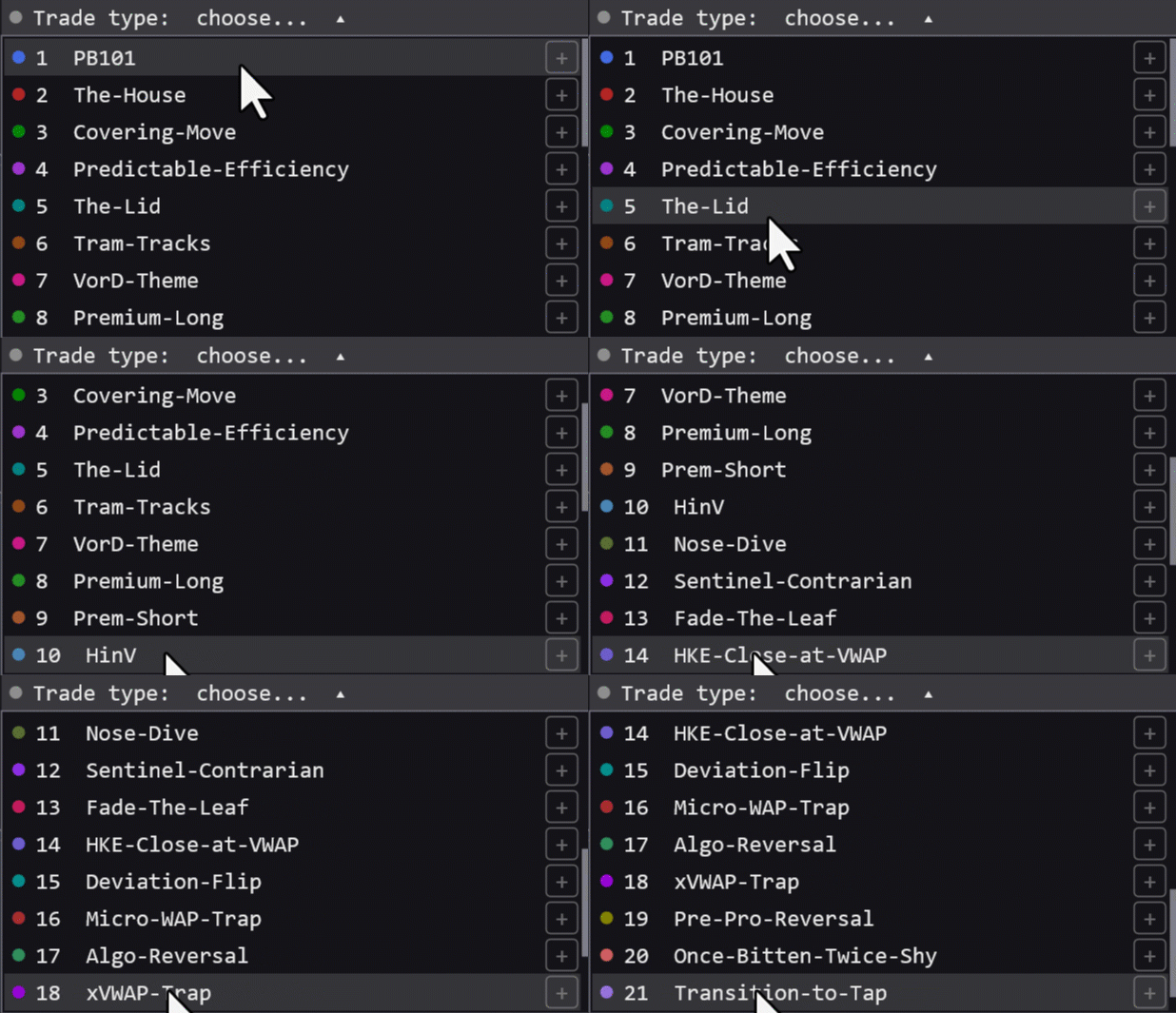
A playbook is a catalogue of trades that enables you to monetise all of the different ways price behaves as it moves.
Playbook trades aren't 'setups' you act on in a vacuum. Along with heuristics and an understanding of the game, they're the cure to losing more than you win.