
Beating other traders with heuristics: the edge most don't know
Thinking something through is a conversation with yourself.
So whenever you enter a trade, manage it (add, take partial profits, re-enter), or exit, it's a conversation.
Inner conversations you have while trading, other traders have too.
But even though these conversations are on the same topics, their length, clarity, and confusion vary wildly.
Some of them are like the dreaded meeting we've all sat through. They go round in circles, waffle on and seem to go nowhere.
Others are like a frustrating conversation that's either full of irrelevant detail or so brief it skips important information. Hold that thought.
You're always competing against other traders. And in doing so, you want to see opportunities before they do, act before they act, and take profits before they can.
We're told the importance of deliberate practice, which requires deliberate thinking.
Deliberate thinking is how you work out and develop the best course of action.
But when it's time to take the stage, the field or the trading screens, deliberate thinking isn't an option if musicians, athletes and traders want to perform and/or compete well.
Turning all that thinking and planning into a performance skill, while the market moves in real time, calls for a shorthand version. A rule of thumb/heuristic is the shorthand version of that mental conversation.
In the trade examples that follow, you'll see how they lead to fast, clear trade decisions.
You only have to look back at everything you've consumed about trading to know this is an uncommon topic. That's why applying rules of thumb is an edge over other traders.
Heuristic one: Is fuel used up?
The beauty of this heuristic is that it gives traders who tend to chase the market entering a trade insight into what's happening beyond price changing quickly.
Being counterintuitive, it also gives you an edge over the competition.
Starting with the counterintuitive part, traders are drawn to fast-moving price like moths to a flame.
Mostly, this leads to buying tops and selling bottoms. I say mostly because there are times when 'chasing' is the correct trade, and I have a rule of thumb for that too. But the majority of the time, when it isn't, consider this.
Let's say, having trended up for three hours prior, the market has stalled for about half an hour. It's not going down, but it's no longer going up.
That stall has some traders assuming the market will reverse, and they're now looking to get short.
If price suddenly rolls over and drops quickly, the sudden drop is the trigger for traders to chase the market and enter a short trade. If you've traded for any length of time, you know what I'm referring to, because it's the intuitive thing to do, and we've all done it.
The problem, of course, is that by the time we're short, the market flips and starts heading back up again.
From a rule-of-thumb perspective, I think of price movement as using fuel. How fast the fuel gets used depends on the speed of the move.
Say you head out to an oval for a run, and you can either sprint at your top speed or jog at a relaxed pace.
If you run flat out, you're likely to be on your back gasping for breath within a hundred metres, because you've run out of 'gas'.
But if you jog, you can complete lap after lap before you reach that same out-of-gas state.
It's the same for price movement, but people think about it in reverse. When price is moving slowly, grinding away, many traders doubt it can keep going.
Yet it's using up buying fuel at the pace of a relaxed jog, which in turn leads to 'refuelling'.
That refuelling comes from short sellers having to cover (who've entered because they anticipate price rolling over to the downside), and from buyers who sold prematurely, also anticipating price rolling over, now having to re-enter once they see their long trade is still working.
By contrast, fast movement uses up all the stops traders have placed close to the current price.
As usual market behaviour, experienced traders don't react.
But less experienced traders enter into short positions, unknowingly refuelling the market with more buying fuel to take prices higher when they cover their shorts.
So the rule of thumb is: is fuel used up?
Of course, this is contextual, because trading is chess, not checkers. But that's all the more reason to use heuristics, because you can tie them together, like in the example below.
Heuristic two: Aggressive or defensive?
Firstly, I have a bigger-picture view chart telling me the market is ideally suited to 'Premium Long' playbook trades showing up. An indicator tells me when this is the case - which is a heuristic in itself. Note the second line in the message box: 'Defensive profit-taking when fading'.
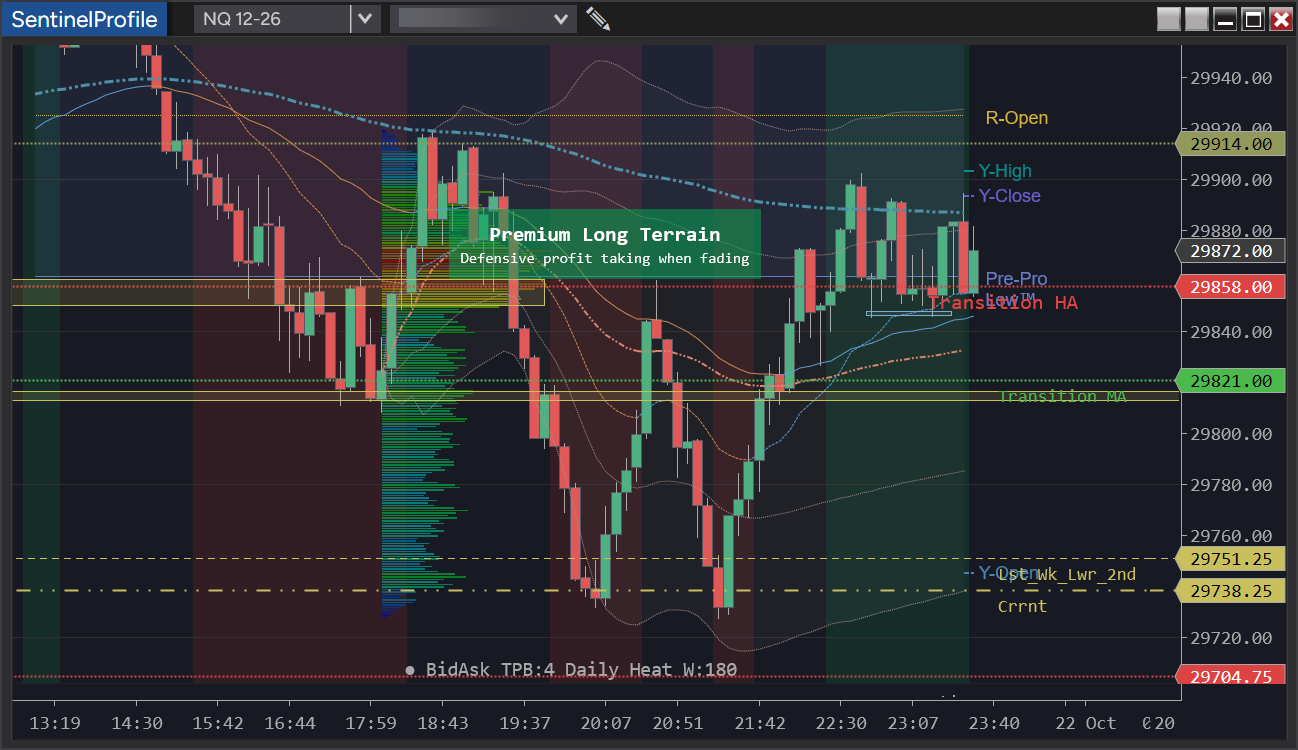
The chart below is a zoomed-in view of the Nasdaq (NQ) and shows my executions.
A note on my executions. I execute my orders on a proprietary DOM that routes them to the micro contract (MNQ) market.
I also have a proprietary tool that displays the MNQ executions on an NQ chart.
The white circle highlights a red line that, based on my trading framework, shows where buyers are likely to step in.
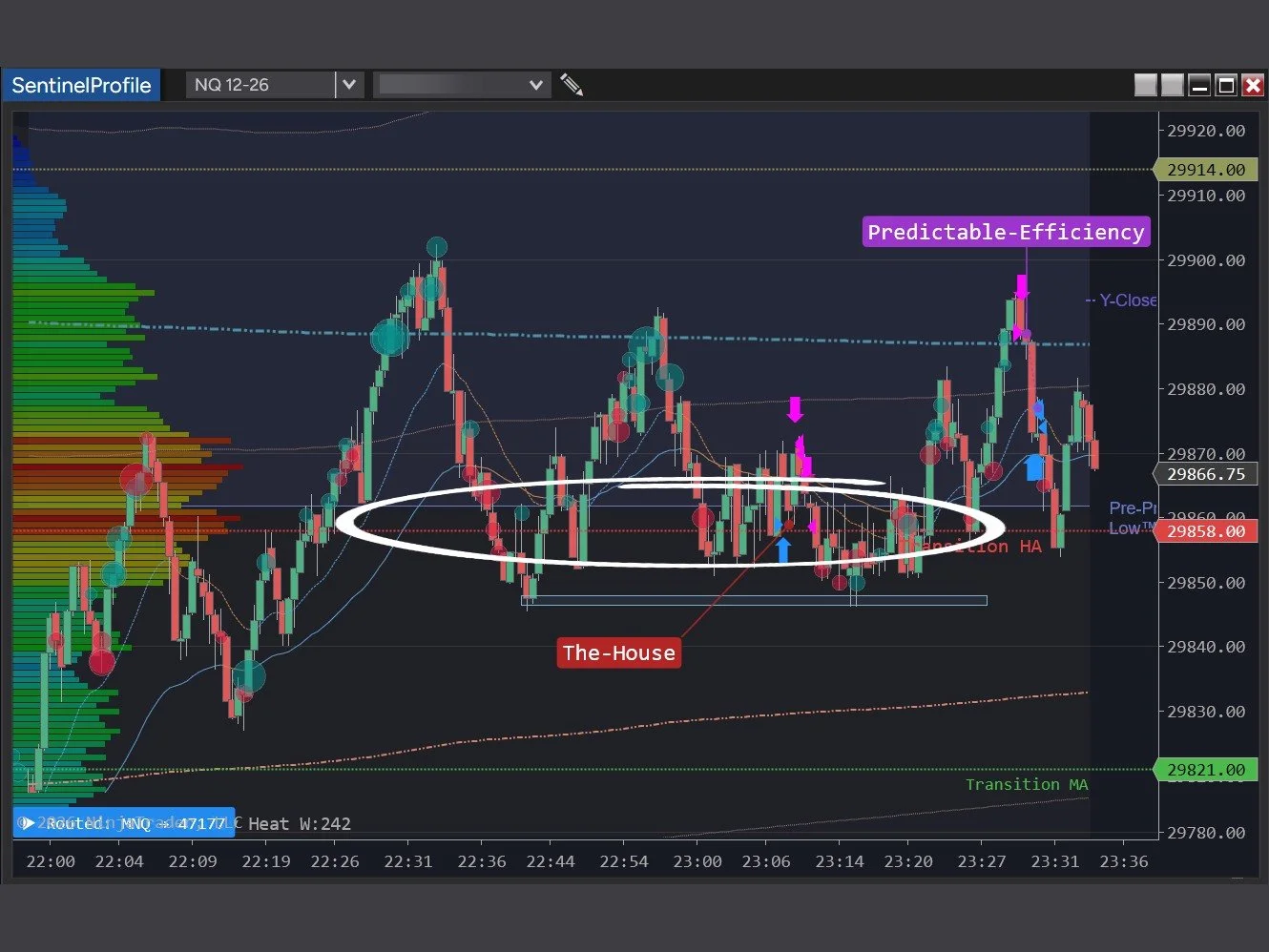
It's an important price to know because what I can gauge from how trading is behaving at that red line is that buyers aren't exactly jumping out of their skin to enter the long side.
The very fact that price is trading repeatedly slightly below the red line tells me buyers are defensive in their approach to trading the long side, despite other conditions being suitable for trading the long side.
If buyers were aggressively entering the long side, then that would appear as front-running that red line.
If the buyers are defensive when buying, how do you think they'll approach profit-taking?
Will they hold for a huge runner, or are they likely to take all the profits on any reasonable push higher in price? It's the latter, right?
With that in mind, can you see how the aggressive or defensive heuristic combines with the 'fuel used up' heuristic?
Same chart repeated below to save you scrolling - notice the playbook trade to enter short as per the playbook trade stamp 'Predictable Efficiency' on the chart.
Prior to moving up quickly and aggressively, price spent about 15 minutes not going up, which drew short sellers into the market.
The fast move up was merely a minor short-covering rally. However, regardless of the cause, the short-covering rally uses up most of the immediate buying fuel as shorts cover their losers. The only other buyers to enter are the price chasers who tend to enter late.
As buying fuel runs out, defensive buyers grab their profits, selling to those shorts covering and the chasing buyers entering. Longs exit at the best prices before price drops back down as quickly as it went up.
By combining both heuristics, I didn't need to waste precious seconds thinking through what was happening and what the best course of action was.
Using heuristics, I was able to enter early into the short and exit conservatively when taking profits. (Another rule of thumb when fading in premium long terrain). Heuristics combined to enter and exit the trade.
As one trade, the P&L is inconsequential. The entire trade, from entry to exit, was over in 1 minute and 1 second.
When trade durations are measured in minutes, the idea is to capture a bunch of them over the course of your time at the screens, as you'll see. That's what makes using heuristics a valuable tool.
Imagine you were to place as many as 10 to 15 trades as part of a 'normal' trading session. That might seem daunting, overwhelming and possibly mentally taxing.
But what if every trade involves mental shorthand? Is it now so overwhelming?
I don't want to encourage over-trading. Heuristics are there as much to quickly identify opportunities as to disqualify trading what is just noise.
Heuristic three: Buyer or seller?
This heuristic has you consider, at current prices, what's the more likely scenario to pay off 'today'. Is it as a buyer or as a seller?
We're not stipulating only one or the other. However, considering using the heuristic 'fuel used up' - and applying that to the daily view chart below - what side of the market is likely to present the greater reward-to-risk trades?
My answer is as a buyer.
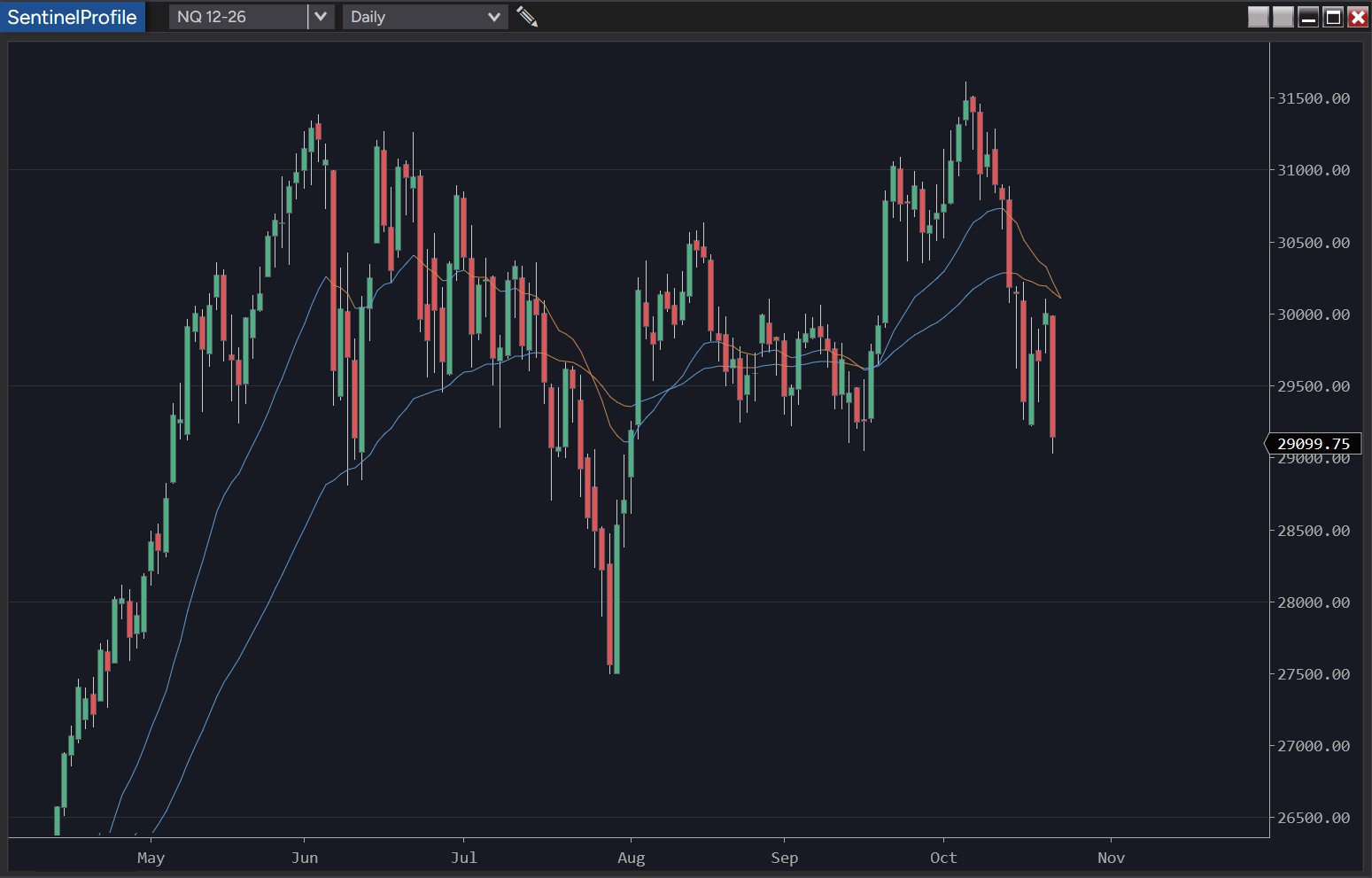
I traded both the short side and the long side on Friday.
But it's as a buyer that I was able to see the trap sellers would fall into.
The brick-style charts below show all of my executions for each trade type, taken as per the playbook stamp labels, 21 trades in total.
Before I get to the trap, just in case you think this is the trading of some ex-video gamer twenty-something year-old and therefore not something you yourself can do as quickly...
At 55 years of age, I'm pretty sure I don't have the reflexes of someone 30 years younger than me.
But shorthand thinking, using heuristics, is what makes it possible to compete as a day trader, which is often dismissed as a young person's game.
Any stamps on the charts that are circled in red were losing trades.
I've also circled VWAP in white.
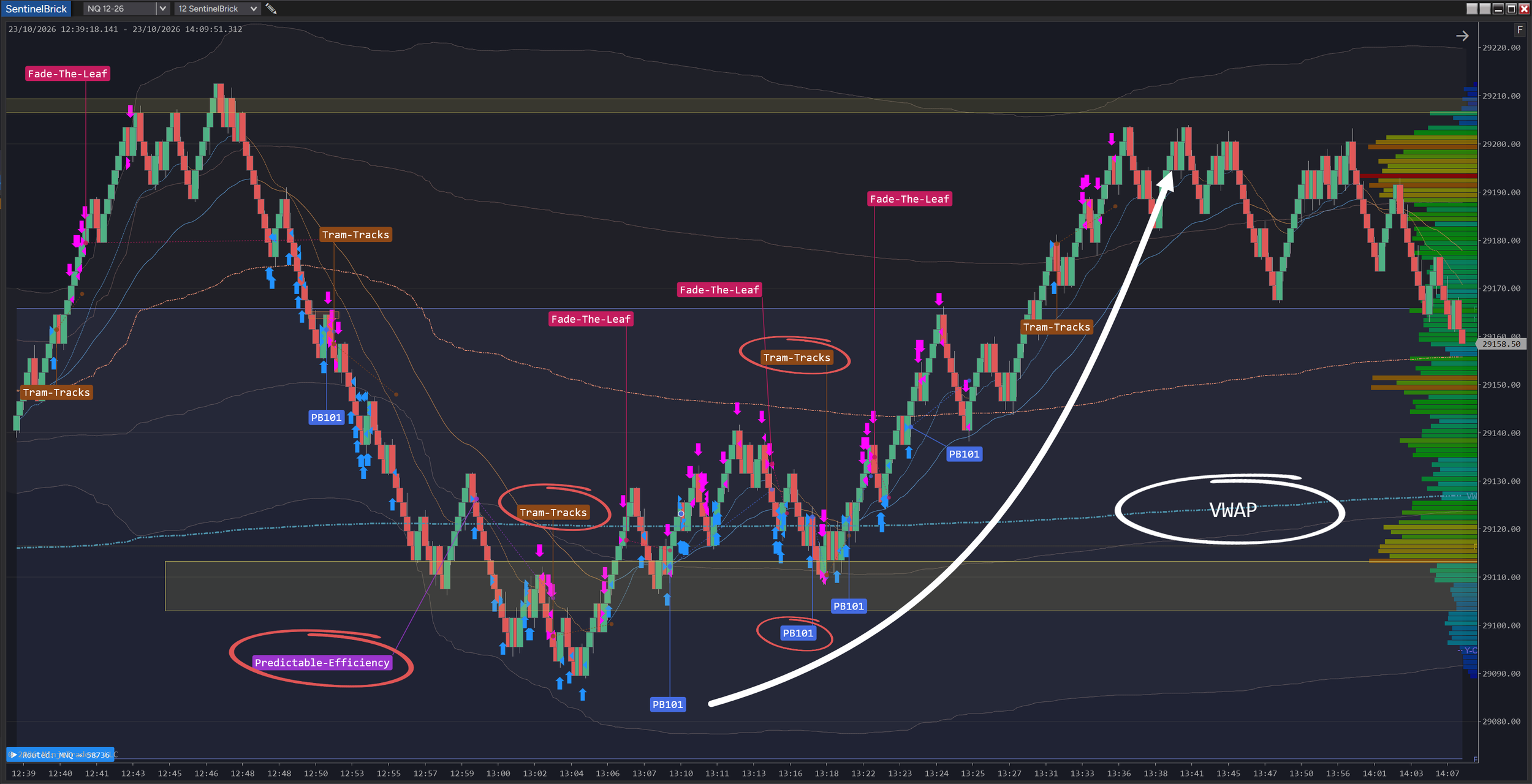
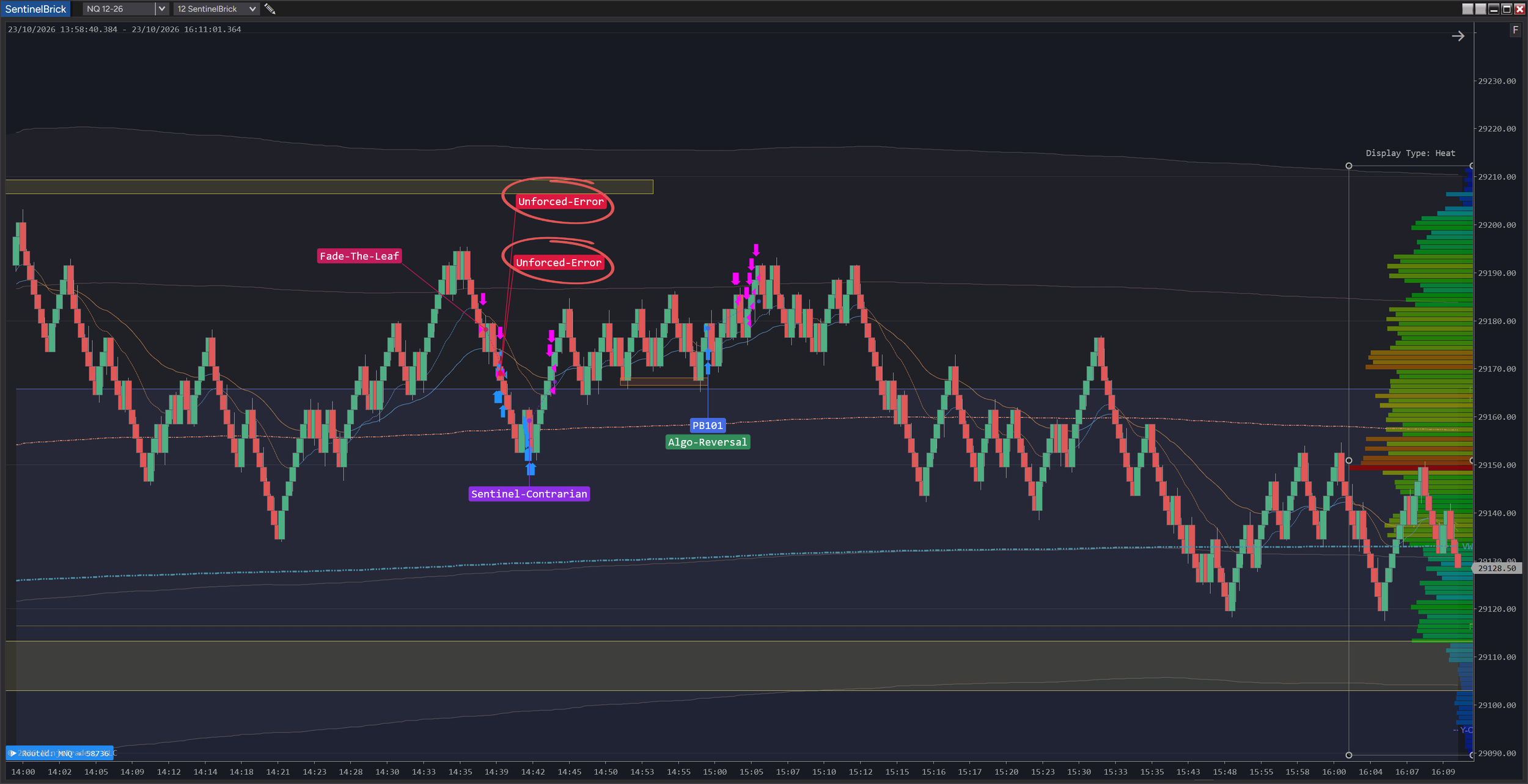
Many traders define their bias around VWAP, and when price is trading below it, they'll focus on the short side.
But as someone who's seeing the market as likely to be a buying opportunity, I'm either taking profits from shorts below VWAP or I'm entering long.
The best-paying sequence on the first chart is represented by the white arrow, which starts with taking the other side of short traders building their positions below VWAP and ends with riding the short-covering rally that comes soon afterwards.
And while I'm not going into the specifics of playbook trades, they too are heuristics, because for each of them you know how to enter, manage and exit the trade, according to which playbook trade you're trading.
It's so easy for traders to fall victim to thinking of trading as something unlike other businesses, what with screens full of multiple colours and a language all of its own.
But it's no different to growing any business. What works, you do more of, and you're constantly looking to make it more efficient. Playbook trades, the trading tools I develop and heuristics all serve the same purpose: to repeat what works, make what works easier to do, while simultaneously acting as guardrails against getting caught allocating resources to stuff that only costs you.
There are many more heuristics than the ones I've shared, but you get the point. One of the appealing traits of trading Nasdaq futures is the frequent inefficiencies that occur intraday, coupled with the volatility. It makes for a market where you can accelerate how competently you carry out playbook trades, because of the vast number of repetitions.
Even if you're a twenty-something ex-video gamer, you'll still need to initially get in the reps.