
Markets compensate you for knowing how others behave
"You can't make money trading because markets are too efficient" is a time-worn truth.
Markets are indeed efficient - but they're not perfectly efficient. And it's inefficiency, when framed correctly, that offers genuine positive expectancy.
Changes in liquidity, positioning, forced buying and selling, and the psychology of the participants are what create the inefficiencies.
And identifying them comes down to knowing how people think and behave. The market compensates you on how well you can identify it.
But first, every business starts with one initial goal in mind - keep the lights on. Establish repeatable and reliable cash flow. Only once that's in place can you think about scaling.
If you're not at that point already in your trading, then the following is one definite way to get there - something you can rely on to keep your trading business ticking over and give you time to scale up without pressure on bringing in consistent cash flow.
And trading being a skill, it makes sense to focus on the easiest (in relative terms) trades you can do over and over.
Not the multi add-on trades that lead to home-runs. They're more difficult to achieve and occur far less frequently. Instead, you want what shows up all the time so you know you can keep the lights on.
This is where a playbook comes in. For context, my playbook consists of 29 different trades. Then you include when you should add to trades versus those you just take the cash, and then also add dynamic sizing (different size and therefore risk depending on odds), and suddenly that's looking like a multi-year project to reach competency.
But in terms of a reliable baseline to maintain your trading business, it only takes a handful of playbook trades.
Yet easier still, to start with, you just focus on one trade that has positive expectancy.
One such playbook trade is named Predictable Efficiency. It's based on knowing what a certain group of large participants do and what price levels they want to trade at.
It's not the only baseline playbook trade but we are going to focus on just one as it's the fastest way to achieve consistent, reliable results.
Moving price to those levels involves forcing independent directional traders to either buy or sell (at a loss) by taking liquidity hostage, and once done, price can return to more 'efficient' pricing levels.
That's a lot to take in, so to avoid being overwhelmed here is a plain English explanation.
This playbook trade shows up several times a day, every day, in Nasdaq Mini futures (NQ) and its 1/10-the-size version, Nasdaq Micro futures (MNQ). It does show up in other FX and Index futures but less frequently compared with NQ.
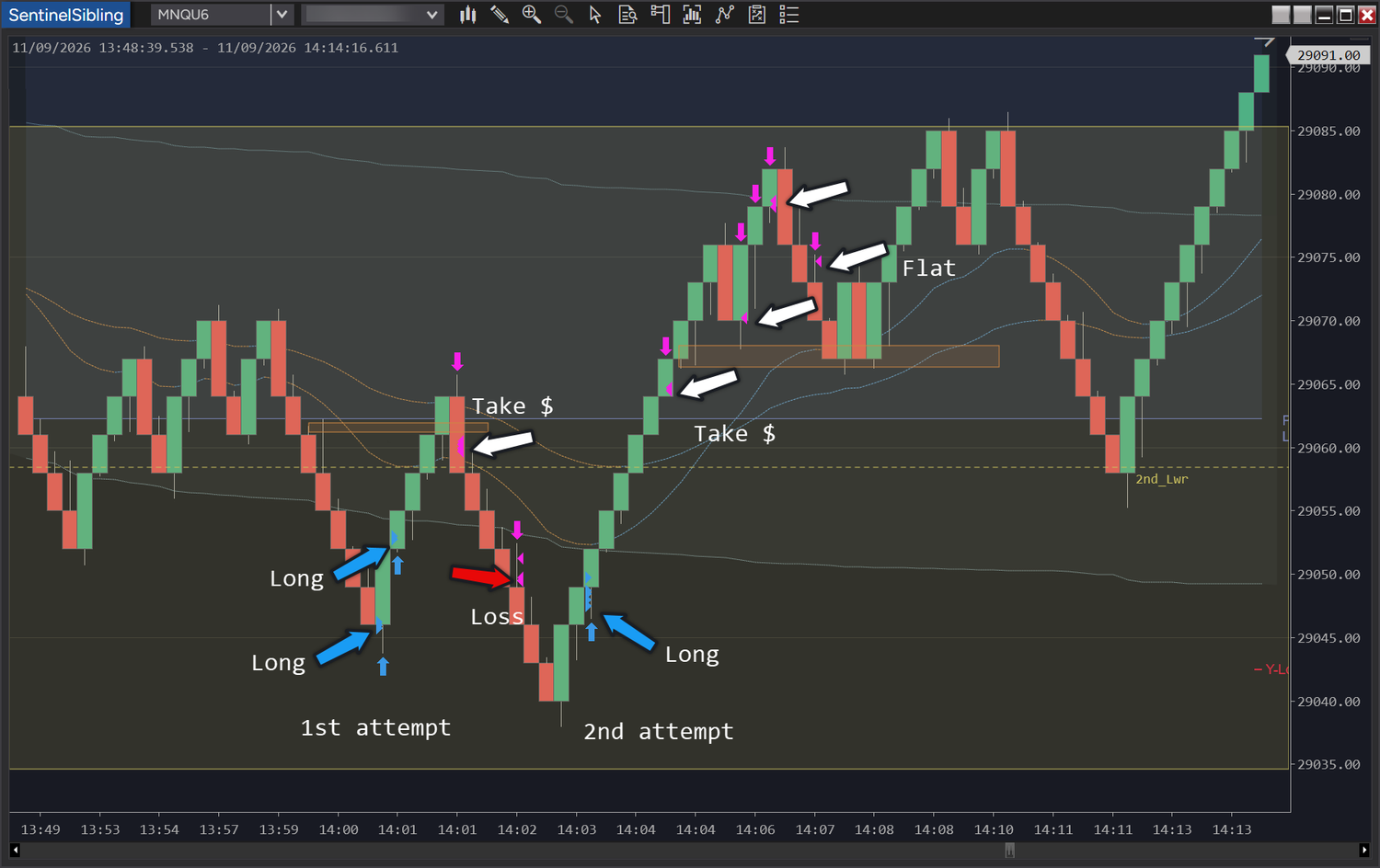
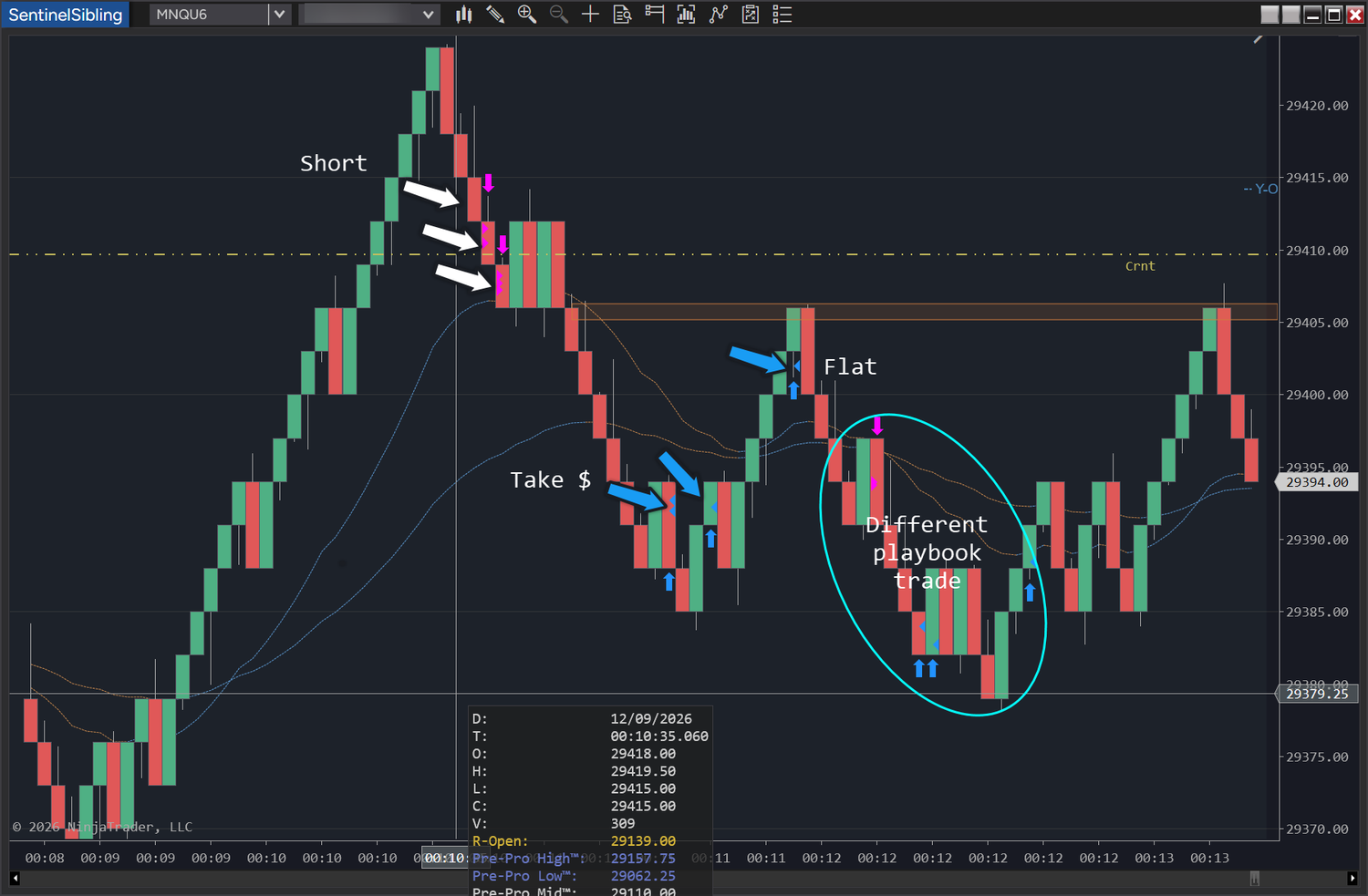
Below are the four times it showed up this Friday just gone when I was at the screens in the afternoon and evening. There are other times it showed up but I wasn't at the screens at the time.
1st and 2nd: tap to enlarge:
3rd: tap to enlarge
4th: tap to enlarge
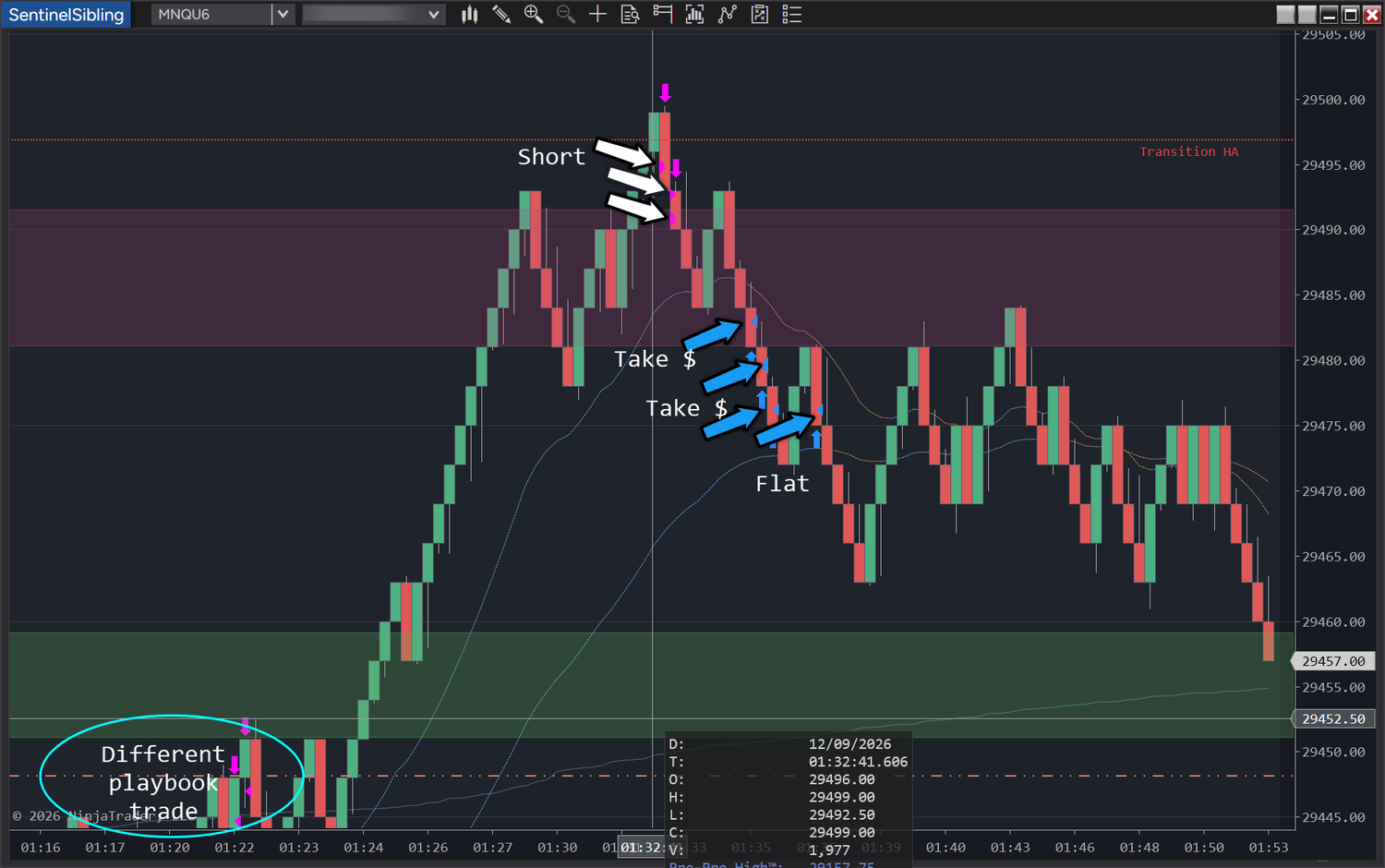
What you'll notice is how quickly the trade is over. That's actually evidence it's working. If you enter the trade and you're sitting there watching your trade move onside, offside, onside, offside, etc, then it's a sign to get out, and do so very cheaply.
Another feature of finishing quickly is once this trade is in your kit bag, you have plenty of mental resources in the tank to rehearse the next playbook trade.
Nine times out of ten this trade is not a loser. That isn't the same as winning nine out of ten. It means it doesn't lose.
On a professional trading desk you have a daily loss limit. Hit it and you're done live trading for the day. With a trade that rarely loses, you can allocate up to 80% of that daily limit to this one trade.
Yet it's not a trade you should take in your real account until you can do it competently in simulation first. Knowing the prices the market is destined to move to and then reverse from is only one part of it. A number of points of evidence have to align, and then there's the execution itself.
Another characteristic of this trade is sentiment is either extremely euphoric or extremely fearful - so it's counterintuitive to take a trade against what the majority are doing. And make no mistake, you'll feel the same as they do to begin with.
It's partly why you need to repeat it - because you'll initially feel the same about the market as the majority - and it's not until you've experienced trading it through your own hands, not once or twice, but enough times there's no denying its positive expectancy.
When you think about it, there are only two types of losing trades. The first is because odds are at play - whether that trade has positive or negative expectancy.
The second type of losing trade is human error. So for example, you think you're making the Predictable Efficiency trade but overlook a disqualifying variable such as the 'tram tracks' being present. (If you're familiar with my playbook, you'll know what this means.) Or you enter the trade right before high impacting economic data, or any myriad of mistakes one can make. Hence, it becomes crucial to take this trade in simulation first.
The charts showing the executions are just that. There is of course much more than just a single chart that goes into making every trading decision.
I developed tools to make NQ tradeable, enabling me to take money from the majority of independent 'traders' who have zero chance of being consistently profitable in NQ.
I'm also equally aware there are traders who are also competing to take money from me. This is why having an air-tight framework to disqualify trades is equally as important as highlighting trades you can take.
Every trading session, someone takes money from someone else. Who ends up on which side isn't decided by how hard you try. Nor is it decided by how smart you are. The market is full of extremely intelligent people losing money, as well as those looking for a quick score (gamblers). Which side you're on comes down to just positive expectancy and competency (usually through repetition) to execute it.
Competency means you're not concerned with the outcome of the next time you take the trade. I had one of these trades lose on Thursday, yet I pulled the trigger on the next time it showed up without hesitation.
It's the same for anyone who takes a positive expectancy trade enough times to no longer mess it up, which is usually also enough to prove to you it creates positive cash flow overall.