
Scalping's not a dirty word
Mention scalping and you might roll your eyes.
Is it trading to make a couple of points, or is it you're in and out of a trade in seconds - or both?
What if you enter a trade and the market moves 30 points in under a minute.
On your 5 contracts in NQ that's $3K before commissions. Satisfied, you immediately take the money.
So does that make you a scalper?
Before answering, keep the following in mind: "Fries with that?" "An extra two-years warranty?"
Here's an NQ short trade from Wednesday where I scaled out over a few exits with the last being 14 points.
Statistically, the odds are high that if condition A exists at the same time event B occurs, you take money out of the market.
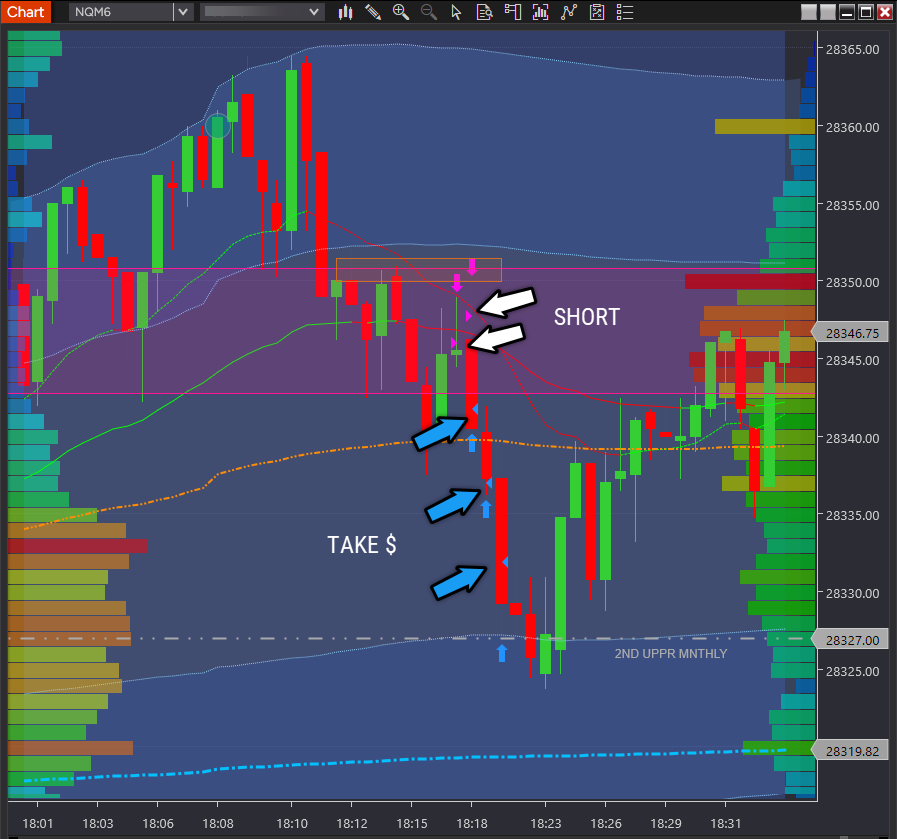
It's centred around a pre-existing 'speed-hump' (the sellers within the pinkish-red horizontal band) and sequence of events (evidence) occurring followed a catalyst event.
And while it looks like 'picking the bottom' to exit - it's just part of the trading framework that creates a map of where you should no longer be short.
The same map also directs you into the long trade once past the speed hump.
Price could have behaved in an unfamiliar way, in which case you don't trade.
But as it turned out, a premium long trade - the highest-rewarding playbook trade for 6A and adapted to NQ - showed up.
The chart captures only the early stage of the move when the market was up a hundred points. The key observation is the speed-hump slowing things down for hours before the market ripped higher.
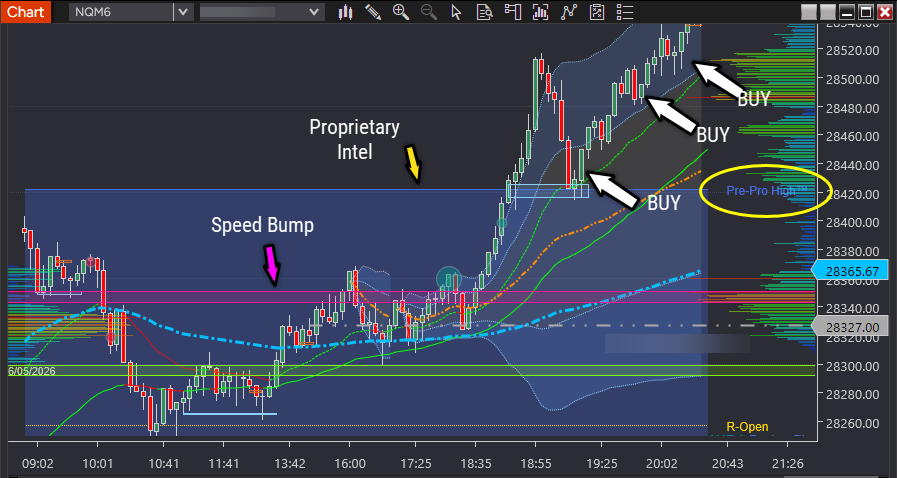
In the past, when I didn't have the skills I do now, all that period before getting past the speed hump is where I'd do my dough.
So really, whether it's the framework, multiple points of evidence, playbook trades - they're all solutions to obstacles I once faced.
And once I realised my obstacles were the same obstacles every other person has, it became obvious to take money from those who don't have a solution.
The out-of-date chicken trade
You couldn't have two more contrasting trades than those above, until you lose the idea of labels like "I'm a scalper". "I trade momentum". "My trading style is...".
And instead look at what the business of trading is: taking money out of the market.
But if you want to take way more money than you tip in, you need depth of skill and knowledge to do so regardless of what's going on macro-economically.
The most successful businesses don't only operate during holiday periods or when the weather's nice.
The first trade wasn't a case of 'while I'm waiting I'll just give a trade a go'.
It's not a fill-in-time trade.
That would be like running a restaurant offering chicken three days past its use-by date at 70% off.
The patron could get salmonella poisoning, you could get a hefty fine, your business shut down pending investigation, and murder any goodwill you've got. It's bad for business.
And let's be honest, we've all taken the out-of-date chicken trade, but it has no place in the business.
But back to the point. Accessories. Extra warranties. Room upgrades. Fries with that. It's all business profit, and all the most successful businesses look for the ancillary sale.
I'm going to take every trade where I have great odds of taking money, big or small.