Trading in the biggest losers' market
Total polar opposite to nearly all traders.
Veterans with 30-40 years' experience are saying:
"Trading these current conditions can change your life trajectory."
Remember this from last week's email?
"Trading is a domain where you have to out-trade enough other participants or you join the majority who lose and fail."
Current conditions are new to any traders who only started in the last 15 years, regardless of previous success they may have achieved.
That's a significant number of traders ripe to compete with. But not only that—the volatility is exceptional.
Last week I demonstrated a way to see an erratic, rapid-fire market with a competitive advantage. And I'll show you a step to enhance it in a minute.
You might know me for trading Australian dollar futures (6A). In my experience, and I've traded across multiple asset classes, 6A is ideally suited to developing all-encompassing skills to prepare you to trade year after year, not just until the shelf life of what you're doing runs out - which it does.
You might also know the Nasdaq futures (NQ) moves too fast and is too volatile for most traders. Yet my interest in it comes down to two words.
Retail prey.
MNQ and MES are the micro versions of the Nasdaq and S&P 500 futures - the entry point for retail traders.
MNQ trades twice the USD volume of MES.
That's your evidence.
Retail traders love it but they don't have the reflexes or framework to trade it.
It's a market full of participants being sliced and diced - and the question is which side of it you're on.
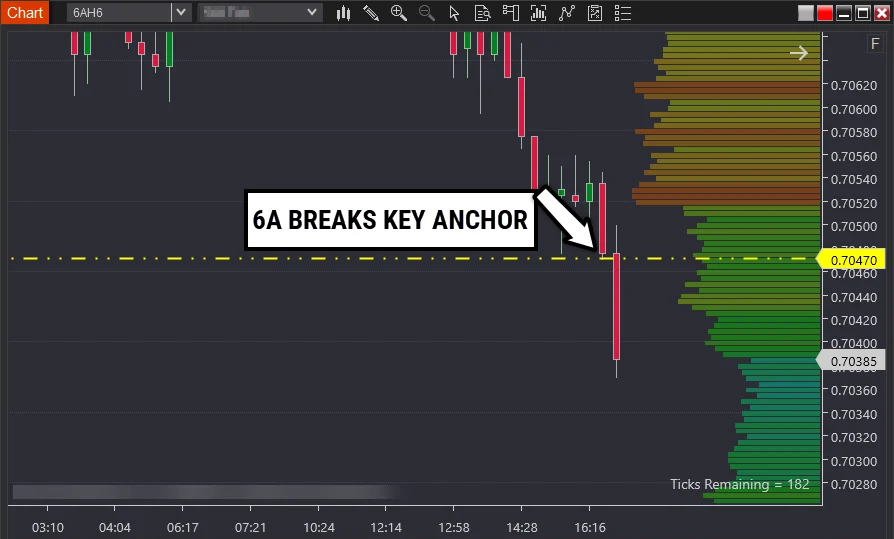
The other part is something most won't see coming: an intraday relationship between Nasdaq and 6A that's invisible without a framework for how 6A behaves.
The kicker is it's not always present. Which is exactly what you want.
And while there are what I call points of evidence unique to 6A, there are also universal points of evidence most traders aren't aware of.
How do I know? If everyone knew, they wouldn't work.
And even though there's a learning curve to act on multiple points of evidence, it's a feature not a detraction.
Most won't endure the frustration of being incompetent long enough to get there - hence your competitive advantage.
So while it might seem overwhelming to trade two instruments simultaneously, trading multiple points of evidence prepares you.
It's really juggling 10 baseballs instead of 10 tennis balls - a minor adjustment.
Combined with custom tools to make sense of what's otherwise too erratic and quick, you've a solution most participants in that market don't.
Before I cover trading NQ/6A futures, here's an extension to seeing the market in a way most traders don't have access to.
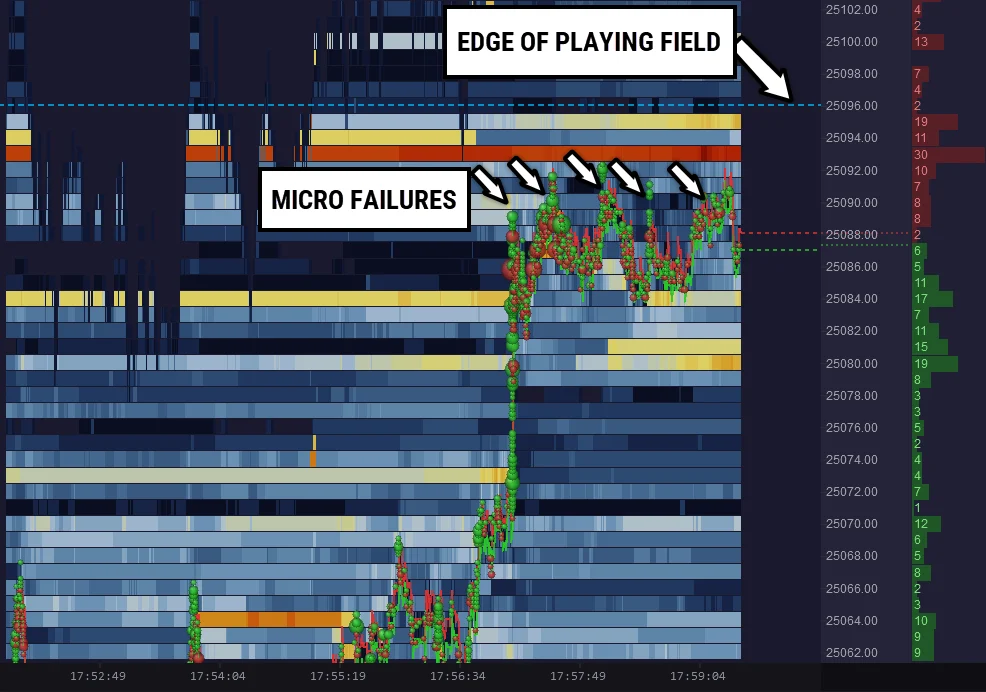
SentinelLiquidity
tap to enlarge
Playing fields - where to trade and where not to trade - are identified during game planning and automatically plotted on other views, including the aggregated liquidity map above.
Its colour tells you what the environment is above it.
Notice the red band of liquidity and numerous micro failures by price to move above it. All of those micro failures are valuable intel, yet you can't see them on price charts - this is a bid/offer view.
The bids and offers are an aggregation of minimum price increments - turning otherwise incomprehensible erratic behaviour into something you can act on.
Knowing the playing fields were identified hours earlier, you can see how what is occurring in real-time via the liquidity map aligns with other aspects of the trading framework.
Putting it altogether
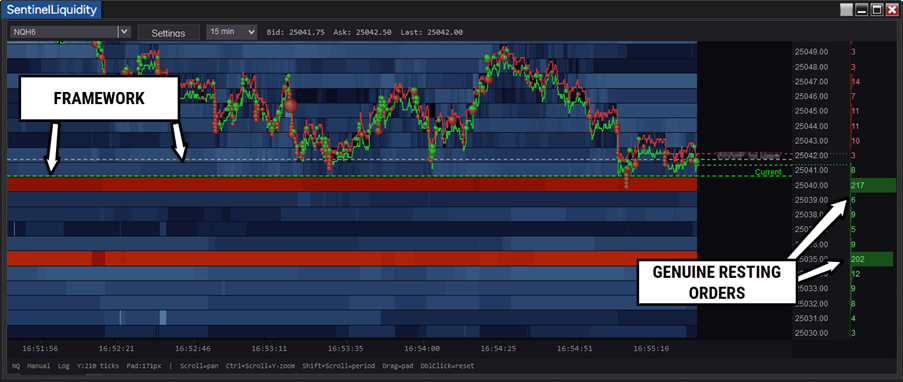
On the liquidity map below, you can see two large genuine resting orders. Knowing they're genuine and won't be pulled is a learnable skill.
Notice how these orders align with the framework identified hours earlier.
Tap image to enlarge
6A breaks a key anchor
Tap image to enlarge
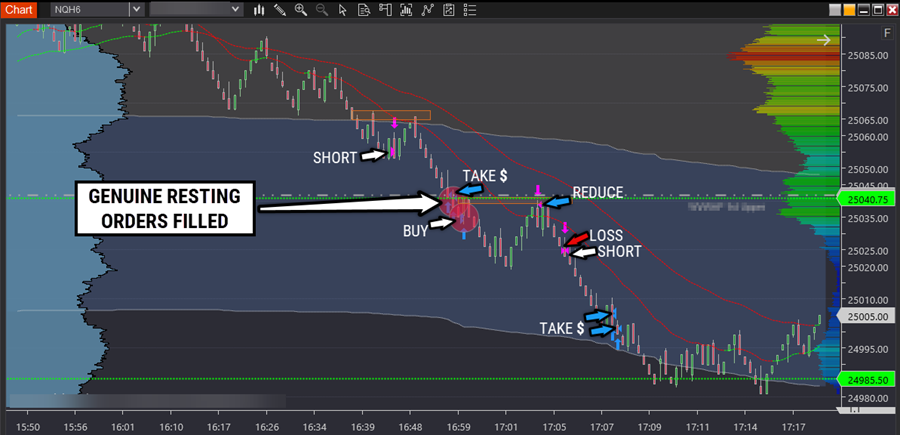
Resting liquidity, 6A/NQ relationship, framework and multiple points of evidence combine to provide the trades shown below.
Tap image to enlarge
Warning:
The heat I took on the first short entry was about USD 600 in the blink of an eye, literally.
When you're developing, it's easy to see how fast this gets away from you - and how scarring that hole gets.
Hence, 6A is a great starting point because it offers a much greater degree of safety while you're gaining confidence.
And of course, you can stay in 6A. Even though the environment was optimal, it doesn't change the fact that a private development client made 7 figures in a single year exclusively trading 6A - but not in his first year!
It was four years after our time together. Exponential trading growth takes years, but it does happen.
I also took heat fading the market (which ended in a minor loss). This is a calculated bet which has a high "no-damage" success rate. However, over a meaningful sample size, it does blow out, but those blowouts don't make the overall sample size unprofitable.
What's the takeaway?
You often hear "You're competing against yourself."
It's the go-to rebuttal for those peddling trading services that don't work - putting it back on you and your psychology.
Competition in trading is real. The majority lose because they're competing in areas where they're outgunned.
The goal is to choose a field where competition in the game you're playing is thinner.
What I've outlined above creates exactly that.