
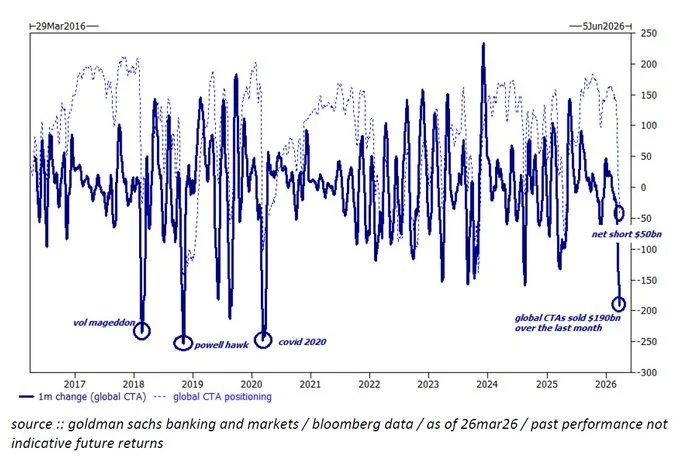
Mar 30, from GS via BBG:
"CTAs sold $190B this month, quickly approaching max short levels."
Mar 31 - April 01:
Nasdaq (NQ) rallies from 22,961.50 to 24,348.25 - 6% in less than 12 hours. Traders who entered short late March did so on stale information.
All the selling fuel was already used up. Late shorts entered on fumes. I wrote about trading fuel recently - fuel article.
August 2025
NQ was showing conditions worth paying attention to. Enough to justify preparation. Not enough to act without it.
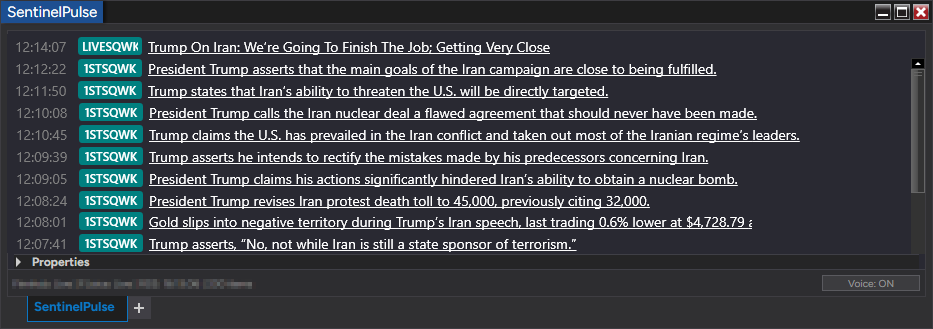
The preparation meant building for it. SentinelPulse for news aggregation across multiple real-time news services, casting a wide catchment net for market-moving events.
SentinelLiquidity to read bid and offer concentration shifting before price moves.
SentinelDOM to aggregate price, depth and volume - with volume split into custom periods because NQ in a sustained high-volatility regime isn't readable on a standard DOM.
In every field where technology plays a role, new tech systems produce outcomes outdated ones can't.
Amazon and McDonald's created competitive moats doing this. High-frequency trading firms did the same. As a trader, you do this in your market.
You stack as many positive expectancy chips as you can and milk every window of opportunity. Or don't.
The 6A benchmark
Eleven years trading a single instrument intraday - the Australian dollar futures (6A) - produces awareness of characteristics, opportunities and repeating scenarios that other traders aren't aware of.
That benchmark is what you carry into a new market. It tells you what to look for and what weight to give it. You can harvest positive expectancy that remains structurally unavailable to most others.
Early 2026
The Iran war was the catalyst that confirmed the hypothesis. The opportunity was real and it was running. The preparation window had closed. Anyone preparing now is late.
Income-producing assets
Catalysts ignite the best trading opportunities, the ones you hypothesise. But you don't put your entire future trading income in the hands of catalysts - you don't know if and when the next chapter begins.
This is why there's a role for layups. Regular trading opportunities which are relatively easy to trade, reliable, consistent, just not extraordinary.
One such is 'The House' signature trade. First developed while trading 6A, now adapted to NQ.
Another is the NDA Covering Move, again adapted to NQ from 6A.
SentinelLiquidity highlights a persistent offer in reddish-orange. Without going into the specifics, this added another component of the trade other traders don't know about.
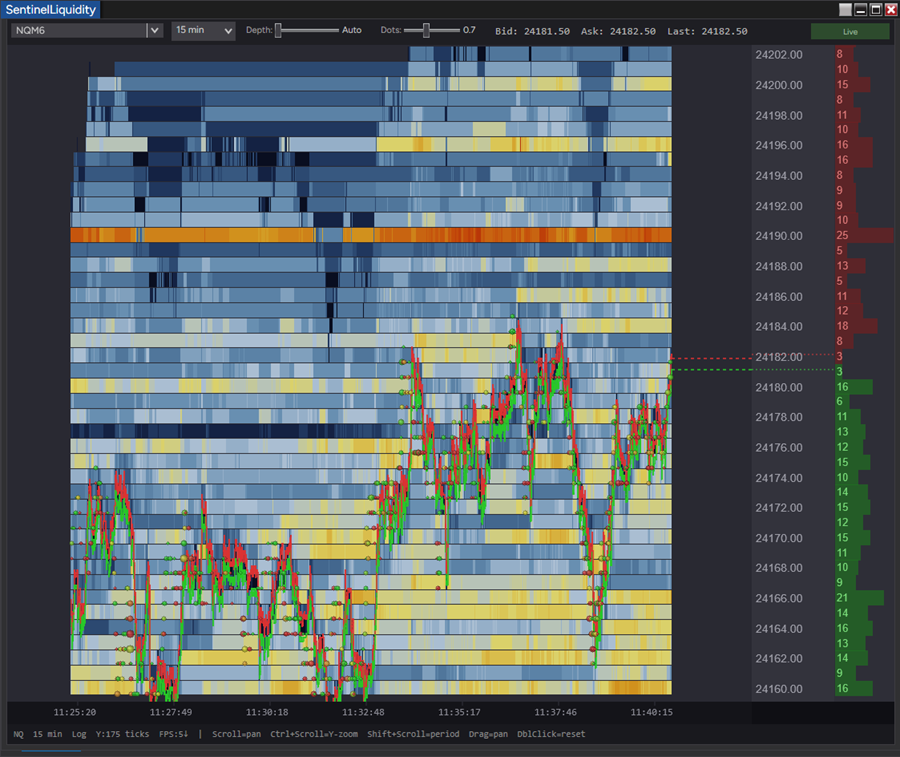
Which traders? All those who went short as per the 'sellers' trap' below.
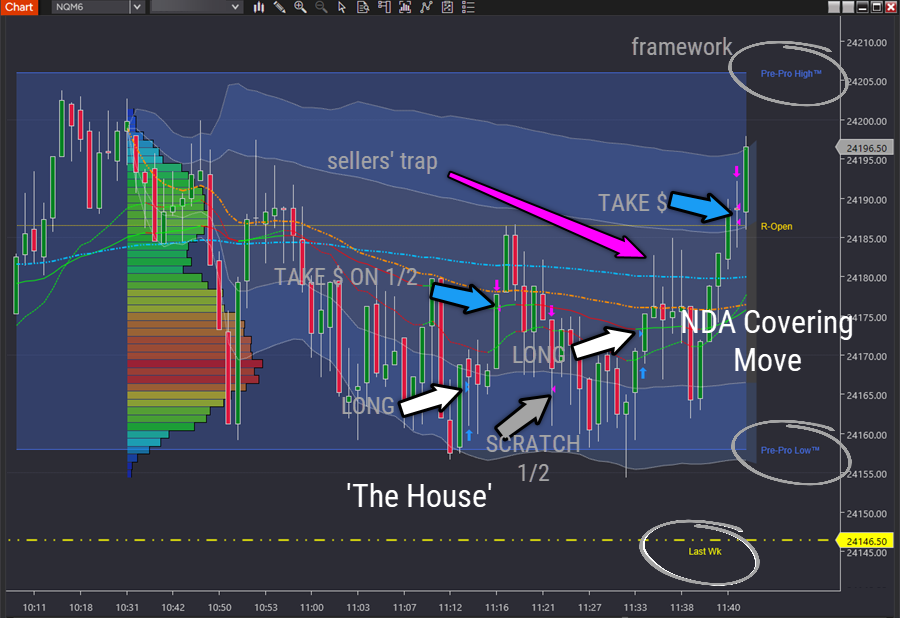
To illustrate the role of layups versus catalysts, and how ideally they co-exist within your trading. For the first 30 minutes of trading, the net was $’X’.
The Catalyst
The second sequence was different.
Selling fuel was used up to the downside leading to a 6% move in the Nasdaq. But we are playing chess.
Waves go in and go out whether the tide is coming in or going out. The market's fuel - traders who can experience pain - works in the same way.
Without going into this more deeply in public, opportunity to the downside remains.
To act quickly when a news catalyst hits, you have to know how you're going to play the course ahead of time. That's what a framework and signature trades do.
I wasn't at my screens when this catalyst first hit. The framework meant I didn't need to be.
But I could see from where price was in relation to the framework. I could see the overlap of two signature trades I've taken thousands of times before in 6A, and what they look like adapted to NQ.
And finally, I could hear the same news direct from traders' squawk boxes on professional trading desks - via SentinelPulse.
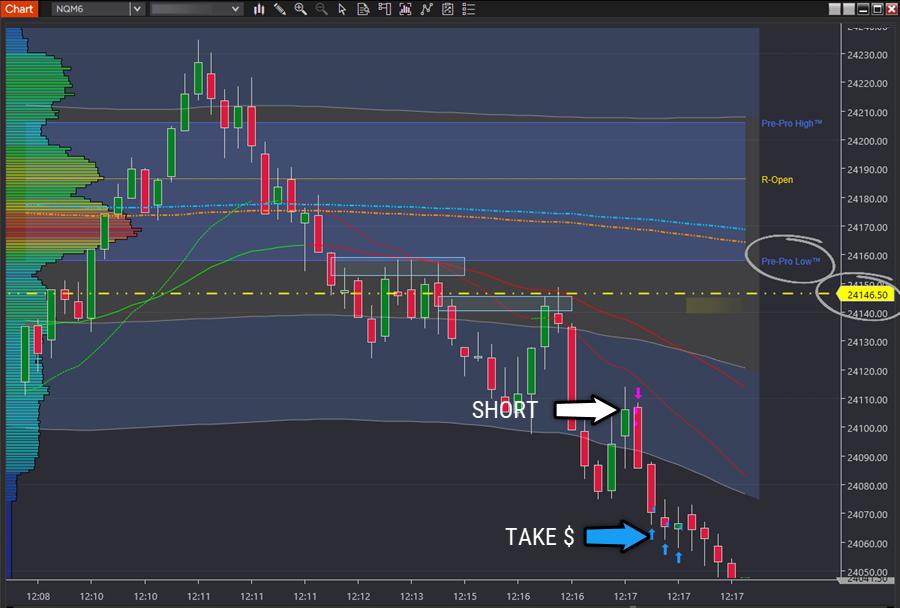
The charts show execution. The points of evidence and signature trade specifics that warranted the position aren't visible in price alone.
My trade took no heat and I was sized larger than the earlier trades because - even though I wasn't there right at the start - enough points of evidence warranted it.
The net result after this short period of trading was now $’4X’. Payouts vary based on sizing, which varies according to the situation and combination of variables involved.
Start with layups - easier and more frequent - develop reaction times and execution precision on them.
Yet most traders want to skip straight to the catalyst trades. That's Formula 1 before you can drive a sedan. Layups first, then Formula 1.
They see the news first, then try to position. By that point the preparation window on how to trade the move has closed.
The framework operates on a different information layer. One that reads conditions before events confirm them. August 2025 was the preparation. The Iran war was the confirmation. You're either positioned before the catalyst hits, or you're the fuel.