When The Party's Over
The party's over is a play on words for the outcome's known.
Although it's more of a nightmare for most and only a party for a few. But that party turns to a nightmare when you're not aware it's over.
Now I'm willing to bet I have way more information.
Let me rephrase that - I make financial bets on having way more information than other traders.
But it's not just information because trading is - far more than the industry tells you - a 'doing it' skill that takes repetition.
If you remember the first time you tried riding a bike, then you know there was a second, a third, then a fourth, and so on.
Which I mention because in 45 minutes of trading, there was a lot of doing, all underpinned by what other traders' actions reveal.
A cognitive bias humans fall into is assuming everything someone says is correct if they're an expert in a particular niche.
So when you hear: "The Nasdaq (NQ) is too efficient, so you can't make money trading it".
What they're meaning to say is complete distortions in price - extreme examples being Gamestop in 2021, or more recently, a 1000% increase over the last year in SK hynix that trades on the Korean exchange (they make memory that's likely in your computer) - index futures don't make these types of moves. They make a different kind.
The current market impact of AI is global.
The tech-heavy NQ futures play a role in hedging. You've got participation from all parts of the globe and flows into and out of different currencies. That's a lot of pulls on price, and pockets of inefficiency show up constantly.
Ever attended a party not knowing the theme or dress code? Or what about a party, and there was no one you knew?
You don't want to be that person at the party, or that trader in the market.
Where I've referenced the playing field concept before, you'll see it applies to NQ. You'll see buying and selling taking advantage of inefficiency. And in previous articles where I've referenced the concept of 'fuel', you'll see the role it plays.
In fact, all of the following relates to who the other traders in the market are and how they behave. People don't change, so you can apply 'people-based' trading to every market.
In the case of NQ, I only had to adjust for changes in volume, volatility and market pace. Tools in the Sentinel suite I built for these differences in character.
Intel, fuel and playing field.
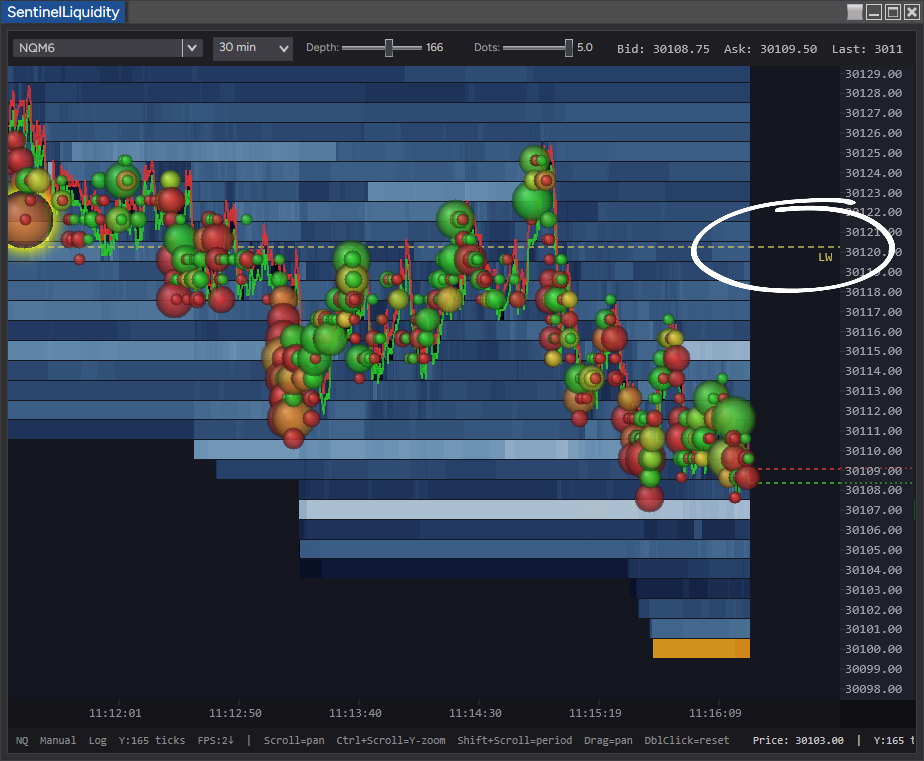
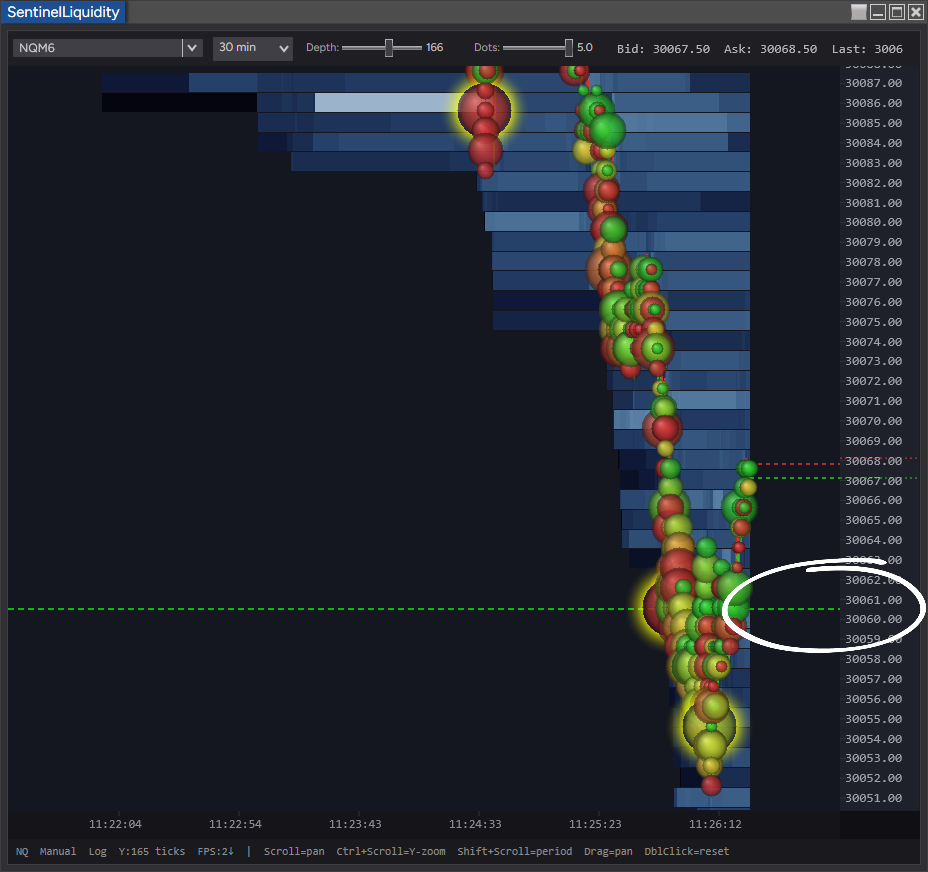
Notice the yellow dashed line below (white circle). I didn't have to add it to the chart below - that happens automatically when I notice it and mark it in my charts that focus on identifying current themes. Its colour tells me what it means. No looking up notes.
What's the dominant colour for the bubbles? It's green. It's telling me that despite buyers continuously lifting offers, they can't take the price above a level important to commercial and hedging participants.
But let's go back a little earlier...
The large green and red bubbles circled below occurred exactly at the price level just mentioned.
It's a large order because I have the tools to both add a yellow ring around the bubble to alert me visually, and an audio alert to announce 'NQ Large Trade'.
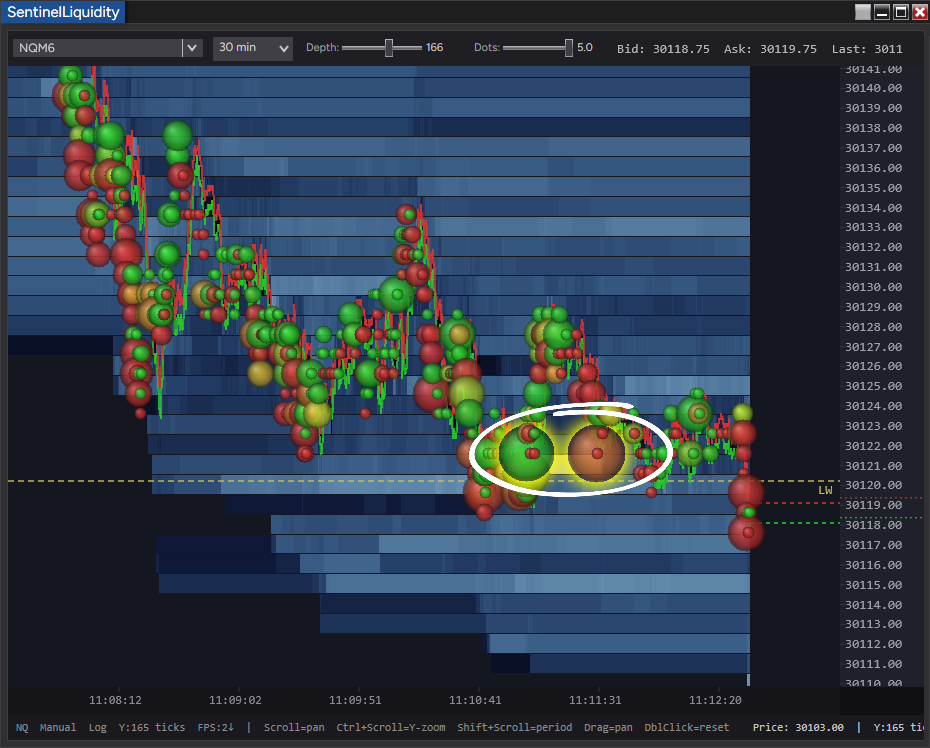
When a large player gets long at a key price in terms of market valuation and then bails moments later - what's that telling you?
They likely know what's about to take place, which is:
The market will trade lower. But not by a little. It will move too low for them to hold their position due to a lack of margin, and they can't sit through a drawdown. So they have no other choice but to exit.
Right now, I've got information that many of the buyers in the first screenshot aren't aware of. What you don't know will hurt you.
Now for the highlight of the party.
That seemingly unimportant green dashed line I've circled below - that's the edge of the playing field - a price identified much earlier in the session.
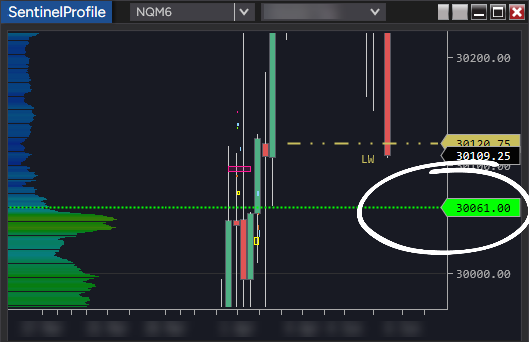
The colour signals the meaning. When monitoring the trade, wherever you look, there's a visual cue telling you when the trade is done.
And when the price reached the edge of the playing field, as per below, what do you notice? A ton of business was transacted as per all of those bubbles stacked on top of each other.
Again, it's knowing in advance what traders will do and where they will do it.
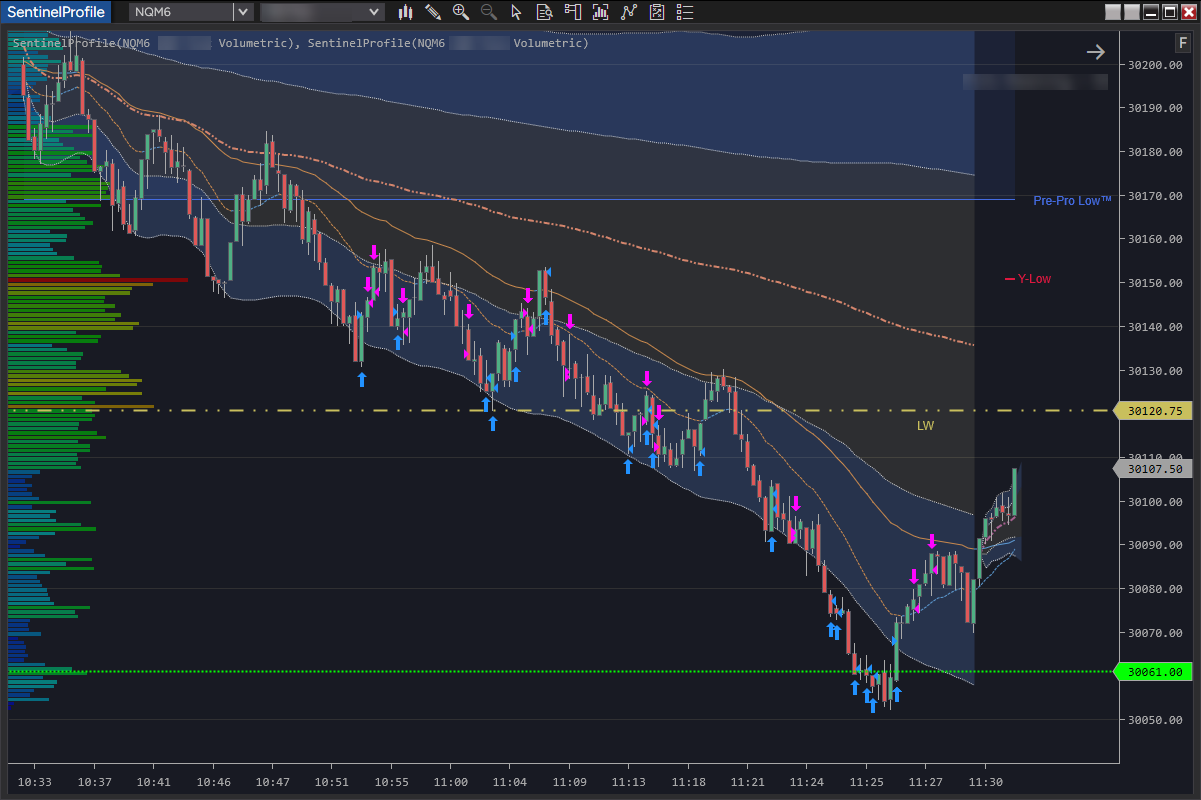
For reference, NQ moves in increments of USD 20 per point per lot. During 45 minutes of trading, NQ moved 100 points.
Even though there are some losing trades (see executions below) - you can get a good idea of the overall outcome. You can also see how the short trade ends with all the buying right at the edge of the playing field. Followed by a quick scalp long - a reflex action acting on the next playbook trade that showed up. (fuchsia = sell, blue = buy)
With so many decisions to make when trading, I want to offload the lion's share to the framework, like in the examples I highlighted above. Otherwise, I'm going to suffer from cognitive overload and lose money.
One of those decisions is counterintuitive. What I experienced for a long time was - when you're having a good run, it's natural to think: "I'm on a roll, I'll keep going here".
But what happens is you give everything back. In the case above, that's not chump change.
Yet if we get back to information and knowing more than all the buyers I was on the other side of, at some point, everyone starts to work out what's happening. The issue for them was that they worked it out too late.
I had the element of surprise working in my favour - information that other traders didn't have.
But once that element of surprise passes, and everyone can deduce what just happened, there's no competitive advantage.
The market is much tougher to trade, regardless of how much the market may or may not continue to move. As Dr Brett Steenbarger @steenbab says, "Not all movement is opportunity". It's only an opportunity to make a market donation.
There's also another consideration:
Trading like above is something I can't sustain for hours at a time, as it's mentally fatiguing. But I don't tend to feel tired until well after the mental impact has already hit.
That's why it's so important I don't trade once the outcome is known. It's the perfect time to take a break: 1. because the trading landscape changes, and 2. I need time to recharge. It might be an hour, it might be two. But then I'm as good to go as I was first thing.
First you have to do the reps - or you're screwed. When you've done the reps, other traders who haven't attempt to compete - and you simply take their money.
I dare anyone who hasn't done the reps to trade NQ and avoid getting pole-axed.
To accelerate those reps, I wanted to replay sessions using true historic bid-ask data beyond charts without the usual bottlenecks of software taking forever to load, commence, fast-forward, rewind etc. Which is why I developed SentinelProfile - months of developing and testing in the real market - but now playback is frictionless.
When the price is moving quickly, what are you monitoring beyond price?
When you're in a position and the price is moving quickly, your attention can collapse to only execution.
I developed a continuous seven-factor composite analysis that reports back the current rates of change of spread, market depth, price velocity and so on - a live picture of the market's behaviour as it relates to your current trade.
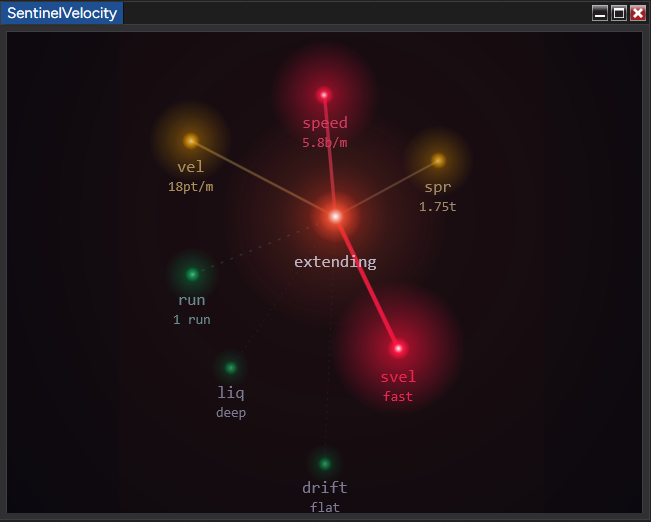
Sharpening perceptual cognition is just another form of information that other traders don't have.
Variants of market pace aren't openly discussed, and there certainly aren't any commercial tools available that measure them. So once again, it's about 'what do I know others don't, and how can you use that information to extract profits from the market.
When you look back at what got you into markets to begin with, you know there was a part of you that wanted to know what would happen next. You just need to narrow that down to what people will do next.