
The trade that suddenly takes three or four more entries
Performance psychologist to first-tier hedge funds, quant firms and discretionary trading firms, Dr Brett Steenbarger, wrote recently:
"One of the top psychological challenges I've seen from traders this year is frustration. Traders who kept doing what worked in the first part of the year became frustrated and discouraged (when either trend/momentum stopped working or those benefitting from relative value in stable interest rate regimes blew out)."
"My strategy stopped working" is one of the most common trading frustrations you hear about.
Yet, ironically, what tends to happen when things aren't working like they were is traders double down on these approaches, almost trying to force them into working. Often that's by increasing their trade size.
Why do we double down when something stops working?
We double down for very human reasons. Losses make us more willing to take risk to get back to even, past drawdowns taught us that persistence pays, and a strategy that worked for months becomes part of our identity.
"But you just focus on what works"
Nice one, Einstein, why didn't I think of that? Yet that's literally what you're told to do. The problem though is breadth.
Breadth refers to having a range of different strategies, playbook trades etc that let you first quickly recognise the market has changed and secondly move to a different means of taking money out of the market.
For example, right now there is a specific signature trade from my trading playbook - Predictable Efficiency - that's been working exceptionally well, showing up several times a day, every day for months now.
But on Friday, on three occasions, it involved more effort. I had to re-enter and/or add to the trade where usually it's been a one-shot trade.
You can see this in the screenshots below of the Predictable Efficiency trades from Friday.
A couple of things to know about when you look at the charts:
They use a brick style of bar, not a time/trade/volume bar so they look unconventional.
Even though I place trades in NQ, in the background they're automatically routed to MNQ.
MNQ executions are then automatically displayed on a chart of NQ.
You can see in the trade outcome boxes how many times I had to re-enter into each trade.
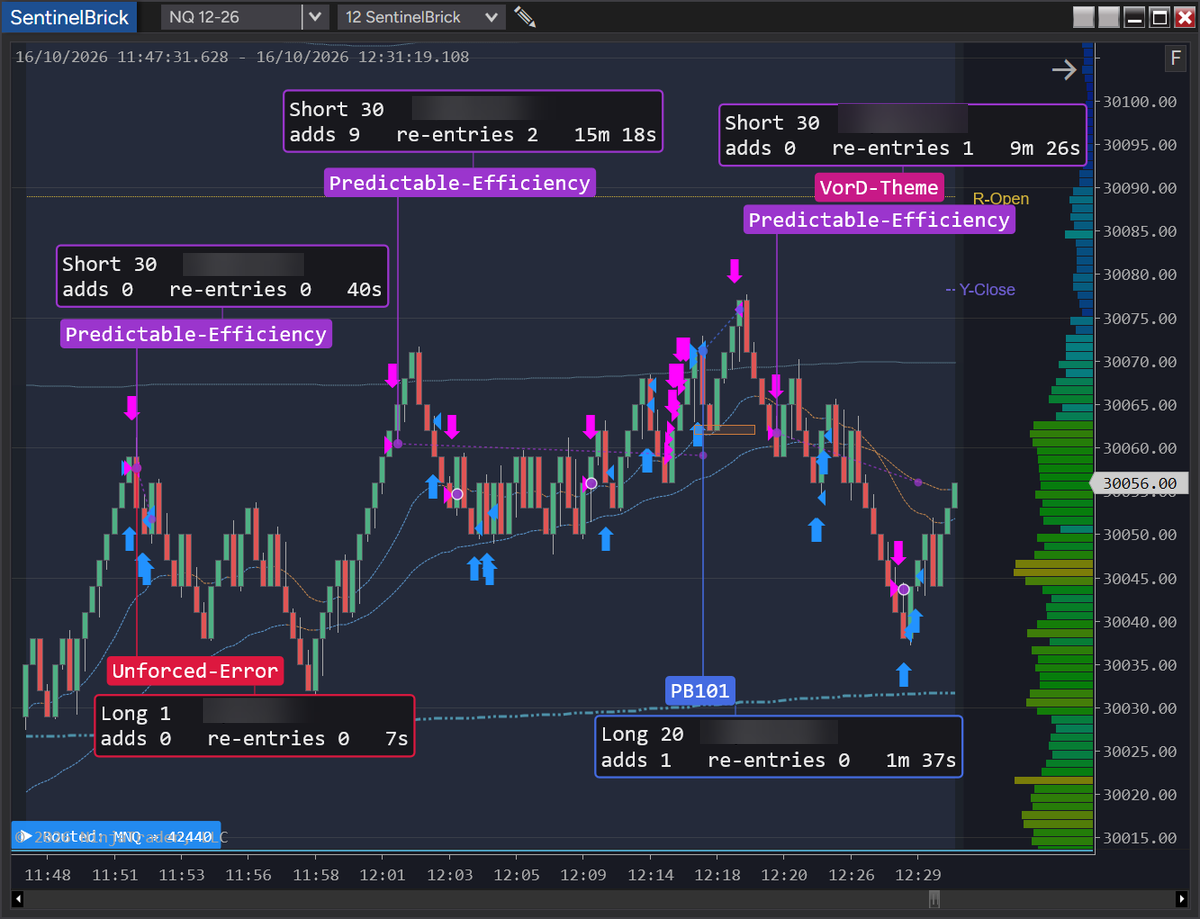
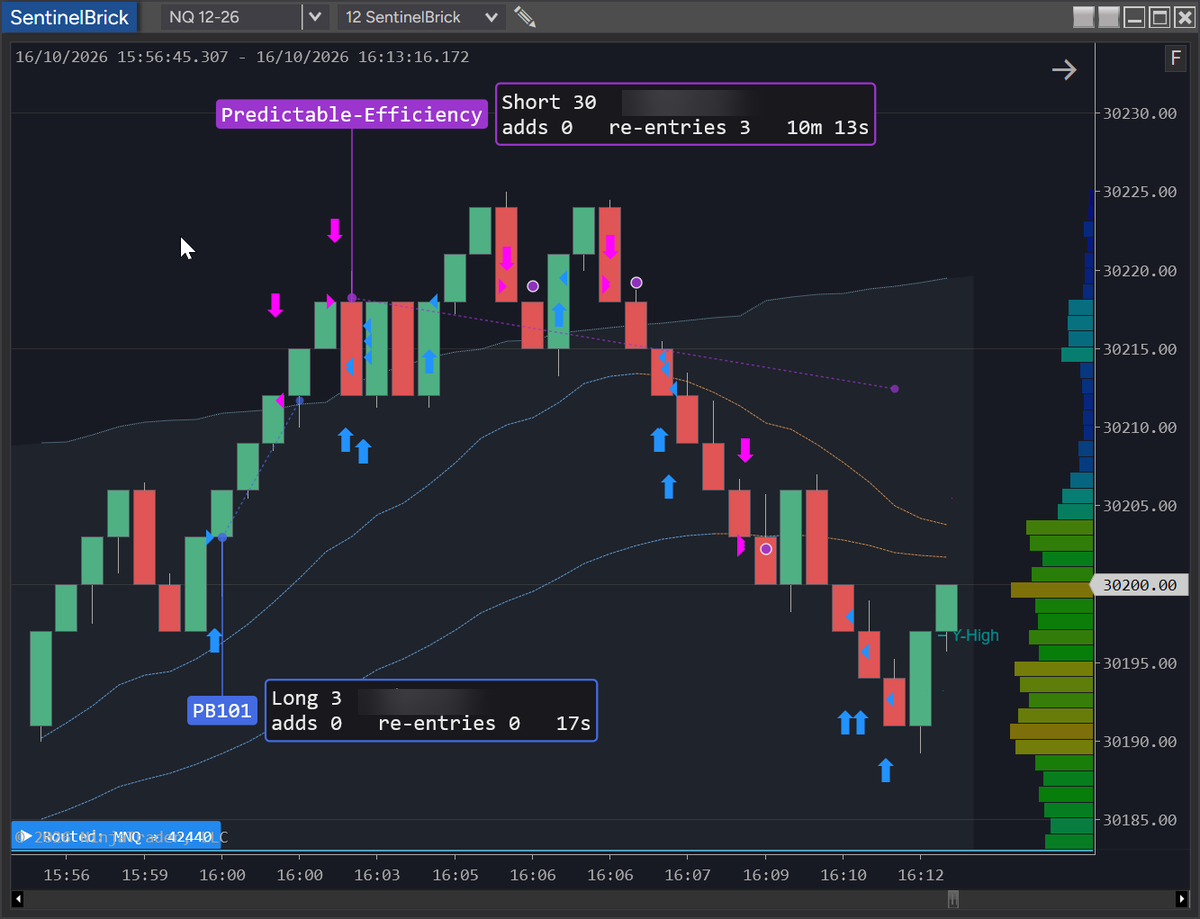
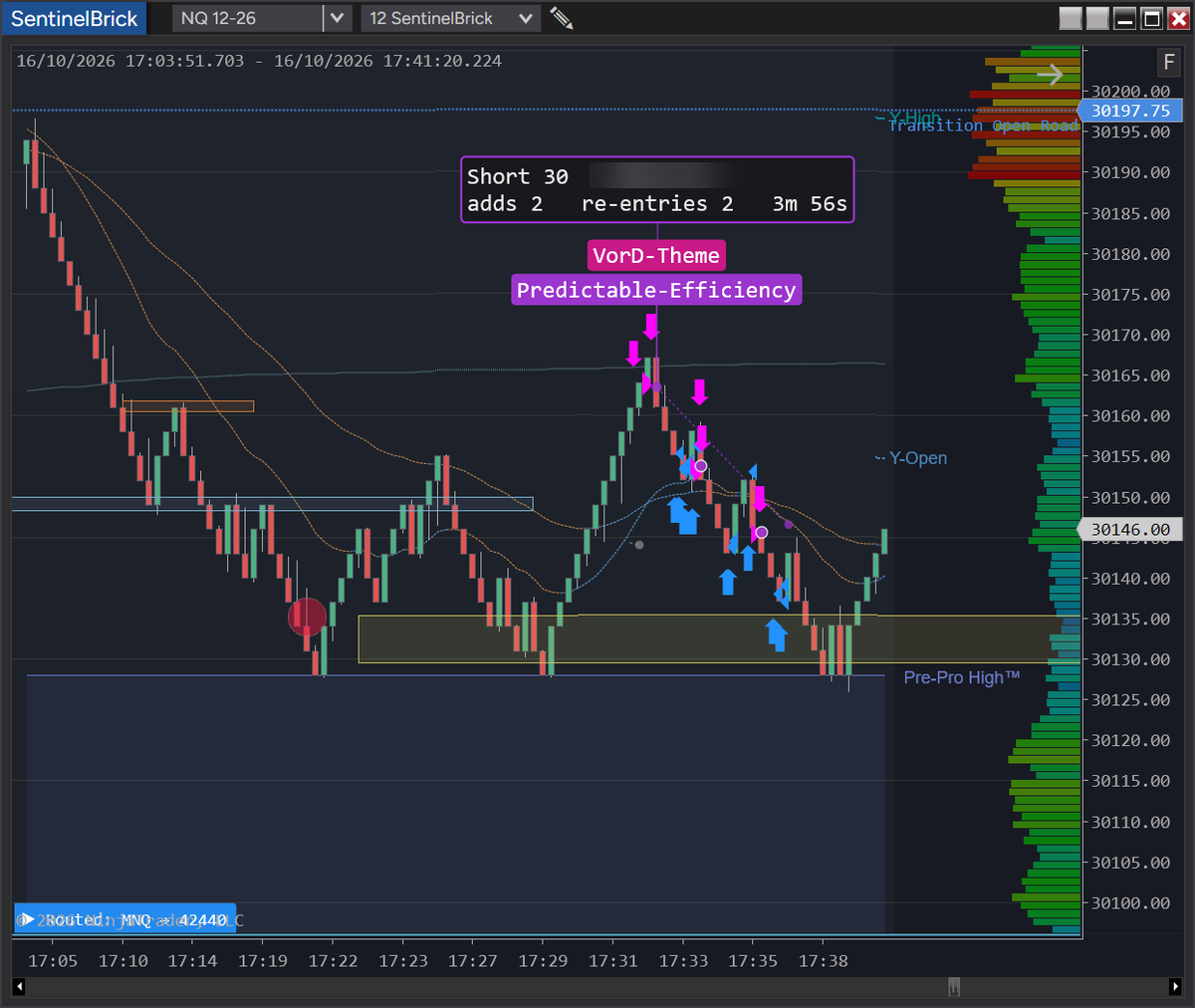
Every buy (blue) and sell (fuchsia) is recorded in your account as an individual trade, making it a complete nightmare to work out what's what when going over all your executions.
Far more logical, easier to manage and easier to see how different playbook trades are performing is when all the buys and sells that pertain to a single signature trade are grouped together.
Of course, it required developing it myself as it doesn't already exist. No wonder people don't like going over their trading data because often it's all so confusing and complicated to see which trades are working more than others, which are becoming less effective and so on.
The point about the trades becoming more involved is that this could be the start of this trade becoming less and less efficient to implement.
The extra commissions, the increased chance of making an error - if this continues like this - it's going to be a trade I seldom will take.
But what I won't do is double down my efforts because there's no need to. I don't feel like I need to dig my heels in, take on more risk and expose myself to the very real risk of giving back all the profits from a trade that has been well worth taking.
There are two things I can immediately do as of now. First, reduce the size on Predictable Efficiency playbook trades until it returns to the one-shot trade and, secondly, turn my attention to other trades. I'm after low-hanging fruit, because where there's an easier way I'll take it.
In the current market, breadth of trades is the difference between coming out ahead and giving back all recent profitable trading from the first 9 months of the year - assuming you've been able to trade consistently profitably during this time.
Below is the complete list of signature trades in my playbook for trading NQ (MNQ). I also share these twenty-one trades with clients during Private Development, as well as the framework that underpins every trade. I also share what I just described - collating all buys and sells into each trade they're part of.
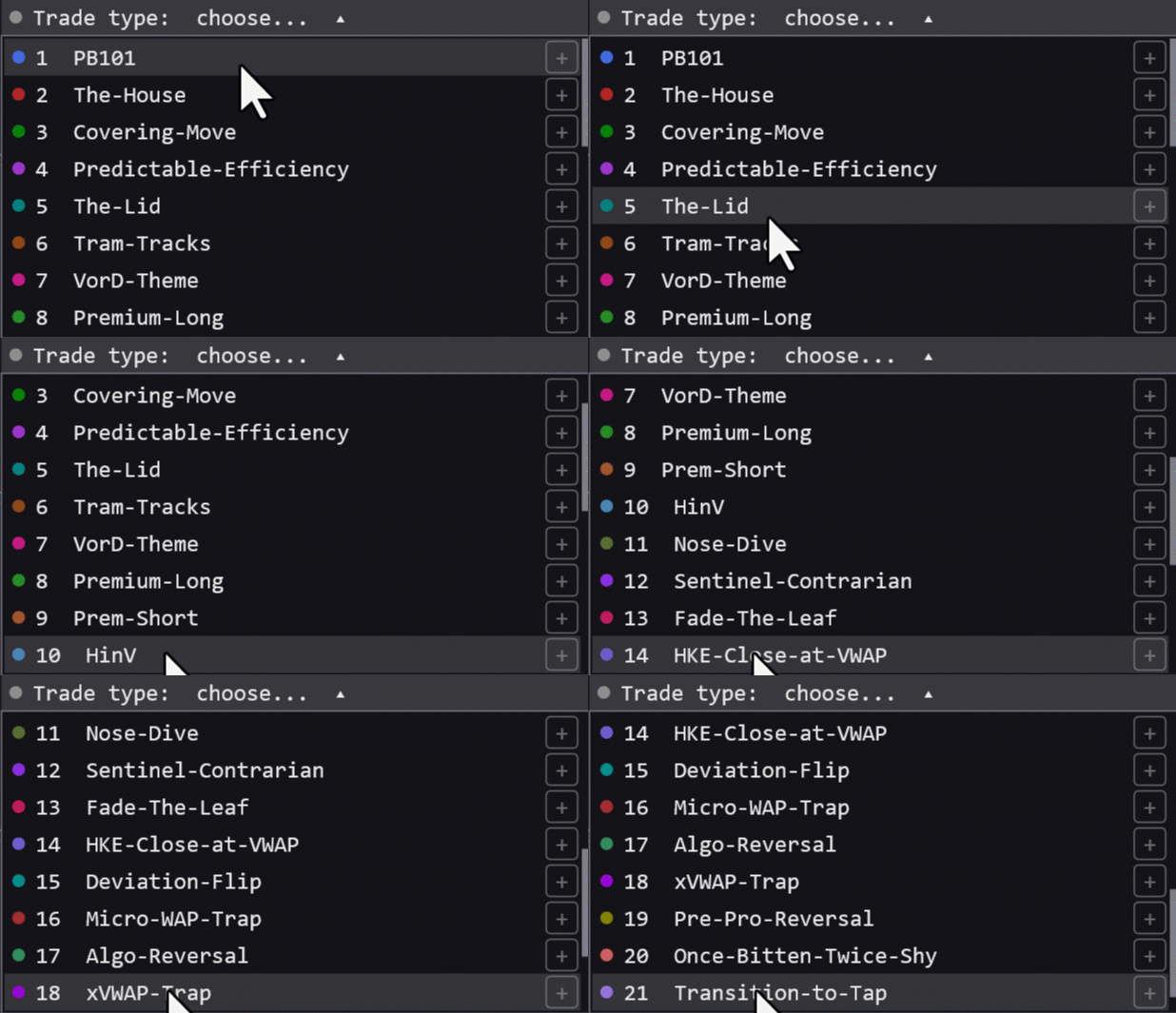
If you've ever developed a trade with positive expectancy, then you know that developing even just a handful takes years. A playbook of 21 trades can take six or seven years or more to develop.
It takes this long because positive expectancy trades that endure year after year are incredibly rare. That's why I refer to them as income-producing assets, and why I would never just 'hand them out freely' because they're simply far too valuable.
Anytime I see posts on social media that say something along the lines of 'profitable trading strategies are easy to find' or 'you can trade just about any strategy and be profitable' I know with 100% certainty whoever posts these comments can't trade. It's the 'tell me you can't trade without telling me you can't trade' meme.
Positive expectancy trades are so rare that the thousands of snake oil salespeople and businesses selling unprofitable trading courses, strategies and systems constantly tell their unhappy customers - 'it's not the strategy, it's your psychology that's the problem.' Hence, we've ended up with millions of traders obsessed with fixing their psychology when the issue is upstream.
Blaming psychology isn't something you see on a professional trading desk, whether that's my experience or the same anecdotal evidence you hear from other traders who traded on one.
The market is not as rosy as it appears.
Stock market indexes have looked healthy this year.
But look under the hood and you see the S&P 500 finished Q3 only 2% below its 52-week high, held up by a small group of AI-linked megacaps, while 83% of its members were more than 10% below their own 52-week highs and 42% were down more than 20%. Source: Nasdaq
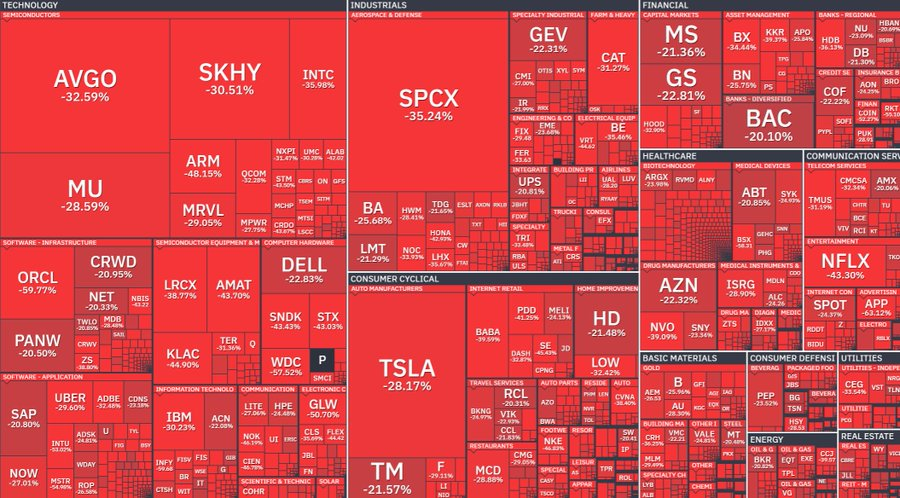
Image provided by finviz.com
I reference this because a popular account on X posted last Monday, "It's easy to make money trading!". Numerous replies echoed the same thing. It's been a consistent theme - just buy the dip after any sell-off.
But last week we witnessed a 1,121-point Nasdaq panic sell-off triggered by the scorching PPI print (headline +6.3% YoY, every line a big beat) plus retail sales coming in hot, all piling on top of the hot CPI from the day before. AI stocks led the sell-off.
Now the debt market is doubting whether the heavily indebted companies behind the AI buildout can meet their obligations. CoreWeave, an AI infrastructure darling, is the clearest example. Its bond yields have surged above 15%, a level typically associated with financial distress, its shares fell more than 15% in a single session, and credit-default swaps are pricing a better than 50% chance of default within five years. As they say, where there's smoke there's fire, and smoke can turn into a wildfire. If it does, the indexes sell off hard and buying the dip stops working. Source: Barchart
The 'trading account is easy' poster hasn't been heard from since.
Trading is many things, but easy isn't one of them. But making it less hard is where we focus our attention, and that means having an arsenal of trades available to trade the different market environments, including any outlier drops in the indexes.
These large sell-offs typically move across time zones, so you can spot them while they're occurring. There were tells as early as two weeks ago that this was likely to come. A comprehensive framework will bring these tells to your attention, so you're waiting for it to show up, not predicting when it will happen.
But when it does show up, you're not caught by surprise - it's 'finally, here it is' and you go to work on it. Your framework and playbook of trades provide you with the mechanism to monetise what's happening. It's no different to trading any other day, other than the playbook trades are paying out more than on a typical day, and they're occurring more frequently. Instead of a mix of long and short trades, which is typical of most trading days, these are all in the same direction. That in itself is saying to you: this is a strong directional day.
Breadth of trades means you're not backed into a corner trying to force trades that don't work in the current environment.
A trader lacking breadth in their trading is caught two ways. First, they can't trade profitably when the market changes. Second, it's only when you have breadth that you can identify the changes, otherwise you get trapped making the wrong trade over and over until the beating your account takes is screaming things have changed.
There's nothing worse than watching an extreme market event from the sidelines. These are the times when you can come to the market with the skills to take advantage of an opportunity that might not come around again for years.