Nobody Asks Traders How They Think
"Now do it again. But don't try as hard."
Okay?
Ashtanga yoga isn't 'class-led '. Instead, it's the same sequence of postures every session. How much of the sequence you do each day depends on your capability - interesting fact: Paul Tudor Jones has reached quite an advanced level.
After 4 weeks of beginner training, I was finally able to do a sequence of Ashtanga yoga.
And on completing my sequence, hearing '...don't try as hard', I took it as don't force anything. Which you're not supposed to do, so it's a factual statement. But I didn't make the connection to the underlying message. I still wasn't thinking about yoga correctly.
Fast forward seven weeks, I had the chance to attend a workshop with Peter Sanson - globally recognised not because of how advanced he is - that's a given - but because of his skill in conveying his deep understanding. When he conveys a concept, you 'get it'.
As soon as I heard it, my mind went straight to 'oh, that's trading.'
I doubt I'd have made the same connection seven weeks earlier. By the workshop I'd repeated the chain of postures so many times I was far more aware of what I was doing.
Having practised 6 days a week for over 40 years, reaching his arms up and folding over from the standing position, Peter's been able to 'touch his toes' hundreds of thousands of times.
Yet when he first folds over, he said he has no idea if 'this time' he'll reach the floor. Instead, he folds over gently and lets his body tell him how far it can go, in this moment. Zero expectation. Zero focus on the outcome. And that approach applies to every single posture.
So of course, now that I knew the correct way to think about my practice, I only ever listened to my body and let it tell me how far I could twist, bend, stretch and manoeuvre while focusing on my breath and engaging mula bandha and uddiyana bandha at the same time. Except changing your thinking doesn't really work like that.
The instinct that "understanding comes first, then behaviour follows" is intuitive, but it's backwards for most skill acquisition.
You don't get the new identity first and then start acting like it - you act like it, over and over, until it's not acting any more. It's just who you are.
You notice it listening to or reading interviews with successful traders. Nobody's asking them how they think. It comes through anyway, and it's clearly different to the majority of what we're familiar with.
It's a wonder the industry doesn't promote these mental models, opting instead for 'you don't need a new strategy, you need to work on your psychology' and other such banal 'advice'.
So what does correct thinking look like?
Here's one. 'I trade to make money.' You don't. You trade to take money from whoever's on the other side. Sounds like a technicality, until you follow it through: a trade everyone can see coming is a trade nobody's paying you for.
It's easier to understand with a sporting analogy. Every season the top team plays the bottom team at some point. In a year where the top side is several games clear of the next best, and the bottom side several games worse than the next worst, it's extremely high odds the better team wins, and by a thumping margin.
But do you put a bet on it? No, because it's so crowded the bet barely pays. And there's still the fat tail risk - half the squad down with food poisoning on game day - so you can't mortgage the house on it either, even with such high odds, because the risk to return is so poor.
The only trade worth taking is the uncrowded one. But as a newbie I didn't know this. I thought if a trade worked it was because I did such a good job of my analysis - when in fact it was a random outcome on a 50/50 coin toss. All the trading literature said set your reward higher than your risk, and I was naïve enough to think doing that meant I was doing everything right. But risk-to-reward is only one part of the equation. Even today, go onto any social media thread, and the answer to all your trading problems is risk management and psychology.
I wasn't thinking positive expectancy, a playbook of very specific trades you can repeat, knowing who you're trading against and taking money from, what an uncrowded trade is - and that's nowhere near the full list. I needed access to the right sources of knowledge, and that only came when I entered the industry.
Back to the yoga mat. There's criticism that Ashtanga leads to injuries. But it's not the practice causing the injuries - it's the wrong thinking applied to it. You never push your body beyond what it's capable of 'today' when your thinking is correct.
The problem with much of trading coaching and courses is the assumption you've already got the correct thinking. But how do you distil it correctly?
If it's too specific it's just a checklist with no room to build judgement, interpretation and understanding. Too vague and it's philosophy, not something practical, nothing repeatable.
A framework is the middle ground. Specific enough to give you steps to work through. Structured, but it doesn't connect the dots for you. You do.
Can you get it wrong? You will at first. Interpreting data is its own skill set, same as anything else - you're going to misread it before you get good at it.
That's the difference between a checklist and a framework. A checklist is rigid. Markets aren't - they're ebbing and flowing, constantly changing, and a fixed set of rules fails.
A framework tells you what to look for and where to find it, so you have the full context to find asymmetric trading opportunities. And once you know every part of it, most of what you're covering isn't new information. It's confirmation, each piece lining up with what the rest of the data's already telling you.
Add a playbook of ultra-specific trades on top of that, and you're not just seeing the opportunity - you're watching for confirmation it's real. One of your signature trades shows up, and you act exactly the way that trade's meant to be played. That takes the mystery out of what your trading day looks like, right down to the specifics of each trade.
You've moved most of the decision-making onto your framework. Imagine what that does for your moment-to-moment experience in front of the screens.
For the successful trader, a framework is control in the chaos. A large component of decision-making is done; you're making fewer real-time decisions. You understand the context, so the market can move without overwhelming you.
By moving decisions into the framework, you're mentally fuelled to focus on finer, real-time details of your trade. It's less mentally draining, and you'll find your decision quality isn't being handicapped.
For the developing trader, it works differently. You don't change your thinking by trying to think differently. Your thinking changes through doing something based on a different way of seeing the market. Do it enough times and those guidelines become how you naturally see the market.
But what's going to keep me doing it?
Too often you expect to see proof you're making progress.
Not seeing it depletes your enthusiasm and motivation, not the difficulty of the work itself.
Trading involves interconnected skills, and only when they're all combined do you see the outcome - until then, the progress remains hidden.
Remember The Karate Kid. "Wax on, wax off." "Paint the fence." "Sand the floor." Daniel questioning why, convinced none of it has anything to do with karate, convinced it's just free labour. Hidden progress at work.
The progress is there, though. Go back and rewatch a session you've traded and the market feels noticeably slower than you remember it. That's familiarity, and it shows up after a single rewatch. Run the same framework and the same playbook trades every day, and that slowing effect becomes how the market actually feels to you.
Experience this, and you've got the time to take in more. You see more connections you didn't before. You notice more opportunities.
Friction
Over the years I've seen first-hand what looks like a minor annoyance in a trading platform create enough friction that trading loses an element of fun - fighting software that's annoying you.
A few too many 'clicks' and you miss a trade.
Daylight saving shifts and you forget the US equities pre-market open has moved, then get caught out with a losing trade.
Trying to line up a specific period of market data with the window boundaries just to see a calculation for that period.
Wanting colour differentiation across your drawing shapes so your charts don't turn into clutter you forget the meaning of, except making those changes every single time is a PIA.
Having to go into settings and drop-down menus for a custom chart bar type.
Accidentally closing a window of tabbed charts, and having to reload each individually instead of just 'open tabbed-layout'.
Loading a chart and everything slows down, or pauses for minutes, for no reason.
Add them all up over a day, it's friction. And this is by no means an exhaustive list.
Friction leads to skipping steps of the framework.
Particularly before the thinking has changed, it's easy to tell yourself 'how bad can it really be if I skip this bit?'
The impact isn't immediate. It's hidden regression, and that gap creates a false sense of "I probably don't need to do that any more."
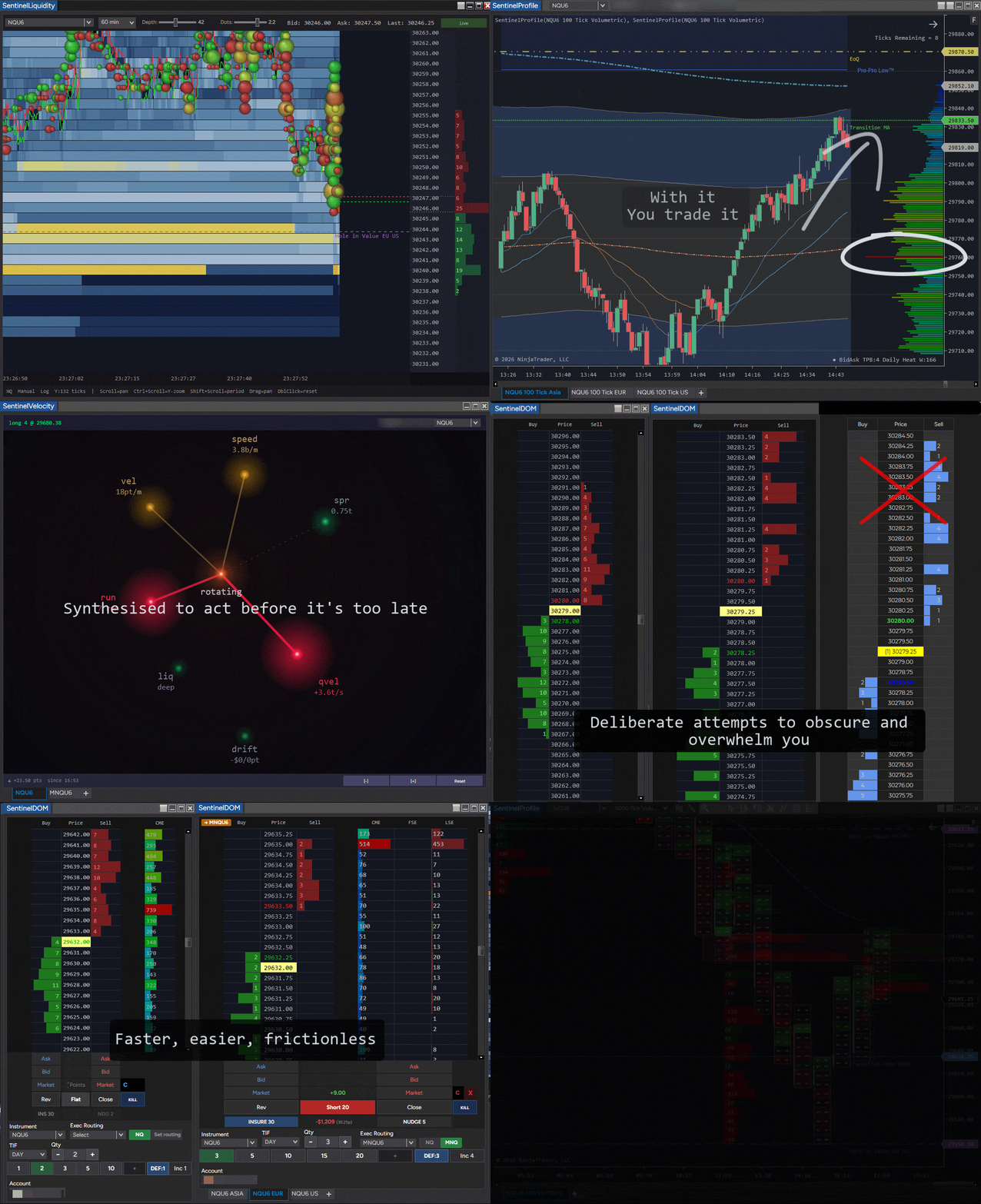
So starting last August, I've been addressing the points of friction with custom-developed tools to solve all points above and more - like tools that overlay the framework onto all of your charts and windows, to make the day-to-day interactions friction-free. Announcements to remind you XYZ market is opening, and tools genuinely designed to improve your trading.
Less time fighting a trading platform means more reps of the framework itself each day.