
AI Puts AI out of business
45% of the S&P 500 is one enormous bet on AI. No big deal?
How about AI-linked debt is $1.4 trillion. One in every seven dollars of corporate debt is for AI. Regardless of whether the bet works out, the debt has to be repaid.
But this isn't a doomsday post - it's a trader's opportunity post.
During the GFC, I was trading for wholesale clients.
I'd migrated from stocks to predominantly ETFs. And as ETFs were new to my local market, I traded the wide range of US-listed ETFs to express trade ideas in emerging markets, oil, etc.
I took advantage of my options accreditations to massage my predominantly long-only trading. I was an end-of-day trader.
But when the GFC really started to rock the markets - I'd see these mind-blowing intraday moves.
I can still see the capitulation price plunges when banks were dumping customers' stocks whose accounts triggered margin calls.
What really stung was even though I could see it happening, I lacked the knowledge and skills to trade the intraday ecosystem.
I swore I wouldn't miss the next major global sell-off - because for many - they are life-changing trading opportunities.
And I don't mean a blip like COVID. I mean a genuine reset after nearly two decades of 'just buy dips, and you're golden', much of it on you guessed it, margin.
But as I said, this isn't a doomsday post.
Right now, the global yardstick for AI investment is the Nasdaq (NQ). You only have to see how it moves during the Asian time zone any time Asian AI 'darlings' Samsung and SK Hynix are having huge intraday moves.
There's still so much euphoria globally around AI that we're seeing 10 times the intraday trading opportunities beyond what I can possibly participate in a day.
So often you complete a sequence of trades and recognise it's time to take a break to recharge - but before you even get out of your seat - NQ is off again on yet another run.
But it's different this time... or is it.
History tells us most of the companies that built the great transformative technologies went broke, even while the tech itself changed the world.
Hundreds of railways went under in the 1840s. Of the 200-odd carmakers around in the early days, nearly all vanished. Dozens of aircraft makers shrank down to basically two. And the dot-com lot who laid the actual cables for the internet ended up bankrupt.
The world gets the benefit. The people who paid for it usually don't. Whether the technology wins and whether the bet pays off are two very different things.
AI puts AI out of business
In the chart below you can see token prices falling. A token is just how AI companies charge for their work - every chunk of text in or out is billed by the token, like a taxi charging by the meter.
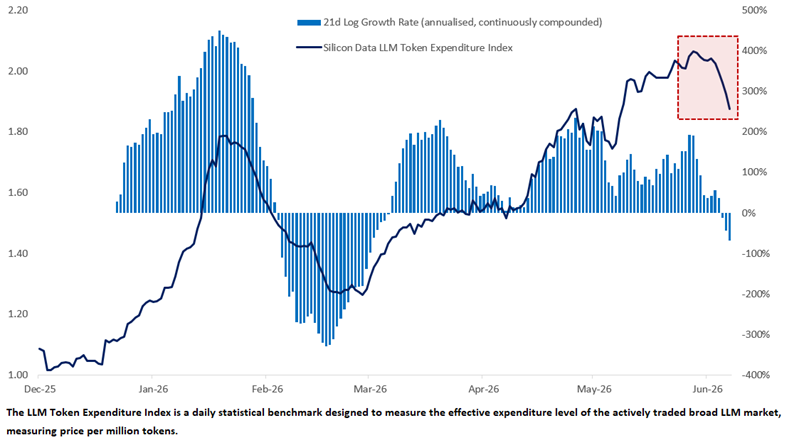
Source CITADEL
The most advanced (and most expensive) AI model available is Anthropic's Fable. But only days after release the US Government banned it, so less revenue there (not nil revenue, but that's another story).
So with Fable not-so-available, the 'frontier' models - as they're referred to - are from US companies Anthropic (Claude) and OpenAI (GPT) whose combined debt runs into the tens of billions and is climbing. But Chinese models are hot on their heels.
The models are converging
The newest Chinese models GLM-5.2 and Kimi K2.7 both dropped two weeks ago while DeepSeek V4 dropped in April.
These models are open weight (meaning anyone can download and run them for free, provided they have the required hardware.
All three are up to 80% capable of available US frontier models, but much cheaper.
Kimi K2.7 does the same job on around 30% fewer reasoning tokens than its predecessor, and DeepSeek (subsidised by the Chinese Government) has been undercutting everyone since release, costing about one-hundredth of the available US frontier models. Kimi 2.7 and GLM 5.2 are about 1/50 the price.
Note: In my experience the performance comparison is not 80%, but my use case is likely not typical and I'm a sample size of one. Also, the other recognised open weight Chinese model is Alibaba's Qwen, while Google offers a range of variants of an open weight model Gemma, but I don't have direct experience with either.
Personal experience aside, for the majority of how AI is currently used - these models are more than capable, hence why people are moving to them for the cost savings, or (as I do) splitting tasks across models.
US redundancies that cleared the way for AI have, in many cases, been reversed because US AI is expensive.
Someone posted on X this week: "10x better ROI from a $19/hour virtual assistant than $4,000 in AI tools. It just doesn't get you the hype on X"
Markets are forward-looking
Right now, markets are pricing in one version of the future. Based on everything covered above, there are good reasons to think that version gets challenged.
The opportunity in NQ today isn't a bear market thesis - it's a volatility thesis.
A market this concentrated, this stretched, and this sensitive to narrative shifts is going to move hard and often. Every data point that challenges the AI story impacts NQ, which hasn't priced in any doubt to the upside. You get sharp, fast repricing as a result.
That's serious opportunity, provided you have a proven framework and signature trades that are second nature - meaning you've done them enough times you're no longer making the normal errors of attempting something new.
The NQ trades that follow use the same framework I've used for over a decade, other than minor improvements in line with increased experience. The playbook trades are also not new, just adjusted to NQ's personality.
What's interesting is it's so common to hear "my strategy stopped working". But because my primary focus is taking the other side of traders forced to exit, I have never suffered this common complaint.
Why? Because markets are counterintuitive, and people don't change. There is a never-ending cycle of traders forced to exit on all sorts of time horizons.
Yet even though it's the same thing I'm doing, I still had to repeat the 'doing' side of trading to get comfortable with NQ's idiosyncrasies. I say comfortable, because it's not about being perfect. Just look at my first mistake.
Signature trade: Predictable Efficiency / Once Bitten Twice Shy
The price range in the chart below is 100 points. I use dynamic sizing (number of lots varies depending on the signature trade). Whether it’s a move of 8-12 points, 16-23, 5-9, etc., it quickly adds up.
I made several mistakes (unforced errors) on the very first long trade, leading to a loss.
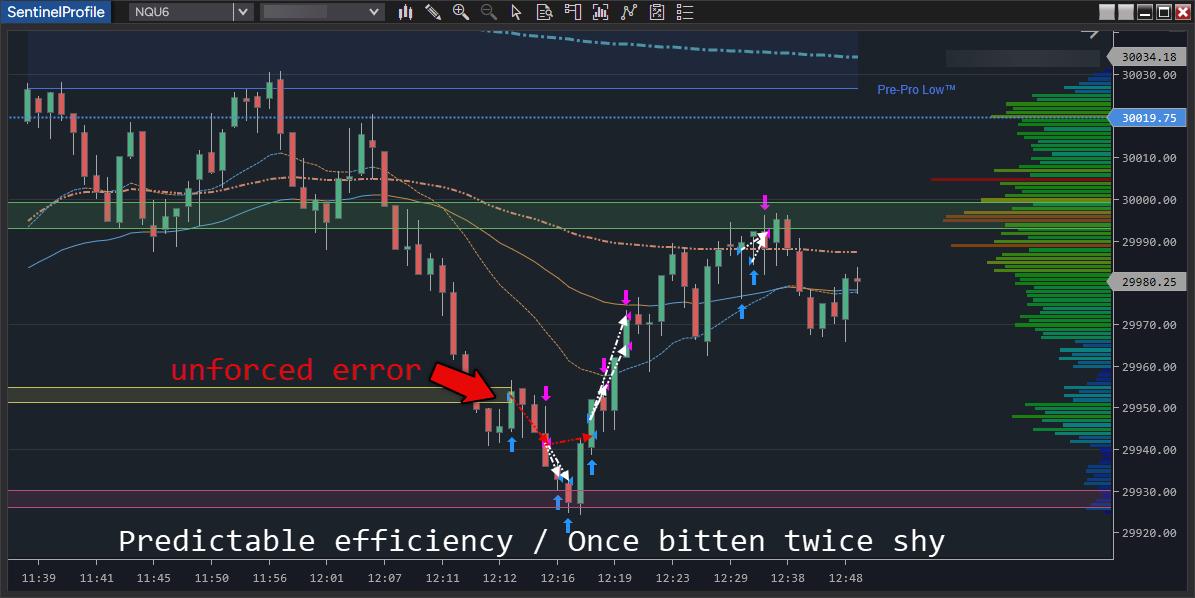
I'll cover the third mistake first. Once I realised my error, I immediately reversed my long position because being short was the trade I should have taken.
But by the time I entered short, there wasn't much opportunity remaining. I was very late into the move, so the odds are not outstanding, and you must size down.
But worse, I didn't give myself the chance to get a far better entry into the next long trade - an A+ signature trade which calls for much larger size - because I was too busy managing an almost scalp-like short, which I partially lost anyway.
So I turned a great pay-out opportunity into a nothing-special winner, because my entry was way too late to go in with the typical A+ size.
Anyway, as the name says, this trade combines two signature trades in one - the 'Predictable Efficiency' and 'Once Bitten Twice Shy' signature trades from the playbook.
I referenced human behaviour earlier. That reddish band that marks the price low is where many short traders entered their positions.
They've already endured maximum pain (100 points of it), so what do they do? They start praying to a higher God, promising if they can exit at break even, they'll never hold onto such a big loser ever again. Sound familiar?
I bet this does too. But once price gets back to break-even - that promise they made suddenly turns to - "Hey, I was right all along - I'm not getting out now - I'm about to make a killing".
But once the break-even escape hatch closes, and price starts heading back against them - there's no way they're going to endure all that pain a second time - and you get a strong covering move as they run for the exits. So strong, provided you enter early, the trade goes in your favour immediately, which is why you can put on much more size.
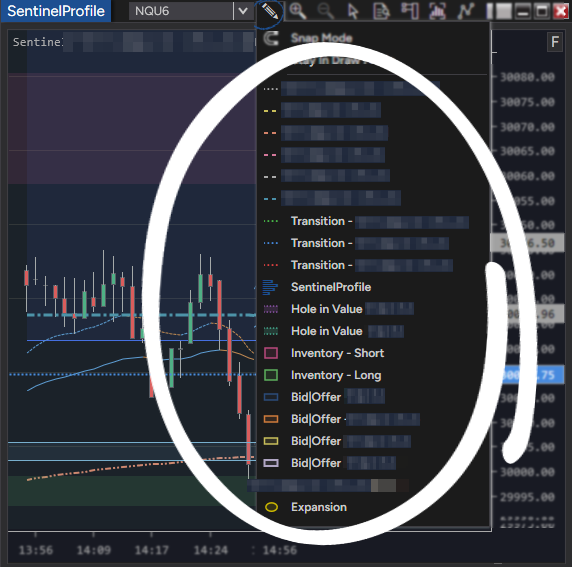
Now as an aside, you might think it's a colossal pain in the bum adding all the different coloured markings on the chart. But they're all added at the planning stage, with each having a specific meaning.
In the image below, you see a drop-down menu of 20 custom drawing tools to choose from. Some names are obfuscated, but I'm sure you recognise how they make not just planning, but also taking trades from your playback, so much easier.
Your brain can process colours and shapes 10 times faster than reading a description. And with all that information in front of you, you don't overlook key aspects of your planning.
Back to the trading errors.
If you look at the chart below, you'll see from this view, the market is displaying a behaviour of the BR Tram Track signature trade.
Without going into specifics, it's clearly not a market to fade at the white arrow - the exact point where I did indeed go long.
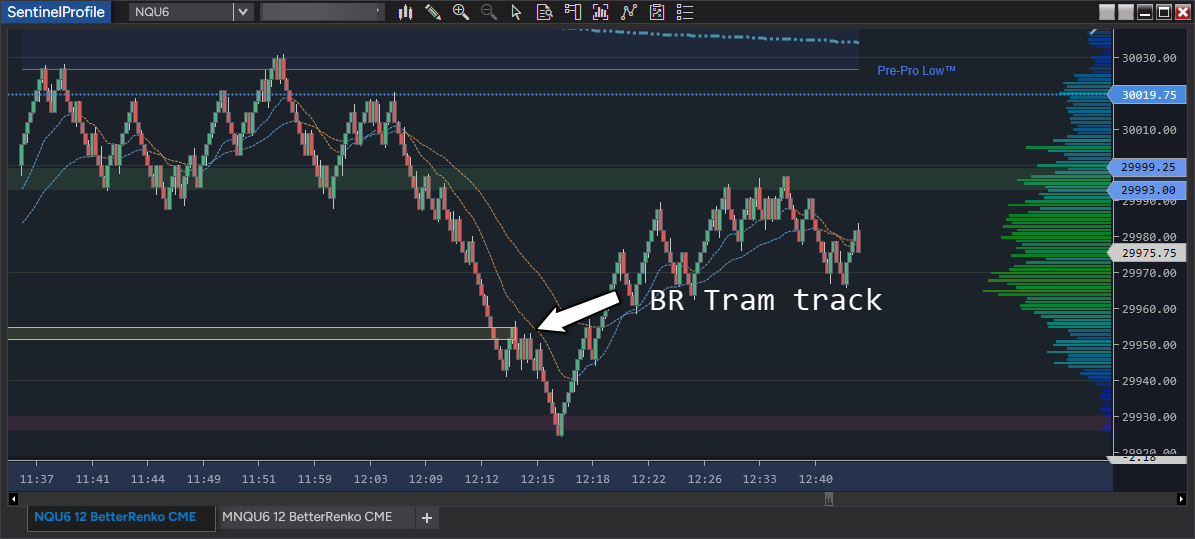
Even with skipping the final error, you can see how using multiple points of evidence improves odds and - excluding unforced errors,In keep you out of poor odds trades.
In the next chart, only a couple of hours later we have three more signature trades.
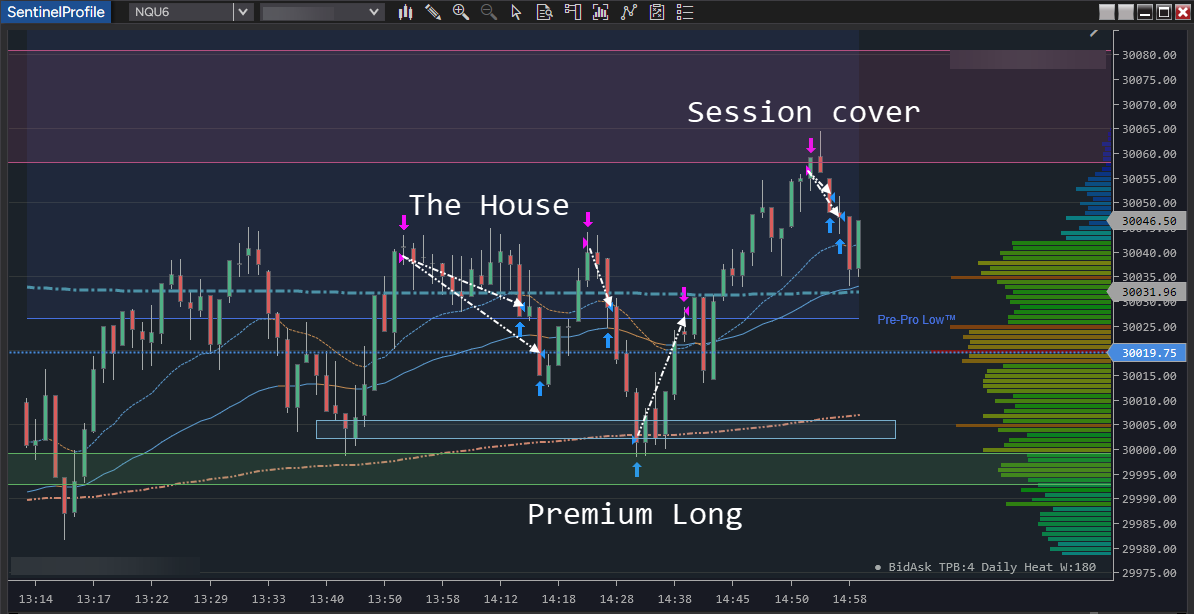
The House signature trade appears to be 'top picking' so I want to provide some context.
In the screenshot of SentinelLiquidity, there's a 'slider' to adjust the size of the bubbles. I've got the setting almost at maximum size, yet the bubbles still appear really small.
The bubble size is a reference to the volume, so in this case price is spiking up on mostly just air and no substance.
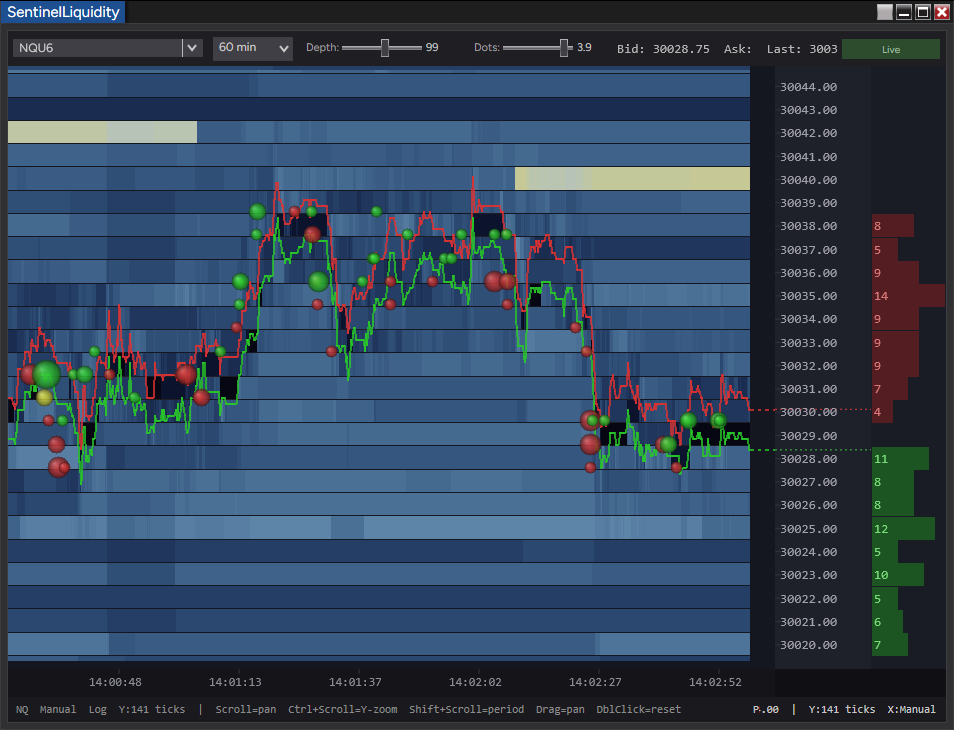
Where I see the biggest benefit to your trading is if you can see price move up on virtually no volume, you know it's a BS move, and it's coming back again. That should be enough to stop FOMO chasing.
Which leaves one option: fade it. Capacity constraints apply, but NQ always moves.
Yet sooner or later, as is the case with NQ, a trade that does warrant size comes along - the Premium Long signature trade. I won't cover why I exited where I did (it's all framework and odds-based).
And for the final trade - the Session Cover signature trade - it takes advantage of traders forced to act based on the clock. I'm also leaning on another large group of short traders. Once again, multiple points of evidence improve the odds of success.
If you think of the game Space Invaders, those blocks of inventory are like the protective shields you're given when the game first starts.
The enemy keeps firing at them until they're destroyed, and you see the same behaviour in the market. For the market to get through, it has to first 'destroy' those blocks of existing positions.
The trades above represent a small subset of a day's trading to highlight the scope of variety and opportunity there is each day. The above represents a couple of hours. The whole day is a smorgasbord.
I swore I wouldn't miss the next major market event - and I'm not. You don't have to either.
Related reading: I wrote a fortnight ago about why I'd moved to trading the Nasdaq futures (NQ): https://bosstrading.com.au/blog-trading-guides/when-the-partys-over