
Where Inefficiency Traders Crave Runs Rampant
It's a meaningless almost invisible 'blip' isn't it.
(You might have to zoom in to see it)
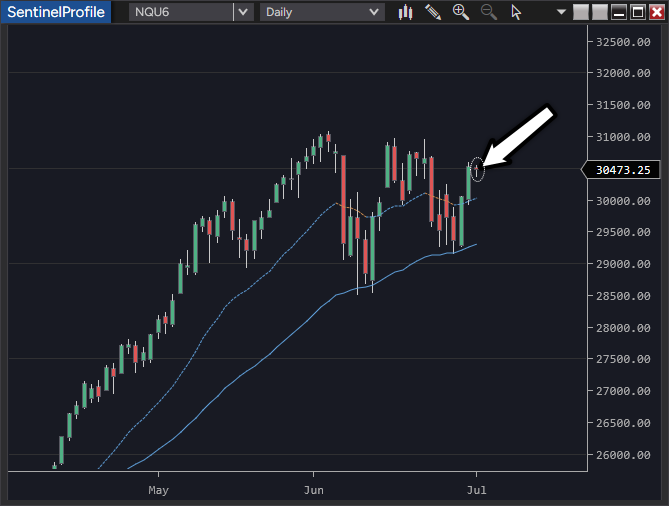
I took the above daily chart screenshot during the Asian session July 1. If you only look at daily charts, you see this and its 'nothing here, next'.
But when you look at the intraday ecosystem for the blip, you see a move of 180 points down followed by 110 points up - 290 points total movement in only 40 minutes.
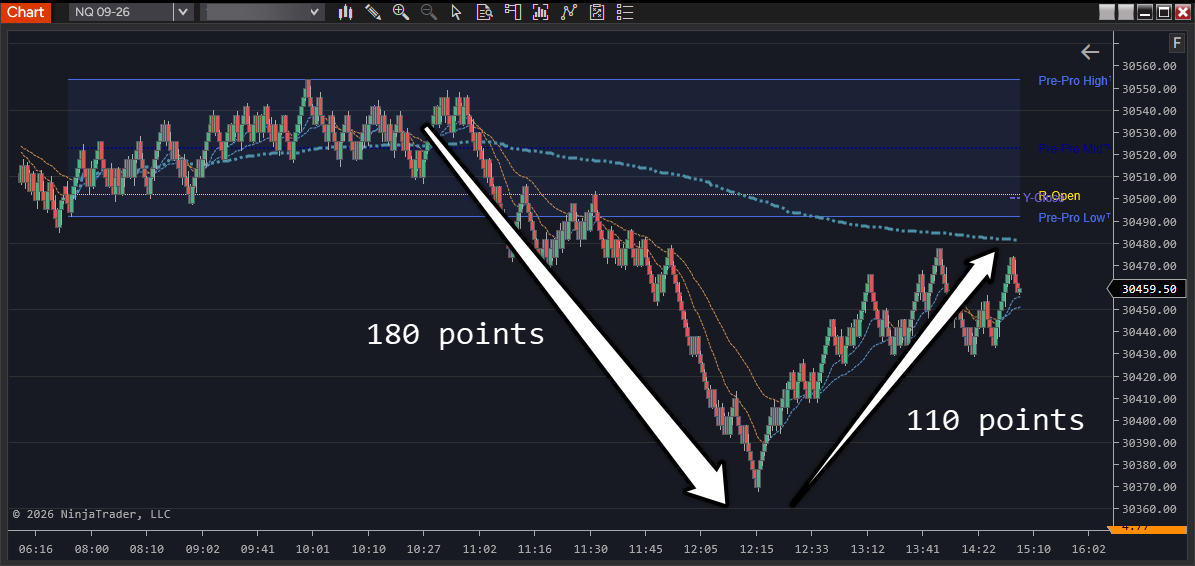
Putting it into perspective:
Just one Nasdaq (NQ) contract moved $3600 to the downside and then $2200 to the upside in under an hour.
Yet that's a drop in the ocean when you compare the daily blip to a 'normal' day in NQ.
The above doesn't tell you it's tradeable. It only tells you there are huge swings in price that happen quickly.
And that's exactly the type of fast-paced action gamblers far and wide live for. A chance to make a leveraged bet for a potential huge payoff nearly instantly.
If you're having difficulty reconciling gambling and financial markets, when I was in the broking industry the CEO would announce himself onto the floor with "How are the punters going?"
Anyone who's worked in broking can confirm gambling in financial markets runs rife. For a legitimate trader that's a good thing.
Every time you place a trade, do you want to compete against a highly skilled and informed trader or a gambler who's running purely on emotion? Exactly.
NQ is the modern-day slot machine on steroids. The wins, the losses, the rush. Everything is amped up.
The fanfare of music and lighting. Anticipating that spinning reel finally coming to a halt to reveal your outcome. It's emotionally captivating.
On the surface, it all seems pretty innocent - except for the bit about slot machines being negative expectancy.
But it's actually more sinister than that. Slot machines run sophisticated software programmed to prey on human behaviour.
And while slot machines are mega business - it's a paltry sum compared to what changes hands in financial markets.
70% of all financial exchange volume is traded by algorithms. A vast array of programs are designed to elicit responses by baiting your natural instincts.
They intentionally obscure reality and distract and overwhelm you while the industry does nothing to help you.
Everyone has trading software but none of it combats these predatory techniques.
On the right-hand side of the clip below is an 'off-the-shelf' price ladder. You're seeing real-time live market footage, the price of each trade as it happens, shown by the yellow cell.
On the left is a price ladder displaying the exact same period, but designed to fight the antics used against you making it much easier to follow.
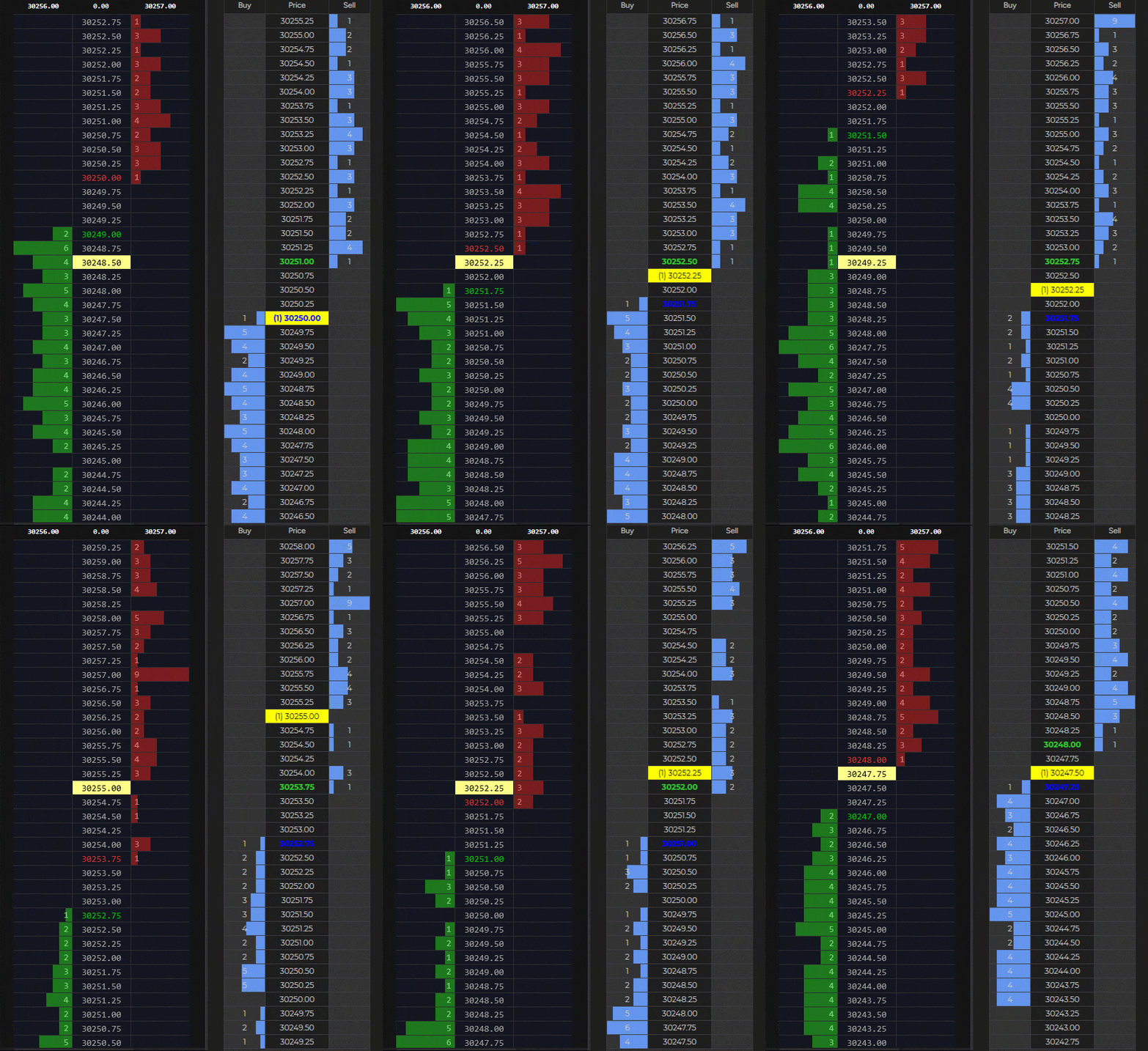
But by understanding the underlying mechanics of NQ, we can take this a step further.
The smallest change in NQ's price is relatively cheap - so there's no need to be hyper vigilant about your entire order getting filled at the same price.
When trading an instrument ultra-sensitive to other market flows and news - the cost of a large resting order going offside is a much greater risk than the 'cheap' cost of spreading your order over a range of small price increments.
This creates the perfect landscape for predatory programs to interweave their tactics into a price auction that's constantly pulling and stacking portions of orders.
In the next clip, you can see the same footage but with a third price ladder that aggregates the last traded price and the resting orders (depth).
Not only is it now simpler to follow and enter your orders, you also avoid predatory tactics designed to trap you.
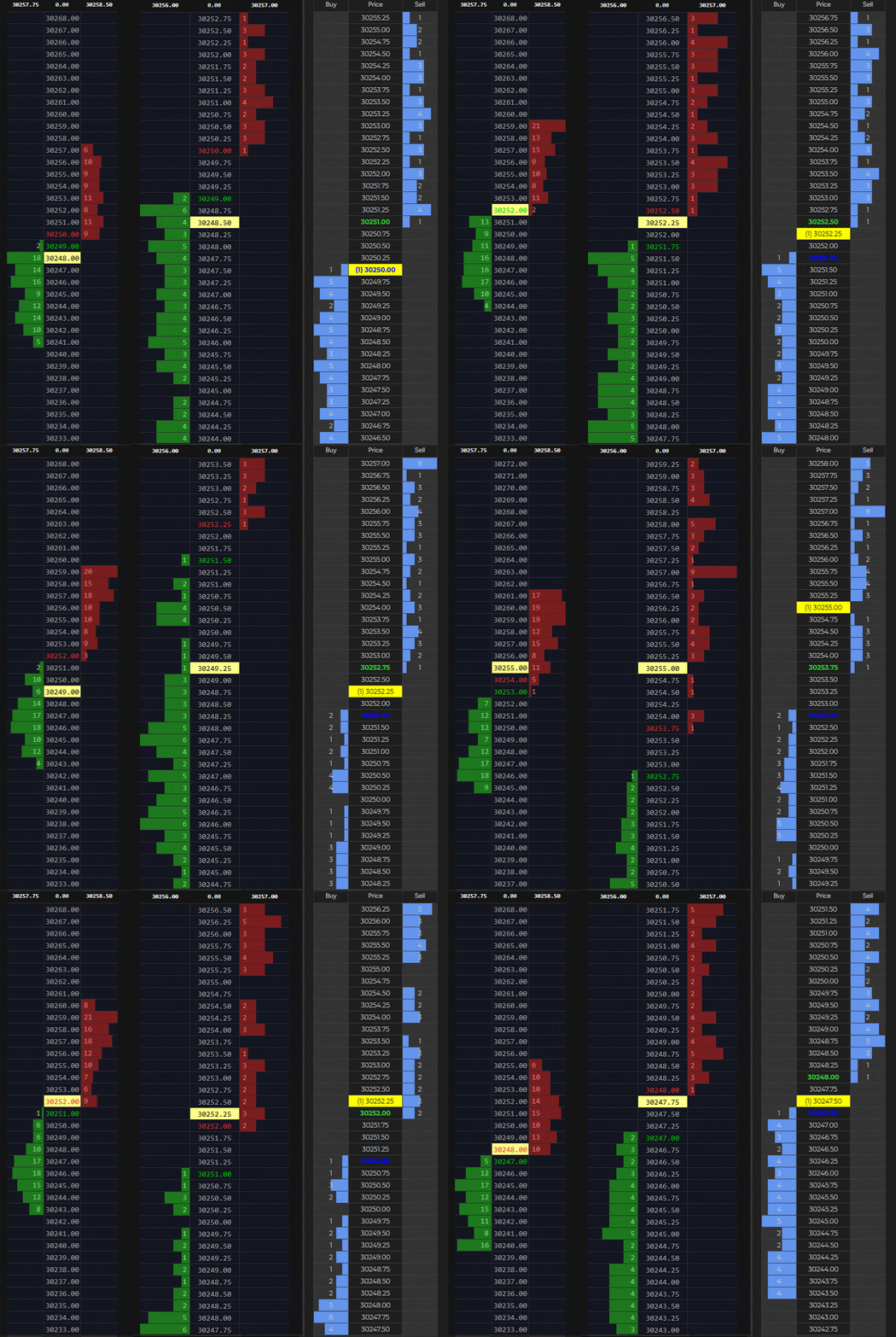
Having the tools to see clearly doesn't mean there's anything worth trading yet.
Efficient Market Theory says prices reflect all available information at any given time. When new information drops, traders react so fast the price adjusts almost instantly.
Which means genuine inefficiencies - COVID dip, tariff dip - are rare. If they appear, you have no choice but to be in them. Miss a genuine market anomaly and you underperform. If you manage other people's money, underperformance means redemptions.
So when fund managers pile into semiconductors with no regard to how concentrated this bet is, it's not that they're sheep. It's that the anomaly is rare and sitting it out isn't an option.
Inefficiencies seldom exist, but there is one exception.
There are always inefficiencies of all kinds intraday. It's these inefficiencies that make hundreds of consecutive days of trading gains achievable. The risk-adjusted returns of intraday trading are unmatched by any other trading time frame. That's just a fact.
Asymmetry loves inefficiency
Asymmetric bets offer you higher reward than the risk. The fat tail is on the positive side unlike strategies that boast high percentage win rates and then all of a sudden blow up (negative fat tail).
Inefficiency is as asymmetric as you get because inefficiency always resolves.
But how do you go about it?
In the gameshow 'Blankety Blanks' - trying to solve a well-known phrase knowing only one or two letters is at best a wild guess.
But when 7-10 letters are revealed you answer instantly because its a phrase you know.
Same goes for trading.
Participants have levels they need to trade at and preying on degenerate gamblers is often the vehicle to move price at their expense. But having all those levels and particular scenarios is no good to you written down in a page of notes.
Trading is much easier when that information is overlayed onto all of your trading charts and windows, using a format that you can interpret 10 times faster than reading your notes.
Then as your 7-10 points of evidence show up you know which trade to take. It's also much less taxing on your mental faculties.
July 1 trading the blip
There are times NQ can travel 60-100 points in a moment. That's where its smaller sibling the Micro Nasdaq (MNQ) comes in - a fraction of NQ's contract size - letting you adjust risk in fractions of your normal sizing.
But switching everything to MNQ isn't the answer. When I opened MNQ using one of my NQ templates, the prices looked the same. The weighted calculations were completely different.
Weighted calculations were reserved for commercial platforms in the early 2000s - the ones I used when trading for wholesale clients. Now they're standard in off-the-shelf software. Hundreds of thousands of MNQ traders use them daily, not knowing they're making decisions off the wrong numbers.
Those who move markets know it. They bait MNQ traders at false levels, wait for enough to get trapped, then MNQ gets dislocated from NQ and crushes the crowd.
MNQ is the tail, not the dog. Your decisions have to stay on NQ.
So I built a tool that routes your trades to MNQ in the background. Your charts, your DOM, your framework - all NQ. The trade just goes to MNQ instead.
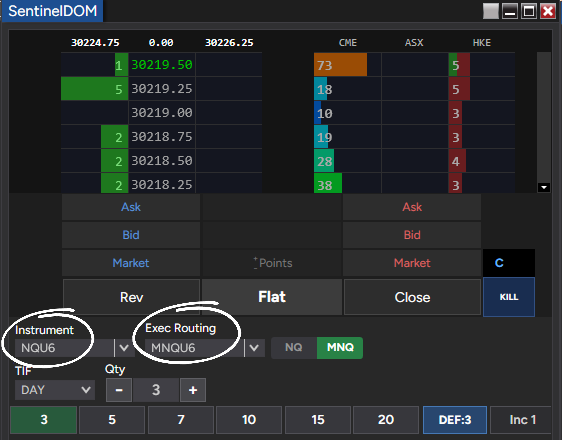
Your MNQ executions appear on the NQ chart too - so you're always reviewing against the instrument your decisions were based on. In private development it also keeps the cost of mistakes down while you're building comfort trading NQ with real money.
Custom tools I've developed are solutions to take advantage of opportunities I see where the industry clearly isn't aware of them, to reduce mental friction and cognitive load and increase the efficiency of interacting with a trading platform. I'm a huge believer in 1+1+1+1= 17 the sum of many advantages has an exponential positive gain. Same goes for the framework and signature trades.
Two charts below - NQ at the bottom and MNQ at the top.
MNQ executions are shown on NQ
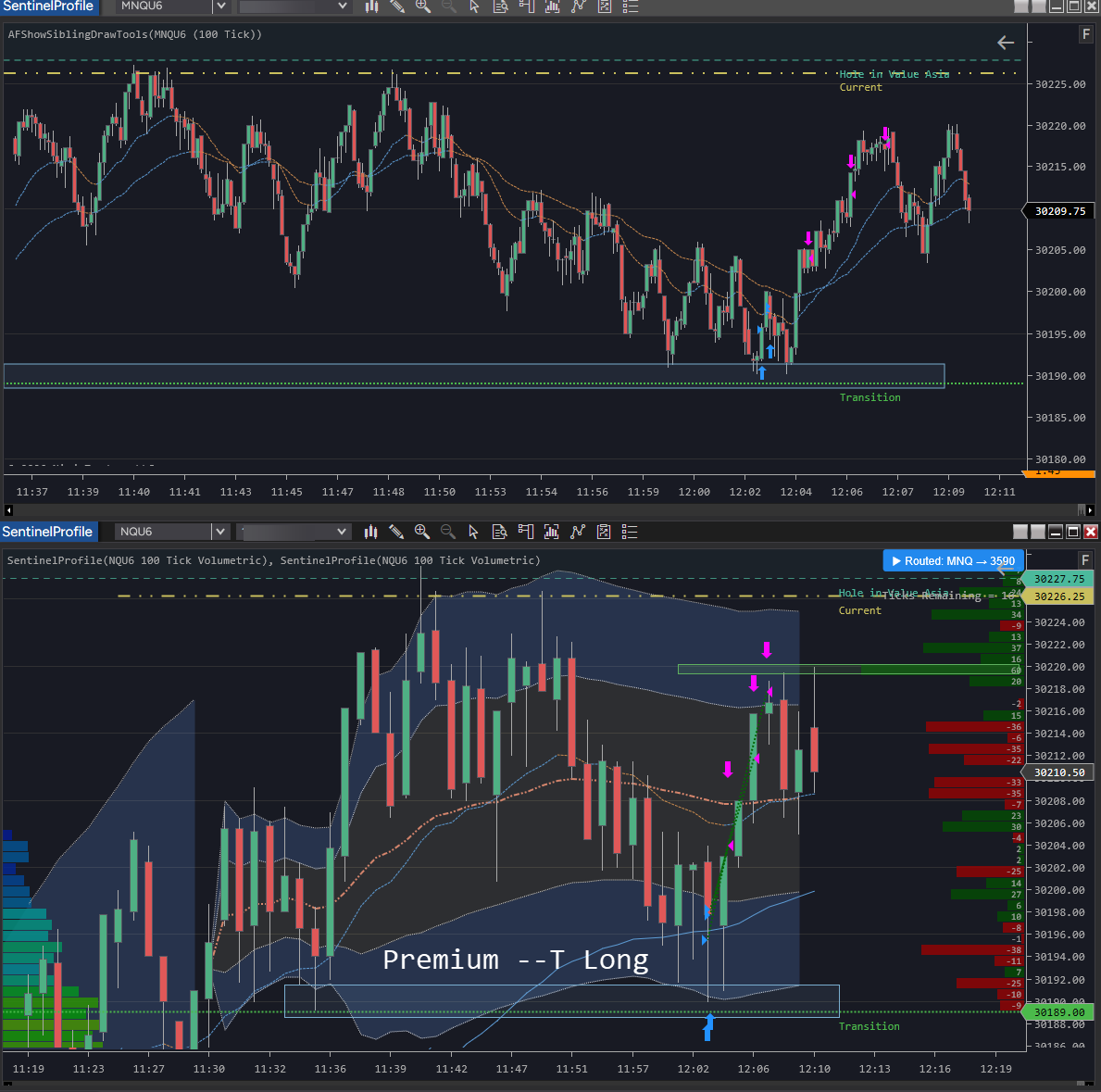
The trade above - [***] Premium Long - is one you might have noticed repeatedly showing up in my writing for years.
The takeaway is making the same exact trade over and over gets it into your unconscious. When that happens, the trade is virtually automatic.
So if you're wondering: "But how can I trade intraday? How could I possibly react fast enough?" - it's actually a great question.
When I was trading at a proprietary trading firm, there were many traders faster in their thinking and execution who I couldn't compete with.
But no market runs at one speed the entire time. And everyone has a range where you can be effective. It might be a smaller range to begin with, but over time, particularly if taking the same trades over and over, you extend that range by a hefty margin.
If you've ever replayed a period in the market that you traded, what you'll first notice is how slow it now seems compared to what you remembered. That's familiarity after just one pass. Familiarity makes time slow down.
Most independent traders don't have a playbook. Sure they might trade a similar pattern, but when you look at the specifics (stuff they don't know about/not accessible) two trades with the same pattern have no similarity at all.
And most traders don't have nearly the same level of efficiency in their trading. The overlaid framework, all the custom tools and drawing tools I developed to reduce the friction and time it takes to act.
That's good news because when you repeat the same trades, each time one shows up - what feels comfortable for you is actually way too fast for many other traders you're competing against.
In the chart below, the starting price and ending prices are the same. The swings in price are pure inefficiency.
The framework 'knows' the levels and they become a map showing where price is headed/pause/reverse.
Then you wait for the 7-10 points of evidence to show up and it becomes clear which trade to make.
When everything is overlayed and staring back at you, and the trades are those you've taken over and over - you're not overwhelmed with decision fatigue. Nor are you going to keep missing trading opportunities during those times when you are focused on trading. (I miss trades when I have other things to do, or I'm taking a break).
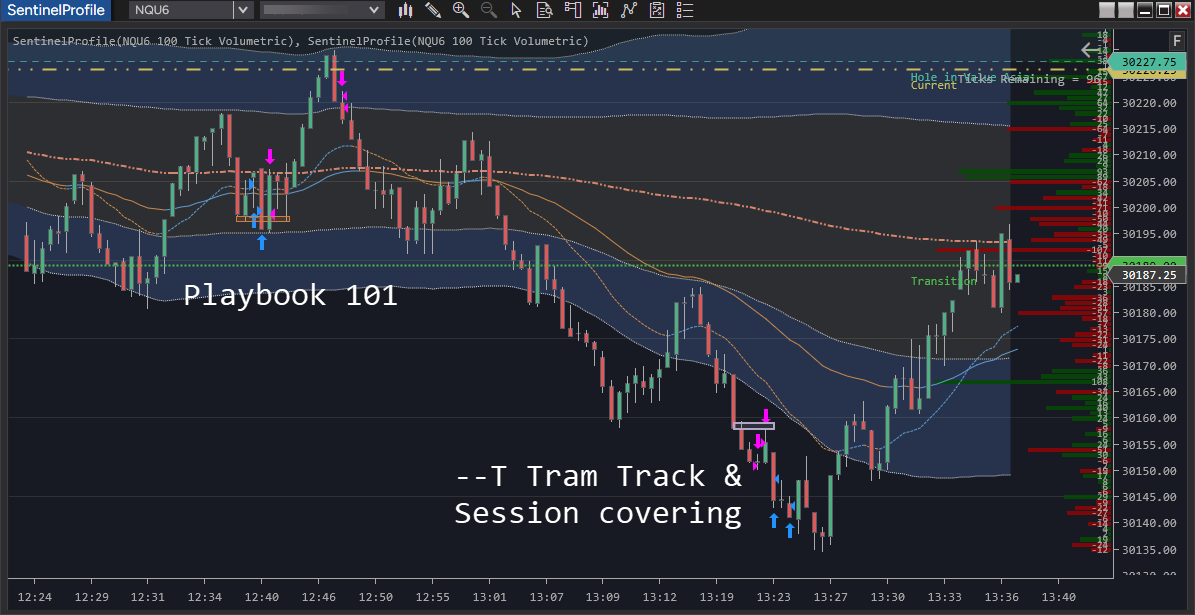
There are opportunities where price moves much further and the pay-out reflects it.
But I chose these trades because they're base hits, not the level 5 trades where you're scaling in, out, and back in again. There are many levels to trading. Consistent base hits is where it starts. And for some, it's perfectly fine to stay here.
Had you made these trades - first in MNQ, then in NQ - you'd be surprised how few lots it takes to walk away with just under $2K. And that's one small window of one day.
Not enough? There are more opportunities you can take, or trade with more size, or both.
In his Market Wizards interview, Lance Breitstein spoke about other traders he traded alongside at discretionary day-trading firm Trillium - who had 200-day winning streaks, and traders who virtually never have a down month in their trading careers.
The intraday ecosystem offers such an incredible trading opportunity to anyone who is willing to trade the cost of developing the necessary skills and knowledge in exchange for the reward.
It's made all the more lucrative because the majority of those who are 'trading' intraday aren't willing to make that trade.
Adam
Related reading: What do you know about the market's playbook aimed at you?