
Trainer wheels in the Tour de France
Trading shows you exactly how disciplined you believe you are versus how disciplined you actually are.
And the typical response is you feel disappointed in yourself, thinking how could you behave this way.
But the issue is more likely that your expectation is unrealistic.
It's a broad subject.
It could be you're executing an approach that stands up in live markets but expecting you'll execute it flawlessly. And that's about as likely as a Wimbledon finalist winning without a single unforced error. It isn't possible. Great trading gets done in spite of some mistakes.
Most likely the approach itself loses on every meaningful scale. Yet a few winners convince you it's profitable, when every losing method consists of winning trades too.
Or maybe it's simpler than both. You understand how to implement a framework and playbook, but you're still riding a bike with trainer wheels expecting to compete in the Tour de France. The framework and playbook stand up in live markets. You just haven't done it enough yet.
But not just any kind of repetition. The kind that lets you repeat a trade step by step to flush out the weakest link.
You can strip a trade down into bite-sized pieces.
Are you early or late engaging the overall move. Not the entry itself.
If the outcome is already known, that's low odds and you're now at a small reward opportunity. It's not the place to start trying to get consistent.
The problem here is not defining where you want to do business before the market has already got there. This is a framework problem.
But even if you know where the areas to do business are, you still want enough examples of how the behaviour should look to warrant a trade.
You don't just "buy" or "sell" at these areas. Now it becomes about recognising certain playbook trades.
If you get this far, the friction you feel is "but now I have to wait".
When your playbook's thin, you focus on the easiest trades. That's the opportunity for active waiting.
During the waiting you screenshot and write it up potential opportunities you observed. Any relate to the framework?
Actively waiting is growing your trading cognition. You have a trade you're stalking and another trade scenario you're developing.
You're training your brain to process multiple components of trading, a skill that fast-tracks a simultaneous awareness of 7-10 points of evidence for every trade, six or more times a trading day.
But not on the first day of actively waiting. It accumulates, and so does your ability to focus.
At the same time, it's this active waiting that gives you an inventory of repeating scenarios.
I see multiple opportunities each day only because I've done this to the point where I created an extensive playbook of trades from it.
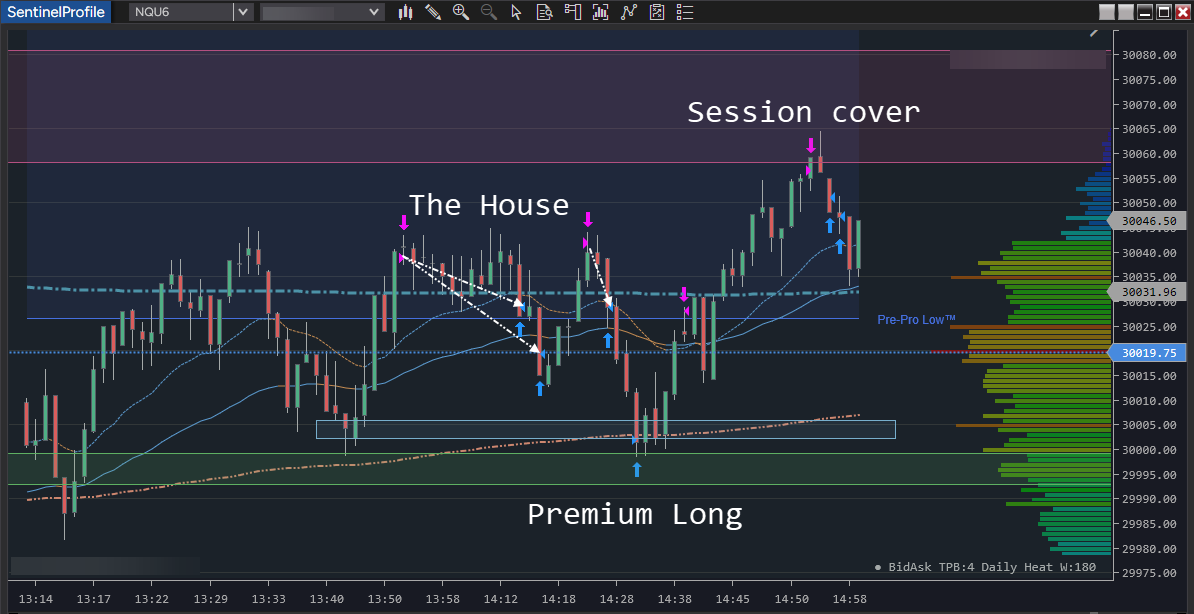
Everyday multiple specific playbook trades show up - tap to enlarge
The faster path is having someone else's playbook. And when actively waiting, what have you missed that's a straightforward playbook trade already shared with you?
Screenshot it. Write it up. and start making it yours. Create your inventory of those shared playbook trades you've identified. Because eventually you'll notice them. Now you have less waiting for a trade because more opportunities are known to you.
Next is your entry.
What I see happening is a lack of understanding that a scenario worth trading isn't the cue to enter a trade. Ultra-specific behaviours need to show up, a certain playbook trade, and then you can enter.
At this point, initially, you'll make a meal of your entries. It's like first hitting a ball with a racket. You don't have the swing timed, the right racket angle or the right spot on the strings to make contact.
Every step is where your trading can be misfiring. But when you have a repeatable framework and playbook you can work through each stage and identify a specific weakness.
And if every step above is correct 80% of the time, then move onto profit taking and exiting at only a papercut.
There's a time and place for partial profits versus taking it all off the table. Holding some, holding all. Every aspect impacts the outcome. Yet you can't fine tune any of these steps unless everything sits in the context of a framework and playbook that's repeatable.
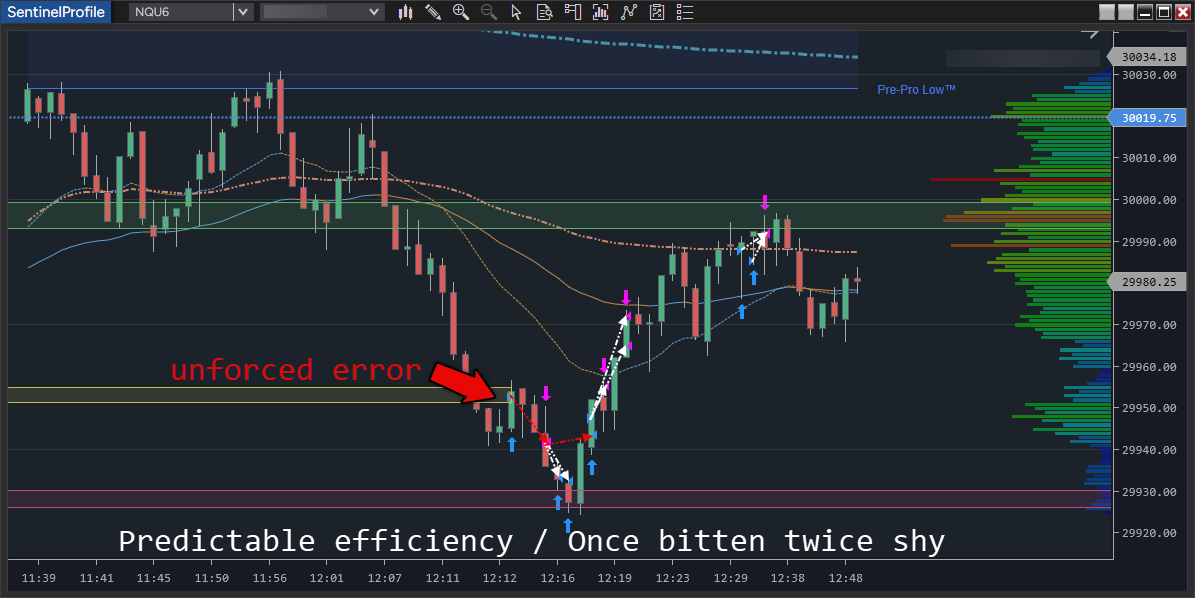
A handful of errors don't prevent profitable trading - tap to enlarge
Once you're competent across all of the above, and across a handful of different trades, the next step is dynamic sizing.
At this point you realise trading is a doing activity where every trade combines numerous micro skills you can identify and evaluate.
But just think of all the traders who can't work on any of these steps because they don't even have a repeatable framework and playbook.
It equates to so many traders that you can take money from. You don't make money trading. You take it.