
They make price hostage just to take you out
As an independent trader, if you can expose tactics traders use to hide their intentions, imagine what a multi-billion-dollar market-making firm knows about every trader in the market.
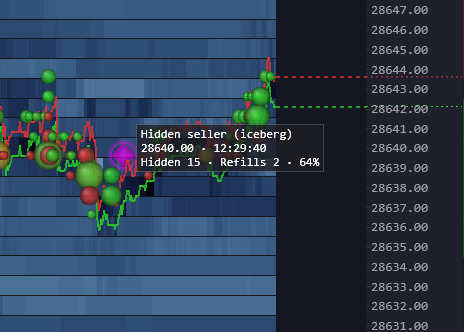
Screenshots from SentinelLiquidity
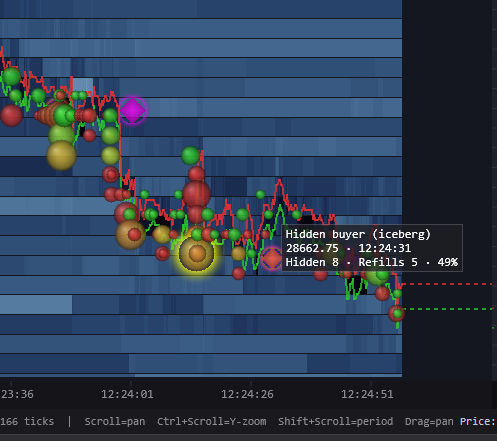
Screenshots from SentinelLiquidity
It starts with common sense.
Anytime a price moves well beyond what is deemed 'expensive' or 'inexpensive' relative to fair value, most market realists have taken their profits.
Skilled traders who missed the move don't react; instead, they FOMO-trade it.
What's left is what the market deems 'weak hands'. Weak in the sense they can't put up much of a fight to defend their position.
The only reason they're even still in the position is because they are the FOMO traders who've chased the move or they're a delusional bunch who've added aggressively to their positions believing they know the future, unaware of market mechanics.
Delusion and leverage work hand in hand - I mean if you've got a 'sure thing', you bet more than just the whole farm.
Market-making intelligence systems know who's who. They can spot a whale of a position comprised of either a mass of weak hands or a single whale of a weak hand - as was the case for hedge fund Situational Awareness. And wherever there's a dumb trading decision, it usually has friends.
What does it take to force these traders to liquidate? Margin calls. All one needs to do is force a risk event.
What does a market maker control in the absence of the strong-hand traders filling the book with orders?
They control liquidity by running a thin book of orders - thin enough for price to cascade through levels to quickly force risk events.
Liquidity is the hostage to force you out of your position. Why 'you'? Have you ever thought, 'The broker is running my stops?'
That gut-punch you feel when your position liquidates as it hits your stop, only to watch price change direction moments later without you isn't bad luck. And it's not the broker.
Market makers know when there are enough weak hands worth nudging to evoke a risk event by taking liquidity hostage.
For 24-year-old Leopold Aschenbrenner's hedge fund Situational Awareness, his lack of 'awareness' around how markets function came at a huge cost.
No one is doubting he's in fact, a brilliant academic who's been mostly correct on AI.
He was, however, dead wrong on software (he was massively short what are now the current market leaders).
And he clearly wasn't aware of how liquidity is used to move chunks of risk to levels large participants want to trade at.
Yet regardless of how much size you trade, prediction is a fool's game. And just like in many cases held in courts, ignorance is no defence.
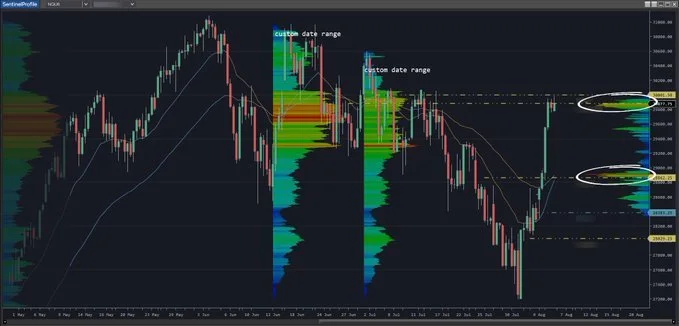
Post the liquidation, it's clear the market mostly traded at two distinct prices - as shown by the relatively larger size of volume in the circled areas. This illustrates exactly the market moving to pre-defined prices - prices you either do or don't know in advance.
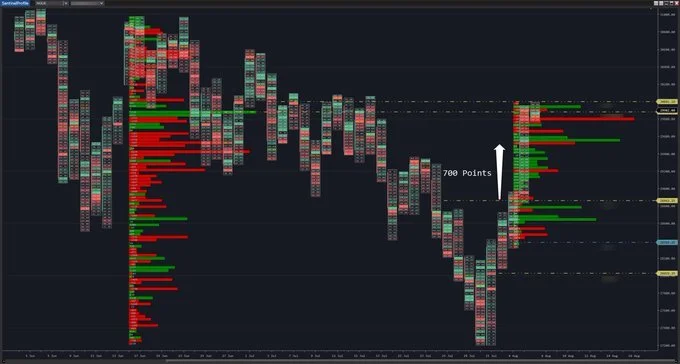
Knowing how liquidity is used to move chunks of risk, it should be clear from the view of aggressive buying and selling below what fuelled a 700-point move to the upside.
Smallest risk, most frequent reward
The two charts above are part of a trading framework that takes advantage of the actual mechanics of the market.
Apply this framework each day - combined with a playbook of trades to extract money every time liquidity's taken hostage - and sometimes it even feels like you're shelling peas.
The trade below combines the Playbook 101, Once-bitten-twice-shy and Covering-move playbook trades.
If several playbooks align simultaneously, then that's such high odds it's simply prudent business to trade bigger.
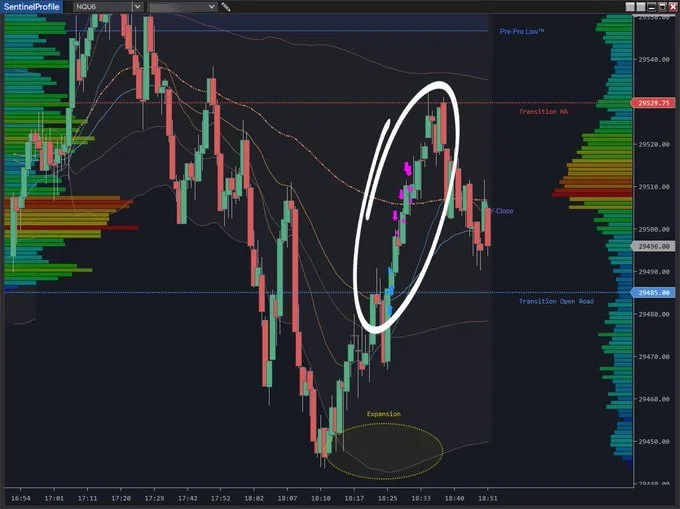
Yet it's never about 'How much is this trade going to pay me?'
When I visit a local coffee shop for brunch, everyone is focused on their role in the business. When I visit the dentist, everyone is focused on their role in running the business. When an uncle took me on a tour of a Holden (car) assembly plant in Adelaide, everyone was focused on their role in the business.
Everywhere, in every business, people know their role and how to execute it - except in trading. What I see is the vast majority of people attempting to 'make money trading' don't know their role, let alone have the skills to execute it.
Market making is a specific business within the trading industry. So is yours - the business of providing liquidity the moment it's taken hostage to trigger a risk event. That's when you say:
"I run a business that takes advantage of forced risk events. My income-producing assets (playbook trades) extract profits from these repeating events."
The beauty of intraday is that after the trade above, liquidity's taken hostage again. Then again. Then again. That's the nature of the intraday ecosystem.
You're never starved of opportunity, and you never have to deal with 'my strategy stopped working' when your trading business is tied directly to the actual mechanics of the market, which, despite trying, no one is ever big enough to win fighting it.