
Why I now trade NQ when plenty say don't do it
After years of trading other futures markets, I moved to Nasdaq futures (NQ), even though many people advise against it. Why is that?
For one, NQ can move 30, 40, 60 plus points in minutes. Trading it at that speed is like suddenly being thrust into a Formula One car mid-race and told "Now you drive".
I can't drive a Formula One car any more than I can trade NQ when it's travelling at top speed.
Yet it's not always travelling at top speed. In fact, during the Asian and European sessions, and even after the first two hours of the US session, it's often moving at a tradeable pace.
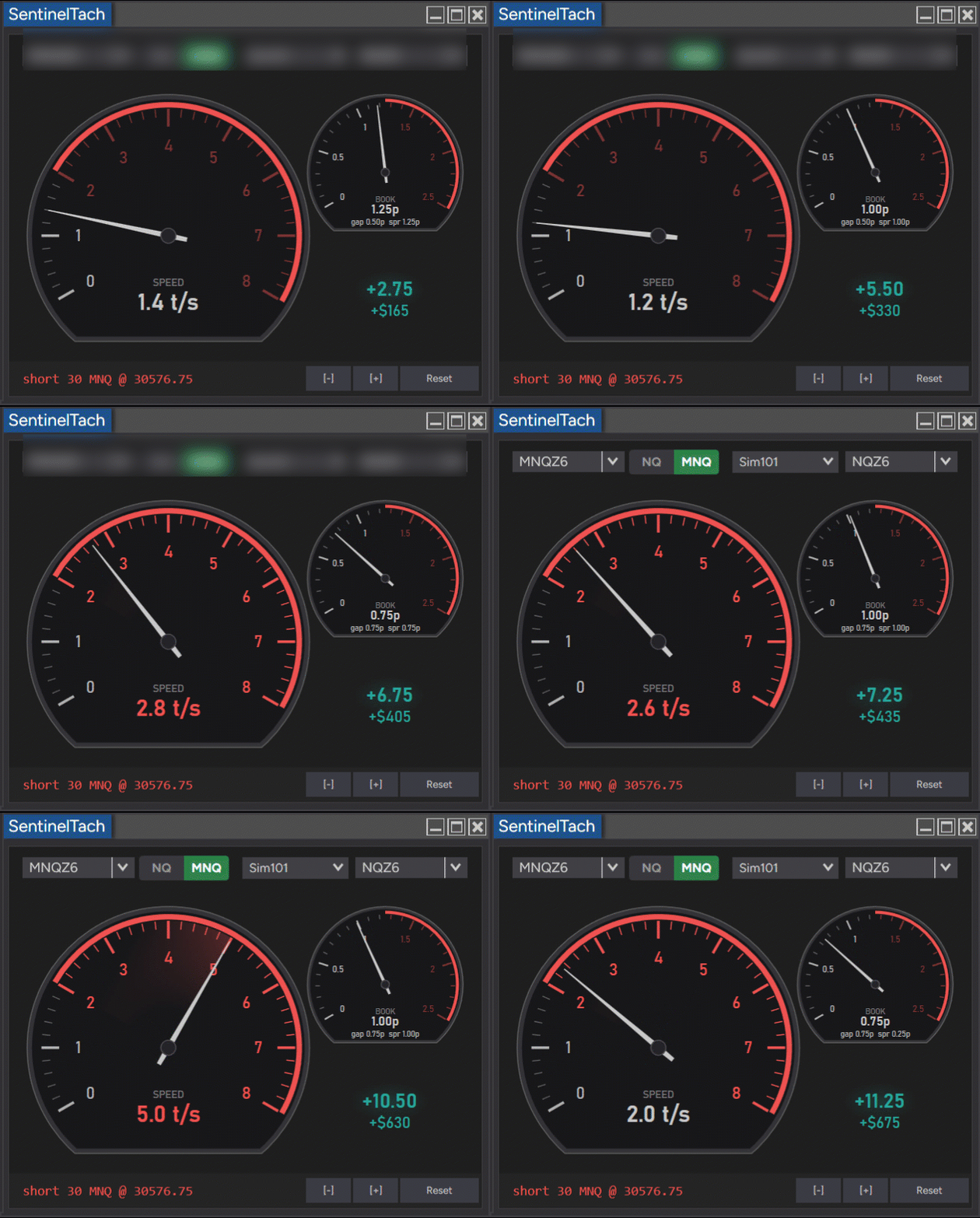
To know the difference, I developed SentinelTach. It shows you the current pace of the market.
It's like the rev counter in a motor car. However, what's within one trader's threshold might be the red zone for another - so I made sure clients can set the red zone to suit them.
SentinelTach shown below:
The second reason you hear to stay away from NQ is that it's too efficient to beat.
They're right, it is efficient, as are all futures markets used extensively to hedge other financial instruments.
But that pace makes NQ a compelling market to 'trade' for anyone itching to make fast money.
In the GIF above, look how quickly the dollar value of 30 micro NQ (MNQ) - the equivalent of just three NQ lots - moves in seconds.
The volumes traded in MNQ are significant, and a 2,000-person Institute for Family Studies survey found one in four American men aged 18-29 trade daily.
In turn, NQ and MNQ make an equally compelling case for skilled traders who know the mechanics of NQ to take the other side of the large number trading it for fast money.
NQ moves in a perpetual cycle of behaving inefficiently, which draws traders into positions, only to return price to efficient levels. I covered this in more detail in Where Inefficiency Traders Crave Runs Rampant.
It happens so reliably that my playbook trade for it is called the Predictable Efficiency trade. That brings me to my first trades today.
When I returned to my screens, NQ had already reversed at a known Predictable Efficiency level (30402.75), marked by its specific colour and line style. I developed custom drawing tools that give each type of level its own colour and style, so the roadmap is on the chart and I don't have to add annotations or check my game plan.
I also developed SentinelContra, a proprietary indicator that adds further evidence whenever it shows divergence at specific levels, including Predictable Efficiency (see chart).
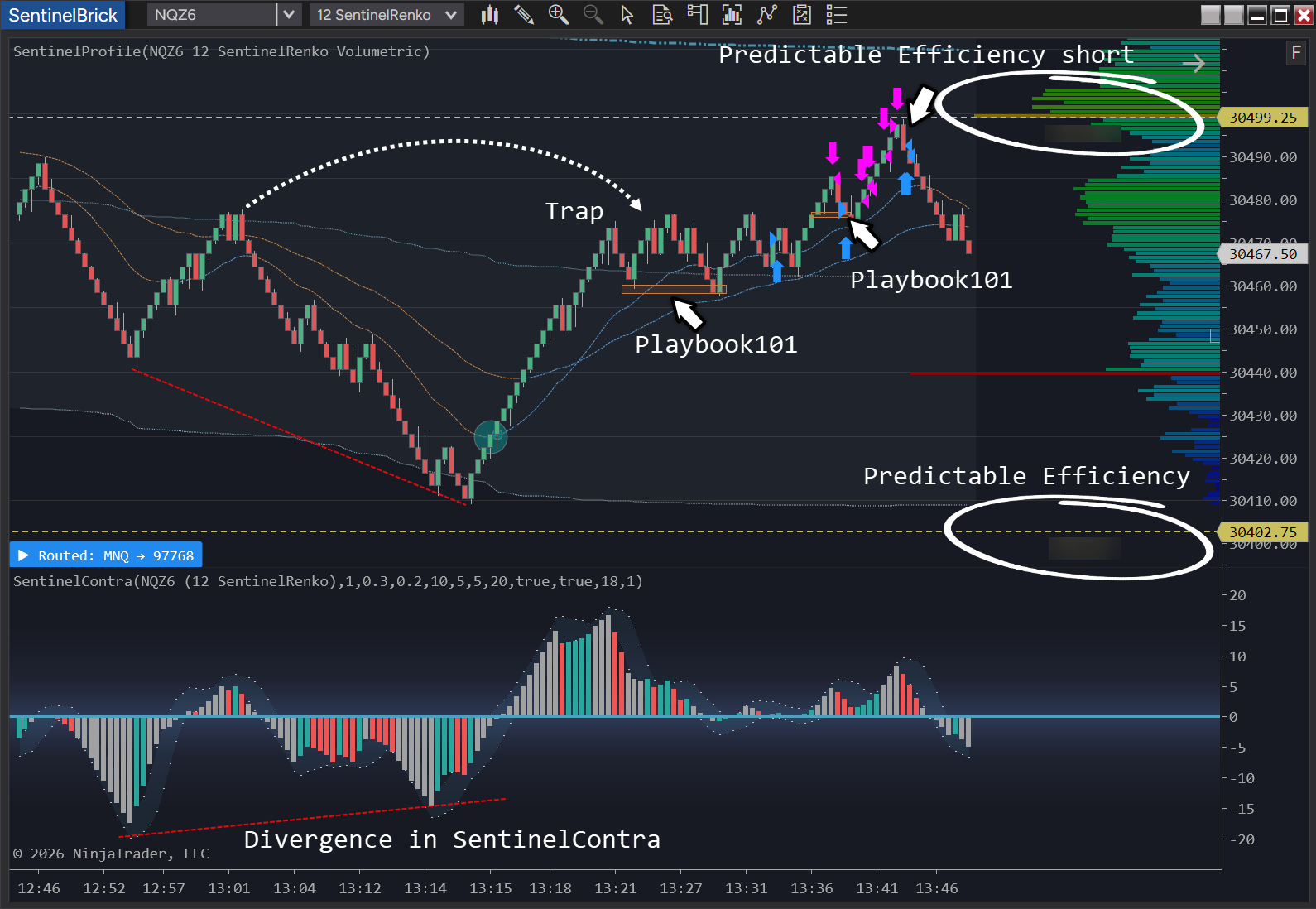
See the 'Trap'? Traders enter short trades at the prior high. But shorting there is now a bad trade, because that opportunity has been and gone. Knowing when prior highs and lows are no longer relevant is a source of trades to take the other side of traders who don't.
It feels putrid being in one of those trap scenarios. Everything seems calm, and then in the blink of an eye the market puts in that punishing vertical move against you, just like that. So imagine what it's like when you're on the other side. It just comes down to comprehending trading at a level you haven't been exposed to before.
I wasn't at my screens early enough for the first of the Playbook101 trades, so I entered long soon after, around 13:31 AEST, took some partial profits, and entered long again at the second Playbook101 around 13:37, aware of the pending trap.
The chart above is a proprietary 'brick' chart, which I use to identify high-odds Playbook101 trades, in particular the second long entry. When it lines up with the EMAs I use, as it does here, that's additional evidence for the trade.
For that reason, the second long was larger than the first.
Moments later, after the trap played out, I entered short into the higher of the two Predictable Efficiency levels at 30499.25, around 13:43. By the way, can you also see SentinelContra showing divergence for the short?
In Markets compensate you for knowing how others behave I mentioned how this scenario has a 90% chance of price moving in your favour initially. For that reason you can enter a larger sized trade and quickly take profits on part of the position. This leaves you with a banked payout plus a risk-free trade - either the balance also pays you or you exit at roughly breakeven.
The total move from one Predictable Efficiency level to the other was almost 100 points, so my trades look minuscule against it.
I don't need to take the entire move, because a fraction of it is still very worthwhile. And participating in worthwhile moves, small and large, doesn't have to come at the expense of low account volatility.
I keep account volatility low by trading intraday and trading both directions. As you can see, I go long and short, sometimes within minutes of each other.
The common theme you'll notice across all of my articles is the repeating nature of trades that come from a framework, one I applied to 6A and now to NQ. Yes, I had to make adjustments to the charts and settings, but the same playbook trades still apply. The constant development of proprietary tools is all part of being able to be on the other side of the majority of losing traders.
It's totally possible with the right framework, playbook and tools, and of course the reps until you gain competency. It might sound like work, but it's a walk in the park compared with years to decades of struggling and losing.